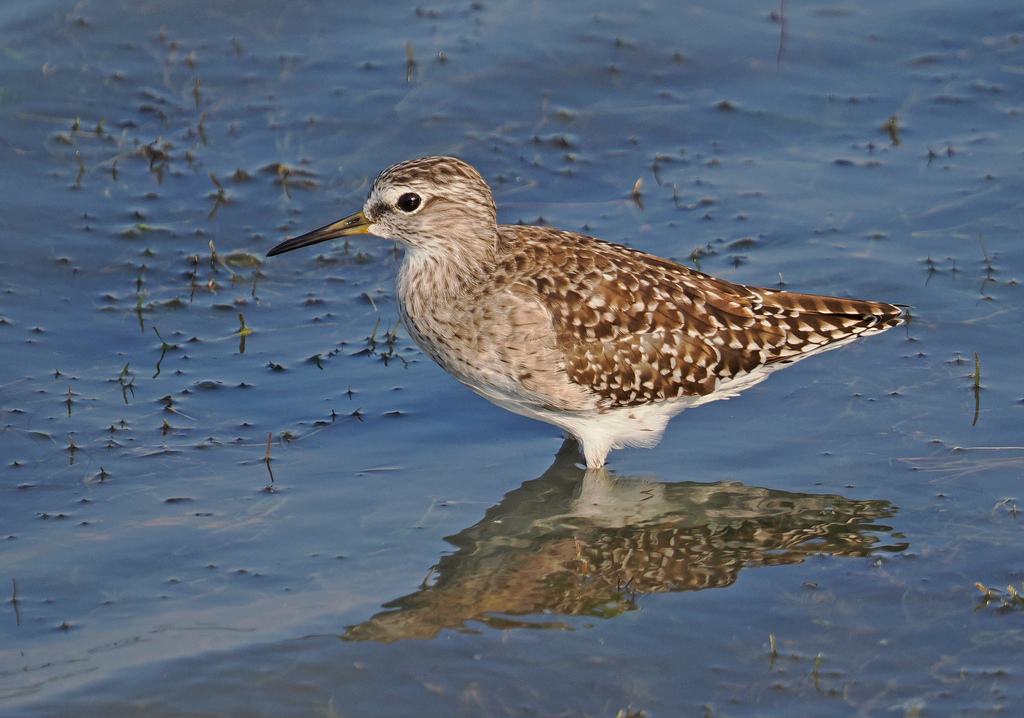
Wood Sandpiper
Photo © Judy Gallagher
Photo © Judy Gallagher — CC BY-SA 4.0 — Source: iNaturalist photo #681911614Identification
The wood sandpiper is the smallest of the shanks, a group of long-legged waders. It resembles a more delicate version of the green sandpiper, with a shorter, finer bill, brown back, and longer yellowish legs. The species displays a small, less contrasting white rump-patch—smaller than the green sandpiper's but more prominent than the solitary sandpiper's complete absence of one. In breeding plumage, wood sandpipers show subdued light-brown upperparts with darker mottling, and somewhat smaller, diffuse brownish spots on the breast and neck.
Range & Habitat
This Eurasian species breeds in subarctic wetlands across a vast range, from the Scottish Highlands westward through Eurasia and the Palearctic region. A small breeding population became established in Scotland beginning in the 1950s. Wood sandpipers are long-distance migrants, traveling to Africa, South Asia (particularly India), and Australia for winter. They are also regular visitors to Micronesia, including Palau and the Mariana Islands, with vagrant sightings extending as far as the Hawaiian Islands.
Unlike many related waders, wood sandpipers favor freshwater habitats rather than coastal environments. During migration and wintering, they are typically found in and around freshwater wetlands, lakeshores, and riverbanks.
Behaviour & Diet
Wood sandpipers forage for invertebrates by probing their bills in shallow water and wet mud. Their diet consists mainly of aquatic insects, crustaceans, arthropods, various worms, and other small prey. The species undertakes extraordinary migrations; birds that accumulate sufficient fuel reserves can potentially cover distances of 2,397 to 4,490 kilometers in a single non-stop flight.
Breeding birds nest primarily on the ground or opportunistically re-use abandoned tree nests of other species such as fieldfares. Four pale-green eggs are laid between March and May, incubated by both sexes for 22 to 23 days. The female typically departs after the chicks hatch, leaving the male to assist; young birds are capable of feeding themselves and fledge at around 30 days old.
Best Time & Places to See It
Wood sandpipers are most readily encountered during migration periods and winter months, particularly from mid-October through mid-May in the Western Pacific and East Asia. In Africa and South Asia, they are present during the Northern Hemisphere winter. Scotland's breeding population offers opportunities to see them during the breeding season, particularly around wetland habitats in the Scottish Highlands. Travelers to Micronesia, especially Palau and the Mariana Islands, have good chances of encountering flocks during the migration season.
Photography Tips
The wood sandpiper's small size and preference for freshwater wetlands make it an excellent subject for wildlife photographers. Look for birds probing in shallow water along lakeshores and riverbanks at dawn or dusk when light is favorable and activity peaks. Their delicate build and fine bill details reward telephoto lenses. During migration, flocks can be approached cautiously from a distance. The bird's pale underparts and subtle brown markings photograph well in soft, overcast light, while sunny conditions can enhance the contrast of the white rump-patch during flight.
Bwindi Impenetrable National Park
Kanha Tiger Reserve
Lake Mburo National Park
Mabamba Swamp
Minneriya National Park
Murchison Falls National Park
Queen Elizabeth National Park
Aberdare National Park
Abijata-Shalla Lakes National Park
Nothing matches these filters.
No community photos yet. Log in to add the first one.
No community observations of this species yet.