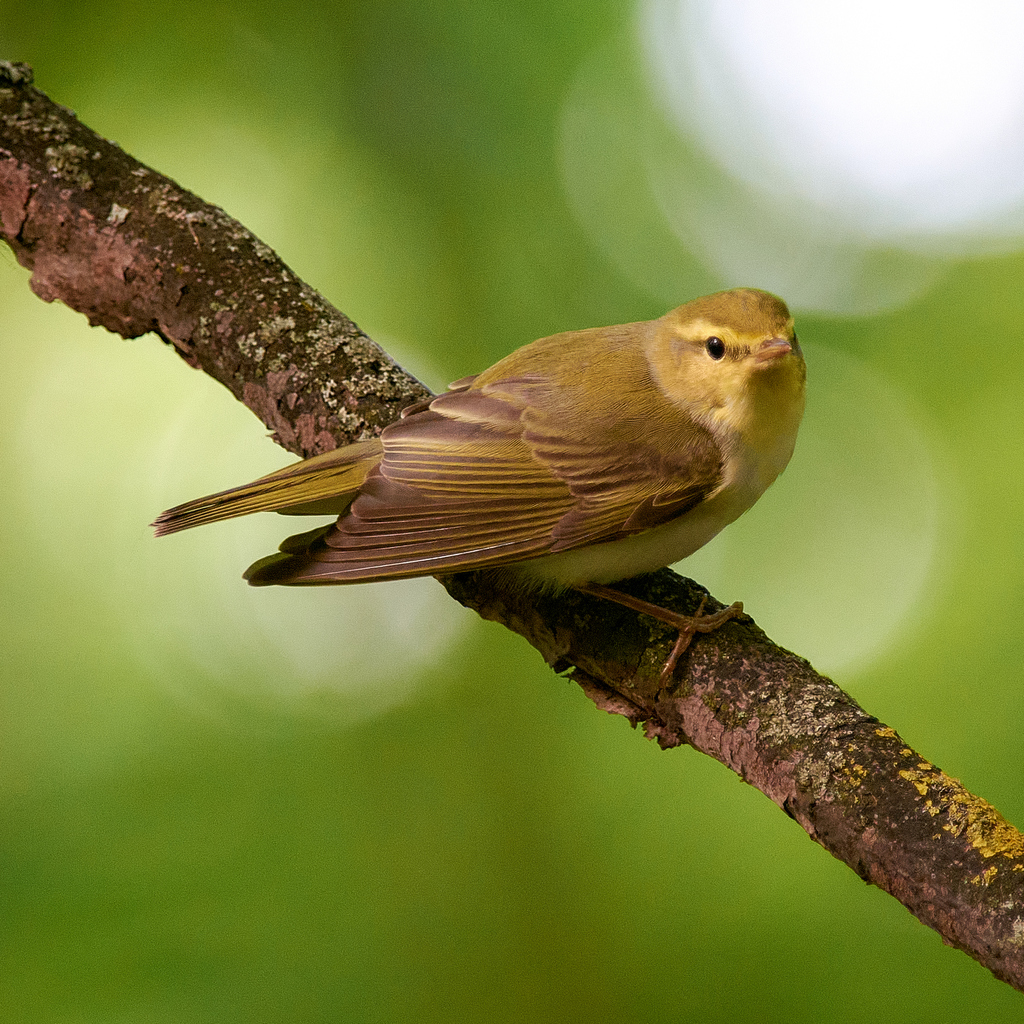
Wood Warbler
Photo © Сергей Неклюдов
Photo © Сергей Неклюдов — CC BY 4.0 — Source: iNaturalist #100301877Identification
The wood warbler is a small songbird measuring 11–12.5 cm in length, displaying the characteristic appearance of a typical leaf warbler. Its upperparts are green, contrasting with white underparts and a distinctive lemon-yellow breast. The species can be reliably distinguished from similar warblers such as the chiffchaff and willow warbler by several key features: a yellow supercilium (eyebrow stripe), yellow throat and upper breast, pale edges to the tertial feathers, a notably longer primary projection, and a shorter but broader tail. These field marks make identification straightforward for observant birdwatchers.
Range & Habitat
The wood warbler is a common and widespread leaf warbler that breeds throughout northern and temperate Europe, extending just into the extreme west of Asian Russia in the southern Ural Mountains. The species is strongly migratory, and the entire population winters in tropical Africa, making it a true long-distance migrant. In the United Kingdom, it appears as a summer visitor between April and August. The bird favours open but shady mature woodlands, particularly those dominated by beech and sessile oak, where sparse ground cover provides suitable nesting habitat.
Various forest structure factors—including slope, forest cover, proportion of broad-leaf forest, canopy height, and forest edge length—influence where this species occurs. While the wood warbler has declined in recent years in some regions, it demonstrates a notable ability to use degraded habitats such as well-wooded farms, suggesting some resilience to habitat change. However, further loss of tree cover is likely to negatively impact populations in the future.
Behaviour & Diet
As a small insectivorous passerine, the wood warbler feeds on insects gleaned from vegetation within its woodland habitat. The species builds a distinctive dome-shaped nest near the ground in low shrub, laying six or seven eggs in May with the possibility of a second brood. Research from primeval forest habitats shows that nest predators are primarily mammals, especially medium-sized carnivores that hunt at night using sound and scent. Nest survival declines as chicks grow older and louder, making them easier for predators to detect.
The wood warbler is highly vocal, possessing two distinct song types that are often given alternately. The first is a high-pitched, fluid metallic trill that accelerates and lasts 2–3 seconds; the second consists of 3 to 5 descending piping notes of lower pitch delivered as "piüü-piüü-piüü." A soft, short piping contact call similar to the second song type is used for communication with other individuals.
Best Time & Places to See It
In the United Kingdom, the wood warbler is best sought during its breeding season from April through August. However, it has declined significantly in recent years, making sightings less reliable than historically. The species is rare in Ireland, with only a very small but apparently stable breeding population in County Wicklow. Across its broader European range, breeding woodlands offer the best opportunities for encounters. Given the species' preference for specific forest structures, particularly mature broad-leaf woodlands with suitable canopy heights and ground cover, targeting such habitats during the breeding season maximizes chances of observation.
Photography Tips
Photographing wood warblers presents challenges typical of small woodland warblers: they are active, often keeping to the canopy and mid-storey vegetation. Early morning in spring and early summer offers the best light and highest vocal activity, aiding location. The bird's distinctive yellow-and-green plumage provides good contrast against foliage, but patience and a telephoto lens are essential. Focus on mature woodland habitats with open structure and lower shrub cover where birds are more likely to be visible. Audio recording equipment can also be valuable for documenting the species' characteristic trilling and piping songs, which aid in both identification and species confirmation in the field.

Private Full-Day Kotu Birdwatching Experience: An Introduction to Kotu’s Diverse Birdlife
Nothing matches these filters.
Abruzzo, Lazio and Molise National Park
Åsnens National Park
Bannau Brycheiniog National Park
Bavarian Forest National Park
Białowieża National Park
Biebrza National Park
Cairngorms National Park
Calanques National Park
Camargue Regional Nature Park
Nothing matches these filters.
No community photos yet. Log in to add the first one.
No community observations of this species yet.