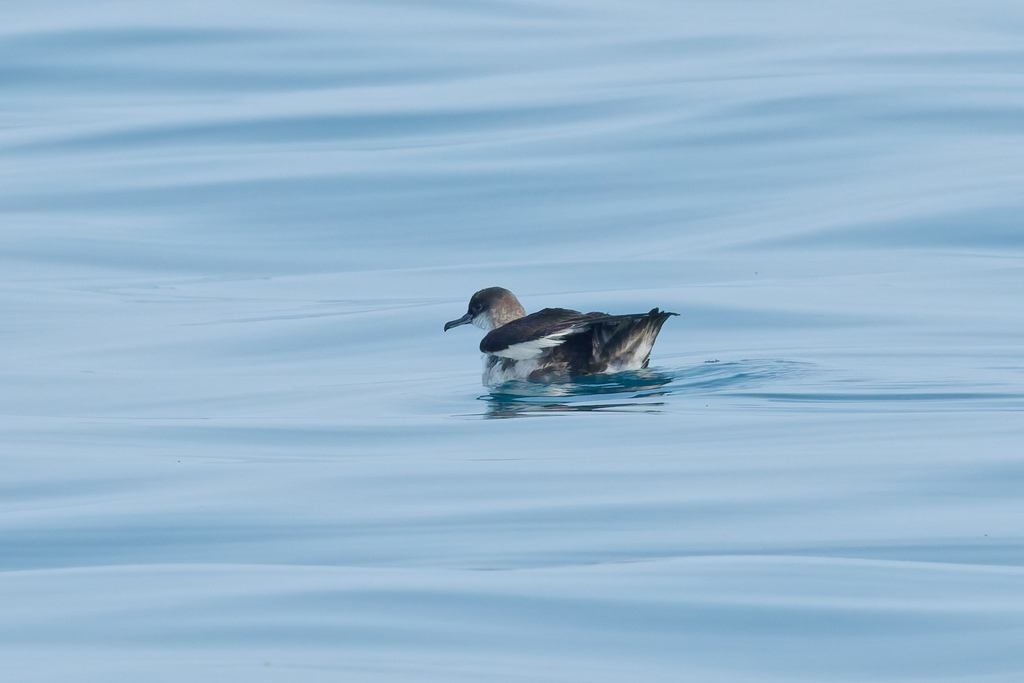
Yelkouan Shearwater
Photo © Donald Davesne
Photo © Donald Davesne — CC BY 4.0 — Source: iNaturalist photo #525107329Identification
The yelkouan shearwater is a medium-sized seabird measuring 30–35 cm in length with a wingspan of 70–84 cm. It is characterized by its distinctive "shearing" flight pattern, where it dips from side to side on stiff wings with minimal wingbeats, its wingtips nearly skimming the water. The bird appears as a flying cross, with wings held at right angles to its body, and creates a striking visual effect as it alternates between showing its very dark brown upperparts and pale undersides while traveling low over the sea. The yelkouan shearwater has a more contrasted black-and-white appearance than the closely related Balearic shearwater, though it remains very similar to the Atlantic Manx shearwater, making field identification of vagrant birds challenging. At sea the bird is silent, but breeding colonies come alive at night with raucous cackling calls that are higher pitched and more drawn out than those of the Manx shearwater.
Range & Habitat
The yelkouan shearwater breeds on islands and coastal cliffs throughout the eastern and central Mediterranean Sea. Most populations remain in Mediterranean waters year-round, though small numbers venture into the Atlantic during late summer. Their breeding sites face pressure from coastal development, particularly from holiday resort construction. A well-studied mixed breeding colony exists on Menorca, where yelkouan and Balearic shearwaters breed together, highlighting the overlap and complexity of their ranges.
Behaviour & Diet
This is a gregarious species that can be observed in large numbers from boats and headlands, particularly in autumn. Yelkouan shearwaters are nocturnal breeders, nesting in burrows that they visit only under cover of darkness to avoid predation by large gulls. They feed primarily on fish and molluscs, and have adapted to follow fishing vessels to exploit discarded offal. The species is currently classified as vulnerable, having suffered significant historical population declines and suffering additional threats from introduced predators such as rats and cats at breeding colonies. On Le Levant Island, one of its major breeding locations, cats are estimated to kill thousands of birds annually, posing a risk of local extinction within decades.
Best Time & Places to See It
Autumn is the optimal season to observe yelkouan shearwaters in large concentrations. Viewing from boats or coastal headlands throughout the eastern and central Mediterranean provides the best opportunities. The species' nocturnal breeding behavior means that nighttime visits to breeding colonies may reveal birds and hear their distinctive calls, though such visits should be conducted responsibly to minimize disturbance.
Photography Tips
Photographing yelkouan shearwaters requires patience and a boat-based platform for optimal results. The birds' low, fast flight over water demands fast shutter speeds and tracking ability. Early morning and late afternoon light can enhance the contrast between their dark upperparts and pale undersides as they bank and turn. During autumn gatherings, boat-based photographers will find opportunities to capture the species' characteristic shearing flight and dynamic banking behavior. Coastal headland positions may also yield opportunities to photograph birds in profile against the sea background.
Asinara National Park
Brijuni National Park
Cabo de Gata-Níjar Natural Park
Cabo Peñas
Calanques National Park
Camargue Regional Nature Park
Cap de Creus Natural Park
Cilento, Vallo di Diano and Alburni National Park
Cinque Terre National Park
Nothing matches these filters.
No community photos yet. Log in to add the first one.
No community observations of this species yet.