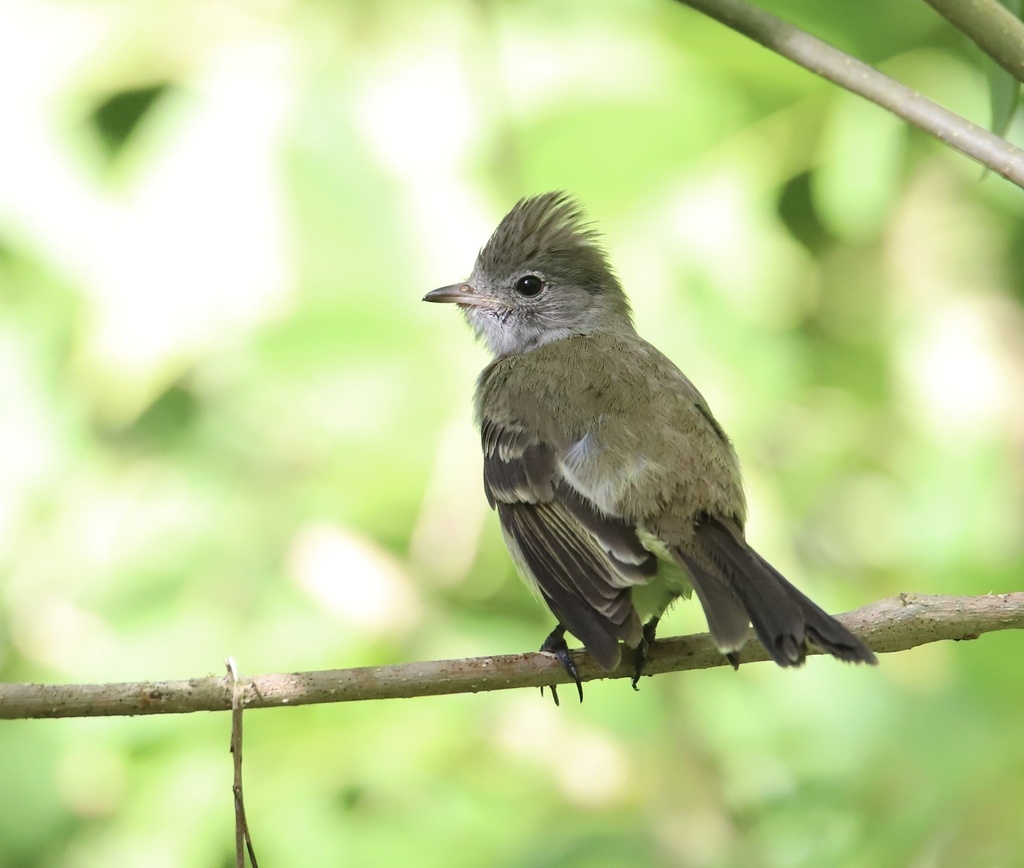
Yellow-bellied Elaenia
Photo © Aitor
Photo © Aitor — CC BY 4.0 — Source: iNaturalist photo #252990963Identification
The Yellow-bellied Elaenia is a small tyrant flycatcher, measuring 15–17 cm long and weighing 21–29 g. It is characterized by a bushy crest with a partially concealed white stripe down the middle, and a distinctive yellow to pale-yellow belly that gives the species its name. The bird has a brownish-olive crown and upperparts, whitish lores, and a faint whitish eye-ring. Its wings are slightly darker than the back, with yellowish-white edges on flight feathers and two visible wing bars formed by pale tips on the wing coverts. The throat is pale gray and the breast olive-gray. Both sexes are identical in plumage, with dark brown irises, black bills with paler mandible bases, and black legs.
Four subspecies are recognized across the species' range, showing subtle variations in coloration. E. f. subpagana has browner and yellower tones overall, while E. f. pallididorsalis is grayer with greener upperparts. E. f. semipagana is notably paler, with a grayer face and whiter throat. The nominate subspecies E. f. flavogaster represents the typical form.
Range & Habitat
The Yellow-bellied Elaenia is found from southern Mexico through Central America and across most of mainland South America, including every Central American country and every mainland South American country except Chile. Its range extends from Mexico's Yucatán Peninsula south through Belize, Guatemala, El Salvador, Honduras, and Nicaragua into Costa Rica and Panama. It is present throughout Colombia, Venezuela, the Guianas, most of Brazil, Peru, Bolivia, Paraguay, and northeastern and northwestern Argentina. The species also inhabits Trinidad and Tobago and several Lesser Antilles islands including St. Vincent, the Grenadines, and Grenada.
This adaptable bird favors lightly wooded and open habitats, avoiding dense forest except at its edges. It thrives in savannas, scrublands, semi-open woodlands, secondary forest, brushy areas along watercourses, and clearings with scattered trees. It readily uses suburban parks and gardens. Elevational range varies geographically, reaching 2,000 m in Mexico, up to 2,400 m in Colombia, and 1,500 m in Brazil and Peru.
Behaviour & Diet
The Yellow-bellied Elaenia is a year-round resident throughout most of its range, though populations in Veracruz and Oaxaca, Mexico, migrate south of the Isthmus of Tehuantepec during winter. This insectivore and frugivore typically forages singly or in pairs, though several birds may congregate in fruiting trees. It hunts and forages in the lower to middle levels of its habitat, capturing insects and plucking fruit through gleaning from perches, hovering, and aerial sallies. It occasionally joins mixed-species feeding flocks.
Breeding seasons vary geographically but generally fall between February and September, with Trinidad and Tobago populations breeding mainly between April and June and additionally in November and December. The female constructs a small cup nest from moss and grass, decorated externally with lichens and bark and lined with feathers, typically placed in a fork of a small branch. The usual clutch is two pinkish-white eggs marked with chestnut and gray. Incubation, performed solely by the female, lasts about 16 days, with fledging occurring 15–17 days after hatching. Both parents feed the nestlings.
Best Time & Places to See It
The Yellow-bellied Elaenia is a common and widespread species throughout its range, making it relatively easy to locate in suitable habitat. The best viewing opportunities occur during breeding season (February to September in most areas), when birds are more vocal and active. In Trinidad and Tobago, the breeding season extends into December, offering extended viewing possibilities. Early morning visits to open woodlands, secondary forest edges, parks, and gardens provide excellent chances of observation.
The species is particularly conspicuous in semi-open habitats where it perches openly. Look for it in clearings with scattered trees, along brushy watercourse margins, and in suburban areas with mature trees. The bird's vocal activity, especially its distinctive dawn song, often betrays its presence before visual contact is made.
Photography Tips
The Yellow-bellied Elaenia's small size and preference for lower to middle vegetation levels make it an approachable subject for patient photographers. Its habit of foraging from exposed perches and making aerial sallies provides excellent photographic opportunities. Early morning is ideal for capturing the bird during its most vocal and active period. A telephoto lens (300–500 mm) will be necessary to frame the small bird effectively while maintaining working distance.
The bird's distinctive features—the bushy crest, yellow belly, white crest stripe, and two wing bars—are best captured with side-on or three-quarter angle views. Overcast conditions help preserve detail in the bird's subtle plumage coloring, while backlighting can accentuate the wing bars and crest outline. Photographing birds in fruiting trees or during aerial sallies can capture characteristic behavior and add context to images.
Amacayacu National Park
Amazônia National Park
Anavilhanas National Park
Araucárias National Park
Arenal Volcano National Park
Bahuaja Sonene National Park
Barbilla National Park
Barra del Colorado National Wildlife Refuge
Baru Volcano National Park
Nothing matches these filters.
No community photos yet. Log in to add the first one.
No community observations of this species yet.