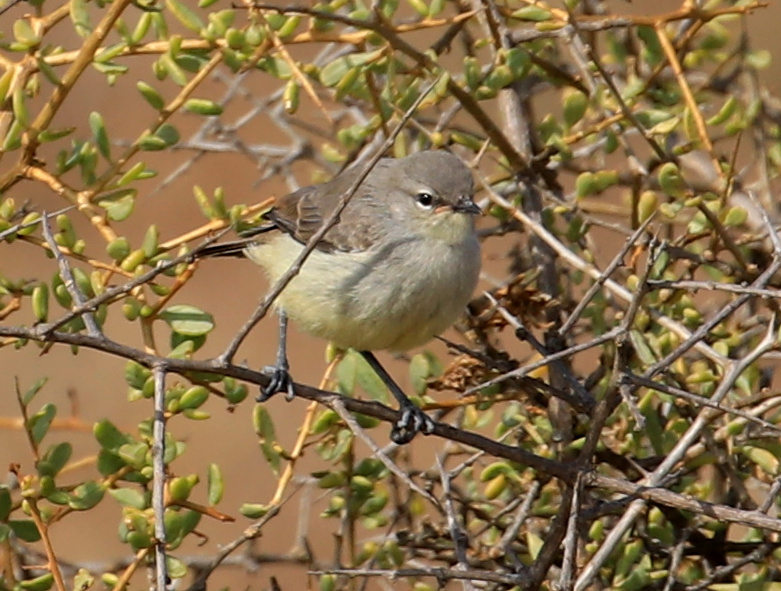
Yellow-bellied Eremomela
Photo © Wynand Uys
Photo © Wynand Uys — CC BY 4.0 — Source: iNaturalist photo #579335371Identification
The yellow-bellied eremomela is a diminutive warbler, measuring just 10 cm and weighing around 9 g, making it one of Africa's tiniest songbirds. Its most distinctive feature is the striking contrast between its grey upperparts and bright lemon-yellow belly. The wings and tail are darker and more olive-toned, while a thin pale grey supercilium and blackish eye-stripe add subtle facial character. The bird's blackish bill is proportionately fine and pointed for gleaning small invertebrates. Sexes are similar in plumage, though juveniles show duller yellow underparts. Some western southern African populations display whitish throats and breasts, with subspecific variation in the extent and intensity of belly coloration. In the field, listen for its distinctive high-pitched, repeated call: tchee-tchee-tchuut.
Range & Habitat
This common breeding species is distributed across Africa south of the Sahara, occupying a vast range of approximately 7.1 million square kilometers. The yellow-bellied eremomela favours open woodland, savannah, and dry scrub environments, making it well-adapted to arid and semi-arid regions. Its preference for dry, open habitats distinguishes it from many forest-dwelling warblers, and it has successfully colonized suitable areas throughout its extensive African range.
Behaviour & Diet
A territorial and monogamous species that pairs for life, the yellow-bellied eremomela is typically encountered alone, in pairs, or within family groups. The bird forages methodically on the ground and in low foliage, probing and gleaning for insects and other small invertebrates—the primary components of its diet. During breeding season, pairs construct neat cup nests in the branches of trees or shrubs, where females lay clutches of two to four white eggs. This sedentary lifestyle and predictable behaviour make it rewarding for patient observers.
Best Time & Places to See It
The yellow-bellied eremomela's status as a common breeding species and its large, stable population mean it is relatively straightforward to locate within suitable habitat. Visitors should focus on open woodland, savannah, and dry scrub environments across sub-Saharan Africa. The species' year-round presence in much of its range makes any season suitable for observation, though the breeding season may offer opportunities to observe nest-building and family group dynamics.
Photography Tips
The bird's diminutive size and preference for low vegetation present both challenges and opportunities. Use a telephoto lens (at least 400–600 mm) to fill the frame without disturbing this territorial species. Early morning light is ideal for capturing the contrast between grey upperparts and yellow underparts. Patience is essential—position yourself quietly near suitable habitat and wait for the bird to forage into open view. The distinctive eye-stripe and facial pattern reward close-focus photography, and the striking yellow belly provides excellent colour contrast against neutral scrub backgrounds.
Bwindi Impenetrable National Park
Murchison Falls National Park
Abijata-Shalla Lakes National Park
Amboseli National Park
Arusha National Park
Augrabies Falls National Park
Awash National Park
Bale Mountains National Park
Bwabwata National Park
Nothing matches these filters.
No community photos yet. Log in to add the first one.
No community observations of this species yet.