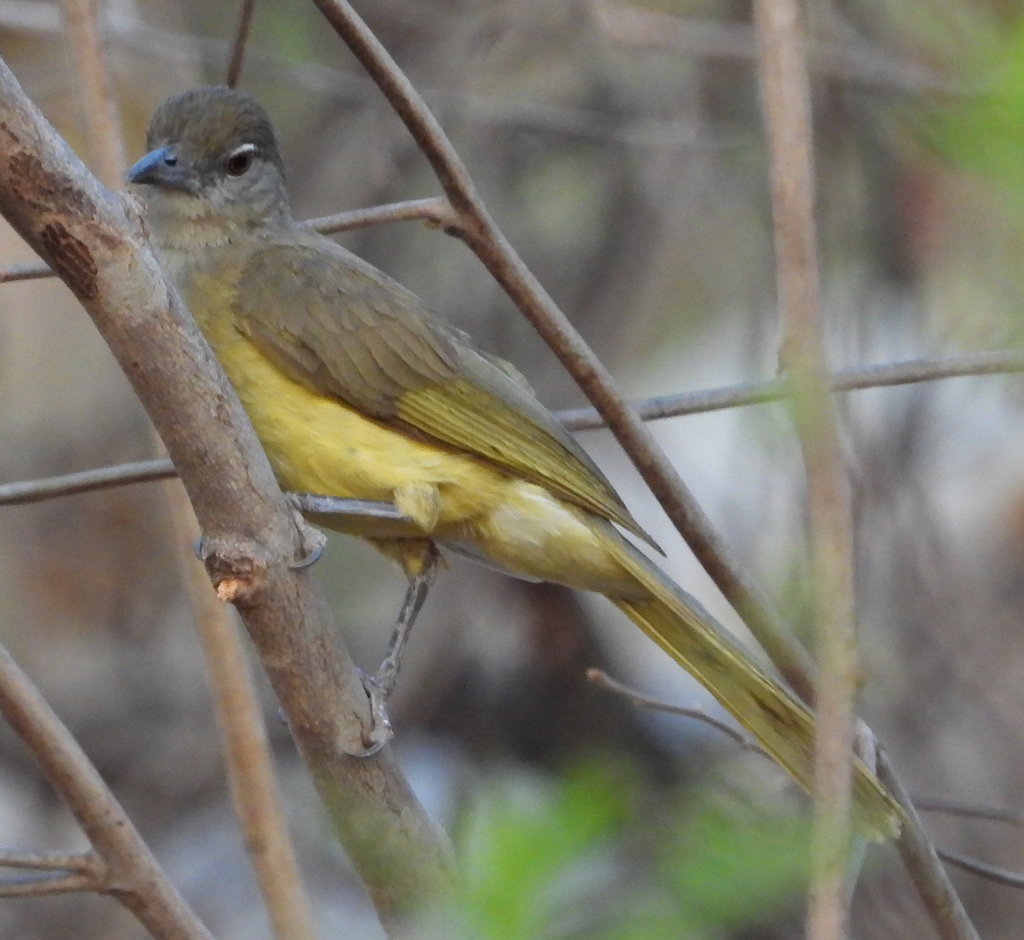
Yellow-bellied Greenbul
Photo © Timothy Whitehead
Photo © Timothy Whitehead — CC BY 4.0 — Source: iNaturalist #248995411Identification
The yellow-bellied greenbul is a songbird in the bulbul family, characterized by its distinctive yellow underparts that give the species its common name. The bird's plumage combines greenish tones on the upperparts with the striking yellow belly that makes it relatively straightforward to identify in the field. Its compact songbird structure is typical of the bulbul family, Pycnonotidae.
Range & Habitat
This species is distributed across eastern, southern and west-central Africa. Three subspecies are recognized across its range: the Kenya yellow-bellied greenbul (Chlorocichla flaviventris centralis) occurs from southern Somalia to northern Mozambique; the Zambezi yellow-bellied greenbul (Chlorocichla flaviventris occidentalis) is found from north-western Angola to western Tanzania, extending south to north-western Namibia, northern Botswana, northern South Africa and central Mozambique; and the nominate race (Chlorocichla flaviventris flaviventris) inhabits eastern South Africa and southern Mozambique.
The yellow-bellied greenbul favours subtropical or tropical dry forests, subtropical or tropical moist lowland forests, and dry savanna habitats, making it adaptable to a range of woodland and forest environments across its African range.
Behaviour & Diet
As a member of the bulbul family, the yellow-bellied greenbul is a songbird, and like other greenbuls it is likely an active forager in the canopy and mid-storey levels of its forest and woodland habitats. The species' ecology and specific dietary preferences remain less documented than some other African bulbuls, but members of the genus Chlorocichla typically feed on fruits and insects.
Best Time & Places to See It
The yellow-bellied greenbul's wide distribution across multiple habitat types in eastern, southern and west-central Africa offers numerous opportunities for observation. Travellers visiting subtropical and tropical forests or dry savanna regions within the species' range—particularly in areas encompassing its three recognized subspecies—stand good chances of encountering this bird. The best approach is to listen for its song and watch for movement in the forest canopy and mid-storey vegetation.
Photography Tips
The yellow belly provides good contrast for photography and should be a key field mark to capture. Position yourself to photograph the bird with back-lit or side-lit conditions to highlight the yellow underparts against the greener upperparts. Early morning hours when the bird is most vocal and active offer the best opportunities for approach and framing. A telephoto lens will help you isolate the bird within the often-dense forest vegetation where it forages.
Amboseli National Park
Arabuko Sokoke Forest Reserve
Arusha National Park
Bwabwata National Park
Chobe National Park
Chyulu Hills National Park
Etosha National Park
Ithala Game Reserve
Kafue National Park
Nothing matches these filters.
No community photos yet. Log in to add the first one.
No community observations of this species yet.