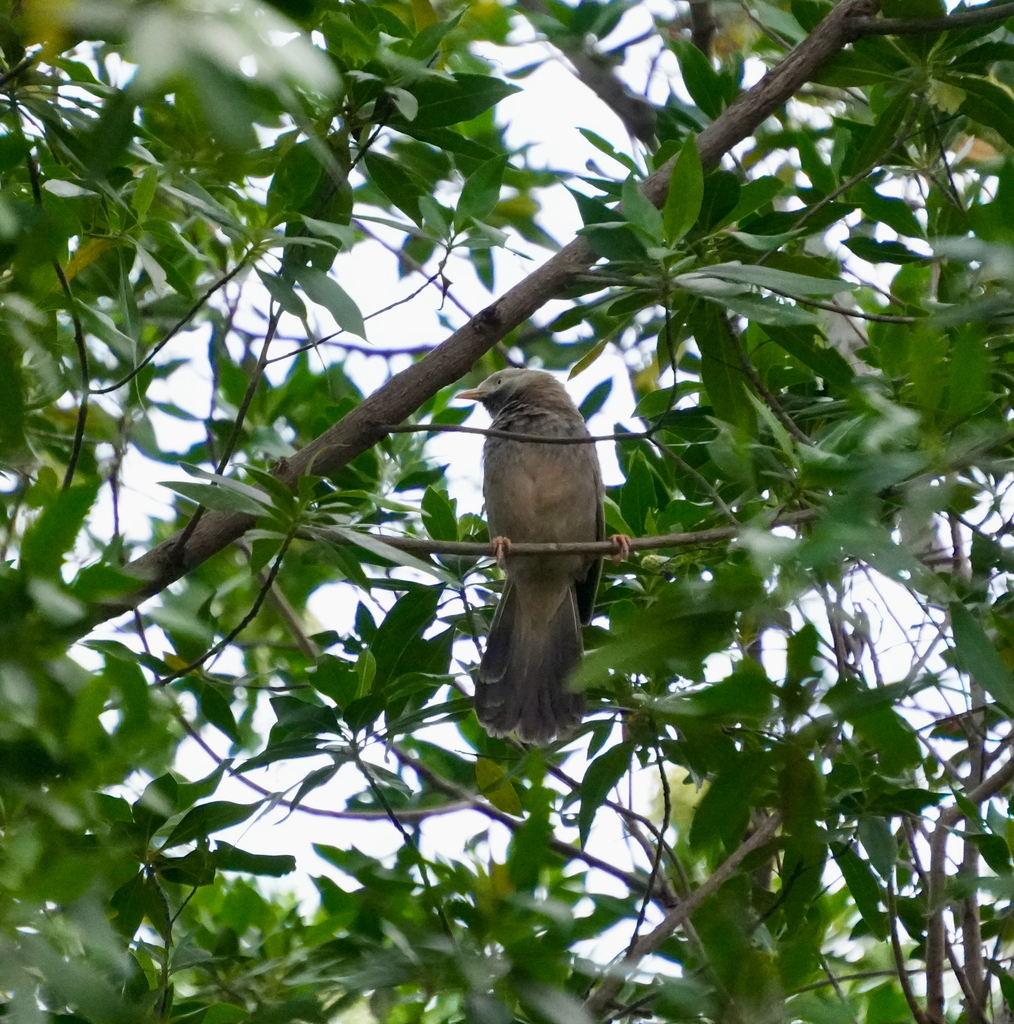
Yellow-billed Babbler
Photo © Aparna
Photo © Aparna — CC BY 4.0 — Source: iNaturalist #370944842Identification
The yellow-billed babbler is a small, grey-brown bird with distinctive features that aid identification in the field. These birds have grey-brown upperparts, a grey throat and breast with some mottling, and a pale buff belly. The head and nape are grey with bluish-white eyes. Two subspecies show subtle differences: the nominate race found in southern India has a whitish crown and nape with a darker mantle, while the Sri Lankan subspecies A. a. taprobanus is drab pale grey overall. The rump is pale, and the tail has a distinctive broad dark tip. Yellow-billed babblers are often mistaken for jungle babblers in areas where their ranges overlap, but they have a distinctive call with a higher pitch than the harsher, more nasal quality of jungle babblers.
Range & Habitat
The yellow-billed babbler is endemic to southern India and Sri Lanka, with a patchy distribution. In India, the nominate subspecies occurs in Andhra Pradesh south of the Godavari river, through Karnataka south of Belgaum into Tamil Nadu, preferring lower altitudes and drier habitats than the jungle babbler. The Sri Lankan subspecies inhabits the lowlands and hills up to about 1,500 metres, avoiding heavy forest. The species is a common resident of scrub, cultivation, and garden land, and has adapted well to urban and suburban areas, frequently visiting gardens and human-modified landscapes.
Behaviour & Diet
Yellow-billed babblers are highly gregarious, living in flocks of seven to ten or more individuals. They are notably vocal birds, with seven distinctive vocalisations noted, and their continual chattering, squeaking and chirping can be heard at considerable distance. The flock employs a sentinel system, with one member perching high while others forage on or near the ground. These birds wake before dawn around 6:00 AM to begin foraging, become relatively inactive during the hot hours from 1:30 PM to 4:30 PM, and assemble around 7:00 PM to preen before roosting, with group members roosting close together. They feed mainly on insects but also consume fruit, nectar, and human food scraps, and have been recorded taking Calotes versicolor lizards and whip-scorpions. The species has weak flight, with a maximum recorded non-stop flight distance of about 180 metres.
Best Time & Places to See It
Yellow-billed babblers are common resident birds throughout their range in southern India and Sri Lanka, making them relatively easy to locate year-round. They are particularly active in gardens, cultivation areas, and scrubland habitats. Early morning and late afternoon are the most productive times to observe them, as they are most active before the heat of the day and again in the evening hours. In Sri Lanka, they are especially common garden birds in both lowland and hill areas. Watch for their noisy flocks moving through vegetation, or listen for their distinctive chattering calls that often betray their presence before they are seen.
Photography Tips
Photograph yellow-billed babblers during early morning or late afternoon when they are most active and light conditions are optimal. Their gregarious nature and constant movement within flocks create dynamic opportunities, though patience is essential. Focus on capturing their distinctive features: the bluish-white eyes, pale buff belly, and broad dark tail tip. The sentinel behaviour is particularly photogenic—watch for the high-perching bird and try to capture it alongside foraging flock members. Bathing behaviour around birdbaths is common, especially in late afternoon or after sunset, providing additional opportunities. Their weak flight and preference for staying in or near dense vegetation means they are generally approachable at close to medium range, making them suitable subjects for both telephoto and wide-angle compositions capturing flock behaviour.
Lunugamvehera National Park
Sri Lanka
+204 birds+14 mammals
Dry scrubland and shallow wetlands converge in Sri Lanka's southeastern lowlands, where Lunugamvehera National Park anchors one of the island's most ecologically vital landscapes. The park's…
VIEW NATIONAL PARKMinneriya National Park
Sri Lanka
+158 birds+9 mammals
Across the dry zone of Sri Lanka's North Central Province spreads a landscape of shallow tanks, grassland margins, and scattered dry forest—a mosaic of water and…
VIEW NATIONAL PARKWasgamuwa National Park
Sri Lanka
+156 birds+8 mammals
Dry deciduous forest and open grassland sweep across the North Central lowlands where Wasgamuwa National Park protects one of Sri Lanka's largest remaining tracts of this…
VIEW NATIONAL PARKMaduru Oya National Park
Sri Lanka
+74 birds+1 mammals
Granite ridges rise abruptly from the humid lowlands of Sri Lanka's Uva Province, their weathered slopes clothed in dry monsoon forest and scattered woodland where deciduous…
VIEW NATIONAL PARKTadoba National Park
Palasgaon Singru, India
+270 birds+20 mammals
Where sal forests meet open grasslands and rocky outcrops rise from red laterite soil, central India's landscape unfolds in raw, untamed beauty. Ancient teak woodlands and…
VIEW NATIONAL PARKPampadum Shola National Park
Vattavada, India
+258 birds+14 mammals
Where misty shola forests cling to the high plateaus of the Nilgiri Mountains, ancient evergreen remnants create a world apart. This 2,316-hectare reserve protects one of…
VIEW NATIONAL PARKBandipur National Park
Hirehalli, India
+302 birds+19 mammals
Where the Western Ghats descend into the Deccan plateau, ancient deciduous forests blanket a landscape carved by the Nugu River. Bandipur unfolds across 880 square kilometres…
VIEW NATIONAL PARKNagarahole Tiger Reserve
Nalkeri Forest, India
+323 birds+23 mammals
Where granite escarpments rise above dense deciduous forests and the Kabini River carves through pristine wilderness, one of India's most biodiverse landscapes unfolds across the Western…
VIEW NATIONAL PARKNo community photos yet. Log in to add the first one.
No community observations of this species yet.