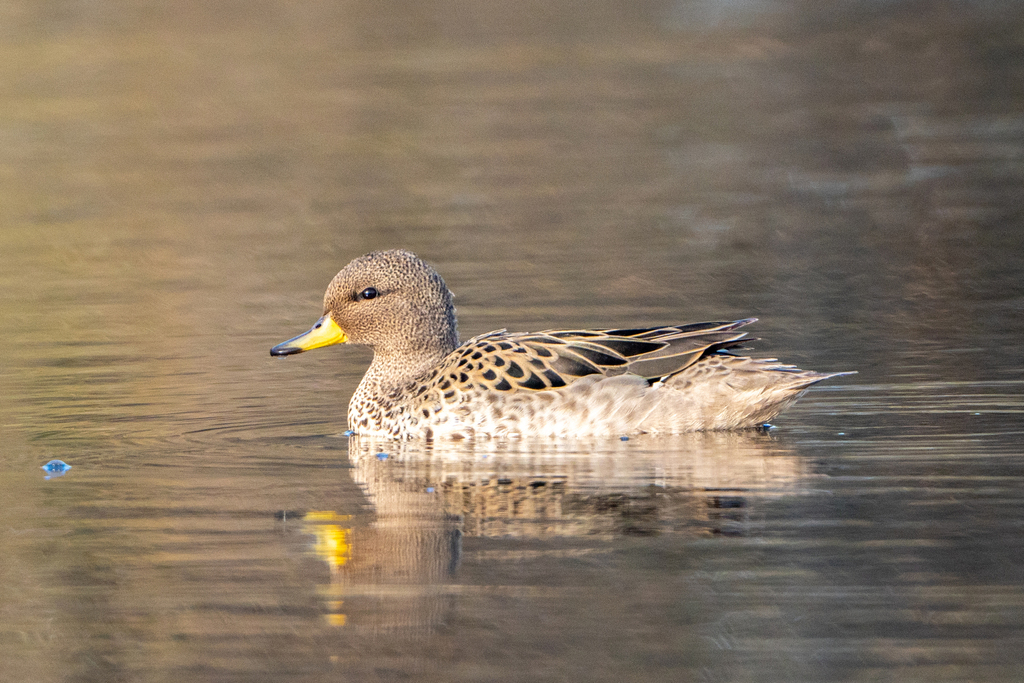
Yellow-billed Teal
Photo © Gonzalo González Mora
Photo © Gonzalo González Mora — CC BY 4.0 — Source: iNaturalist photo #452559360Identification
The yellow-billed teal is a small South American duck easily recognised by its distinctive bright yellow bill with a black tip and black band along the ridge—the feature that gives it its common name. Compared to the larger yellow-billed pintail, this species has a darker head, shorter neck, and plain grayish sides. As one of the "true" teals belonging to the genus Anas, it shares the compact, elegant build characteristic of teals, though its unicoloured underside and striking bill make it distinctive among its relatives.
Range & Habitat
This species is widely distributed across South America, occurring in Argentina, Chile, Peru, Bolivia, Brazil, and Uruguay, as well as the Falkland Islands. More remarkably, it has established populations as far afield as South Georgia, where it first bred in 1971, and has even been recorded as far east as the remote Tristan da Cunha archipelago. The yellow-billed teal shows a strong preference for freshwater wetlands, particularly palustrine habitats—shallow marshes and wetland areas with emergent vegetation—rather than rivers. Despite its broad range and local abundance across this vast territory, it is not considered threatened by conservation authorities.
Behaviour & Diet
The yellow-billed teal exhibits unusual post-mating behaviour among its relatives: after copulation, males characteristically stretch themselves upright and swim around and alongside females in a distinctive display. This behaviour is unique among the closely related teals and pintails, reflecting the species' evolutionary distinctiveness. While specific dietary details are limited in available sources, like other dabbling ducks the yellow-billed teal likely feeds by tipping forward in shallow water to graze on aquatic vegetation and invertebrates.
Best Time & Places to See It
Travellers seeking the yellow-billed teal should focus on South America's freshwater wetlands and marshes, particularly in Argentina, Chile, and Peru, where the species is locally abundant. The bird's preference for palustrine habitats means it is often found in shallow, vegetation-rich wetland systems rather than open water bodies. Those visiting the Falkland Islands or more adventurous travellers reaching South Georgia may encounter this species in its established populations. The wide distribution across multiple countries means that patient wetland birdwatchers across southern South America have good chances of encountering this teal.
Photography Tips
Photographers should focus on capturing the species' most distinctive feature: the striking bright yellow bill with its characteristic black tip and culmen stripe. Early morning light at freshwater marshes and wetlands will showcase these bill colours at their most vibrant. The teal's preference for palustrine habitats means it is often found in shallow water among emergent vegetation—positioning yourself low to the water level can create compelling compositions. Patient observation of males may reward you with images of their unique post-mating display, in which they stretch upright alongside females, an behaviour rarely documented in other duck species.
Cabo de Hornos National Park
Campos del Tuyú National Park
Cape Dolphin
Cerro Castillo National Park
Chiloé National Park
El Palmar National Park
El Rey National Park
Fortuna Bay
Huascarán National Park
Nothing matches these filters.
No community photos yet. Log in to add the first one.
No community observations of this species yet.