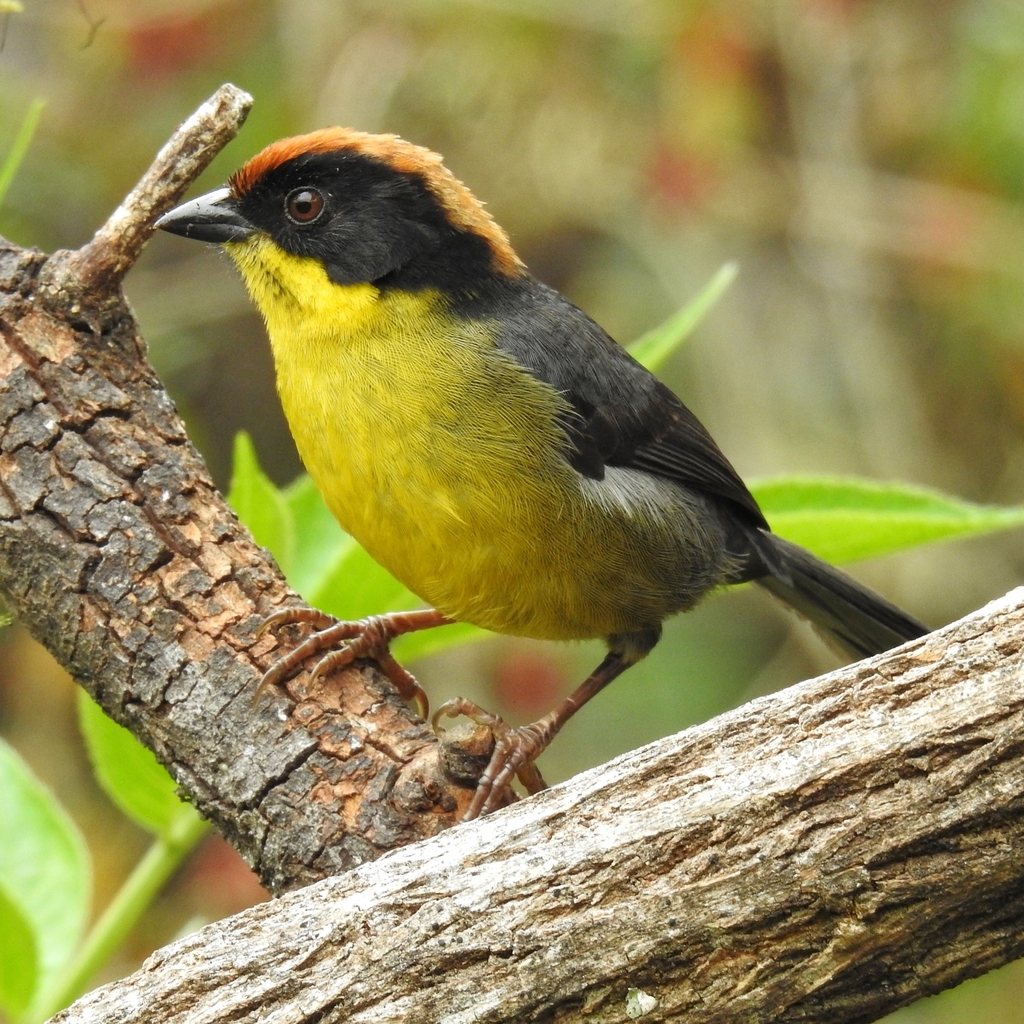
Yellow-breasted Brushfinch
Photo © Esteban Poveda
Photo © Esteban Poveda — CC BY 4.0 — Source: iNaturalist #65786282Identification
The yellow-breasted brushfinch is a small sparrow about 17 cm long, weighing 16–31 g. It is distinctive for its bright yellow throat, breast, and belly contrasting sharply with dark plumage on the head and back. The nominate subspecies displays a striking rufous-to-orange stripe running from the forehead to the nape, a black face with a wide yellow lower cheek patch, and a thin black line beneath it. The upperparts are dark slate gray, with blackish wings showing white bases on the primary feathers. The tail is blackish with olive-edged feathers. All subspecies share a deep reddish-brown iris, black bill, and brownish-gray legs. The species shows considerable variation across its eight recognized subspecies, which differ in crown coloration, extent of cheek striping, primary patch size, and overall plumage tone—from almost black upperparts in some populations to greenish-olive in others.
Range & Habitat
This species is endemic to the Andes of Colombia, Ecuador, and Peru, with a disjunct distribution across multiple mountain regions. Different subspecies occupy distinct elevational and geographical zones, from Colombia's Antioquia, Santander, and Nariño departments south through Ecuador's Azuay and Loja provinces, and into Peru's mountain ranges including Piura, Cajamarca, La Libertad, and Amazonas departments. The yellow-breasted brushfinch inhabits semi-open brushy landscapes between 1,500 and 3,600 meters elevation, including forest edges, secondary forest, roadside thickets, and overgrown pastures. It is notably more tolerant of disturbed habitats than many related brushfinch species, making it adaptable to human-modified landscapes.
Behaviour & Diet
The yellow-breasted brushfinch is a year-round resident throughout its range. Its diet consists primarily of insects and seeds, gleaned from perches in the understory while foraging in pairs or small groups. It occasionally makes short sallies or hops to capture food and seldom participates in mixed-species feeding flocks, though it sometimes forages loosely with other brushfinches. Breeding seasons vary geographically: populations breed from January to June in some areas, with others including August or spanning August to October. Pairs build cup nests from coarse plant material lined with finer fibers, placing them well-concealed 20–35 cm above the ground. Clutches contain two white eggs with darker markings; females incubate for approximately 16 days, and both parents feed fledglings until they depart roughly 15 days after hatching.
Best Time & Places to See It
The yellow-breasted brushfinch is a permanent resident, making it potentially visible year-round in its Andean range. The best viewing opportunities occur during dawn hours when pairs deliver their distinctive song—a relatively short, sweet whistled phrase repeated with variations every few seconds. Search for this species in semi-open brushy terrain between 1,500 and 3,600 meters, particularly along forest edges, in secondary growth, and among roadside thickets. Due to its tolerance of disturbed areas, it may be found in more accessible locations than some endemic mountain species. Different subspecies occupy specific regions, so consulting regional guides or birding resources will help target particular populations in Colombia, Ecuador, or Peru.
Photography Tips
The yellow-breasted brushfinch's bright yellow underparts and distinctive head pattern make it visually striking, though its small size and preference for understory perches present challenges. Early morning light during the singing period offers the best opportunities to locate and photograph this species. Use a telephoto lens (at least 300–400 mm) to photograph individuals at distance while minimizing disturbance. The bird's habit of gleaning food from perches means it pauses regularly, providing moments for sharp images. Backlighting can emphasize the bright yellow plumage beautifully. Be aware that plumage variation across subspecies is significant, so photograph details of head pattern, crown color, cheek striping, and primary patch for field documentation. Patient scanning of brushy understory vegetation during early hours will yield the best photographic opportunities.
Sangay National Park
Cebadas, Ecuador
+320 birds+10 mammals
High in Ecuador's Andean spine, where the Western Cordillera rises to touch perpetual snow, a landscape of volcanic drama and ecological intensity unfolds across Sangay National…
VIEW NATIONAL PARKPodocarpus National Park
Zamora, Ecuador
+496 birds+6 mammals
Where the Andes descend toward the Amazon basin, Podocarpus National Park sprawls across nearly 2,800 square kilometres of the most biodiverse terrain in Ecuador's southern highlands.…
VIEW NATIONAL PARKYacuri National Park
Las Juntas, Ecuador
+166 birds+1 mammals
Where the eastern slopes of the Andes descend into Ecuador's southern frontier, Yacuri National Park unfolds across nearly 1,300 square kilometers of montane cloud forest and…
VIEW NATIONAL PARKAntisana National Park
Quijos, Ecuador
+432 birds+21 mammals
Where the eastern Andean slopes descend into the Amazon basin, Antisana National Park sprawls across roughly 2,500 square kilometers of some of South America's most dramatic…
VIEW NATIONAL PARKCotopaxi National Park
Mulaló, Ecuador
+211 birds+6 mammals
High in Ecuador's volcanic corridor, where the páramo transitions into cloud forest along the slopes of Cotopaxi volcano, the national park unfolds across nearly 500 square…
VIEW NATIONAL PARKCajas National Park
Cuenca, Ecuador
+190 birds+7 mammals
High in the Andes above Cuenca, where elevation ranges from 3,100 to 4,200 metres, the páramo landscape dominates—a windswept realm of cushion plants, alpine grasses, and…
VIEW NATIONAL PARKNatural Serranía de los Yariguíes National Park
El Carmen de Chucurí, Colombia
+320 birds+3 mammals
Where the northern cordilleras of Colombia rise toward cloud forest, the Serranía de los Yariguíes unfolds across nearly 1,820 square kilometers of some of the most…
VIEW NATIONAL PARKNatural Farallones de Cali National Park
Buenaventura, Colombia
+733 birds+27 mammals
Where the Pacific coastal plain meets the western slopes of the Andes, Farallones de Cali National Park sprawls across nearly 3,500 square kilometers of dramatic topography…
VIEW NATIONAL PARKNatural Chingaza National Park
Junín, Colombia
+285 birds+6 mammals
Where the Andes rise above three thousand metres in the Cundinamarca region, high-altitude grasslands and cloud forests converge in a landscape shaped by both geology and…
VIEW NATIONAL PARKNatural el Cocuy National Park
Güicán, Colombia
+313 birds+3 mammals
Where the Andes rise to their highest peaks in Colombia's eastern cordillera, El Cocuy National Park sprawls across more than 6,600 square kilometers of some of…
VIEW NATIONAL PARKPuracé National Natural Park
Puracé, Colombia
+327 birds+2 mammals
Where the Andes thrust upward across southwestern Colombia, Puracé National Natural Park spans nearly 2,631 square kilometers of some of South America's most dramatic montane terrain.…
VIEW NATIONAL PARKNatural Nevado del Huila National Park
Planadas, Colombia
+117 birds
Where the Colombian Andes rise above 5,000 metres, tropical cloud forest yields to páramo and glaciated peaks, and the Planadas region of Tolima contains one of…
VIEW NATIONAL PARKHuascarán National Park
Independencia, Peru
+201 birds+5 mammals
Where granite peaks pierce the Andean sky above 6,000 metres, Huascarán National Park sprawls across more than 11,500 square kilometres of Peru's Cordillera Blanca, a landscape…
VIEW NATIONAL PARKTingo Maria National Park
Mariano Dámaso Beraún, Peru
+423 birds
Where the eastern slopes of the Peruvian Andes descend toward the Amazon basin, the landscape fractures into a maze of limestone ridges, humid gorges, and cloud-wrapped…
VIEW NATIONAL PARKNo community photos yet. Log in to add the first one.
No community observations of this species yet.