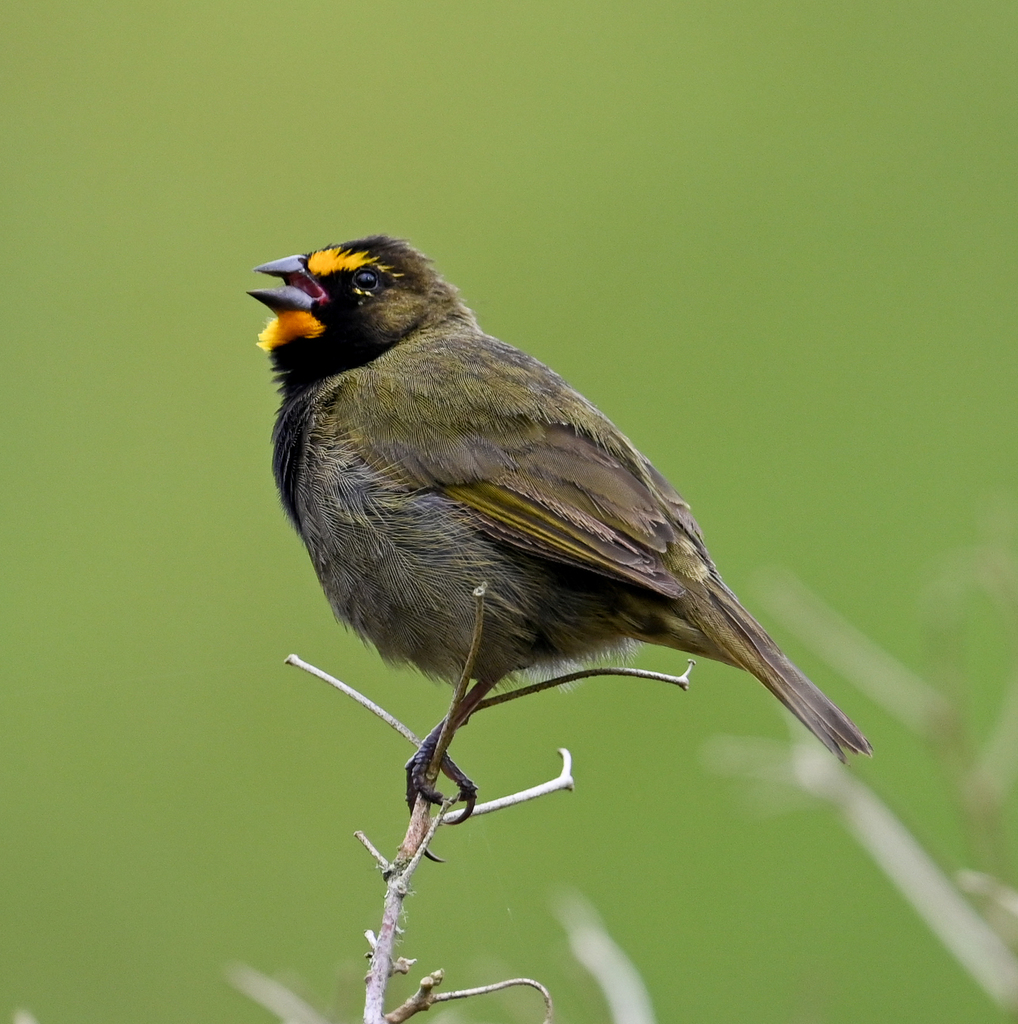
Yellow-faced Grassquit
Photo © Amber M. King
Photo © Amber M. King — CC BY 4.0 — Source: iNaturalist photo #527252282Identification
The yellow-faced grassquit is a diminutive passerine, measuring just 10–10.7 cm and weighing a mere 8–10 g, making it one of the smallest tanagers. Both sexes sport an olive-green back, but males are dramatically more striking: they display a jet-black face and breast contrasted by a brilliant yellow throat, supercilia, and a yellow spot below the eye. Females are considerably duller, with olive-green upperparts, paler grey underparts, and a much fainter or nearly invisible yellow facial pattern. Young birds resemble females but appear even duller and greyer. All birds possess a conical bill—sharper than related seedeaters—dark eyes, and grey legs.
In the field, listen for the species' characteristic weak buzzing call, a rapid ttttt-tee, and its subdued, melodious song consisting of high thin trills. The male's striking black-and-yellow face pattern is unmistakable among small tanagers in its range, though females require more careful observation to distinguish from other small olive-green species.
Range & Habitat
This species breeds from central Mexico through Central America, the Caribbean islands (including the Greater Antilles), and south to northern Ecuador and north-western Venezuela. It is resident year-round throughout its range, though birds move about locally outside breeding season. Vagrants occasionally appear in southern Texas and Florida, and the species has been introduced to Hawaii. It inhabits lowlands and foothills up to 2,300 m altitude, favouring semi-open areas such as weedy fields, pastures, roadsides, low scrub, and abandoned gardens where grass has grown tall. The bird avoids very short, dry grassland but readily adapts to disturbed habitats, benefiting from deforestation and land clearance.
Behaviour & Diet
The yellow-faced grassquit is a fairly sociable bird, sometimes forming loose flocks with seedeaters and other small tanagers and emberizids. Notably, breeding males occasionally congregate to perch together in shrubs and sing. The species feeds primarily on grass seeds but supplements its diet with other seeds, berries, and insects. Food is typically obtained by plucking directly from seed heads (inflorescences) or gleaning from the ground; insects are foraged among foliage in a manner reminiscent of New World warblers.
Breeding occurs mainly in summer months, though nesting may happen in any month except February to April. The species sometimes forms loose nesting colonies. During courtship, males vibrate their wings whilst singing their quiet song, perching only 1–2 cm from the female to ensure she hears them properly.
Best Time & Places to See It
The yellow-faced grassquit is common to abundant throughout its range and easily found in appropriate habitat. The species' preference for weedy fields, roadsides, pastures, and disturbed areas means it is accessible in many locations without requiring remote travel. Look in semi-open lowland and foothill habitats up to 2,300 m elevation, particularly in countries across central and northern South America and throughout the Caribbean islands. The breeding season (primarily summer months) offers the best opportunity to locate males singing from shrubs or grass clumps, though resident populations can be found year-round.
Photography Tips
Males are far more photogenic than females, with their striking black-and-yellow facial pattern providing excellent contrast and detail at all light levels. Their small size necessitates longer focal lengths and patience; photograph birds perched in or near grass or weeds where they typically forage. Capture the wing-vibrating courtship behaviour by staking out singing males during breeding season, particularly in the early morning when activity peaks. Backlighting can enhance the brilliance of the yellow throat and supercilia, while soft overcast light reveals detail in the olive-green plumage without harsh shadows. The species' terrestrial habits and preference for low vegetation mean many shots will be taken at or below eye level; position yourself accordingly for flattering angles.
Manuel Antonio National Park
Quepos, Costa Rica
+426 birds+22 mammals
Where tropical rainforest descends steeply to a rocky Pacific coastline, Manuel Antonio National Park distills Central American biodiversity into one of Costa Rica's most compressed and…
VIEW NATIONAL PARKArenal Volcano National Park
Peñas Blancas, Costa Rica
+551 birds+21 mammals
Straddling the border between Alajuela and Guanacaste in northwestern Costa Rica, this national park rises dramatically around one of Central America's most active volcanic systems. The…
VIEW NATIONAL PARKChirripó National Park
Rivas, Costa Rica
+274 birds+6 mammals
Where the volcanic spine of Costa Rica's Central Cordillera reaches its apex, Chirripó National Park encompasses a landscape that shifts dramatically with elevation, from montane cloud…
VIEW NATIONAL PARKBraulio Carrillo National Park
Las Horquetas, Costa Rica
+547 birds+18 mammals
Where the Caribbean slope descends from the central volcanic cordillera toward the humid lowlands of Heredia, Braulio Carrillo National Park preserves one of Costa Rica's most…
VIEW NATIONAL PARKPiedras Blancas National Park
Golfito, Costa Rica
+386 birds+24 mammals
Where the Golfo Dulce meets the southwestern Pacific coast of Costa Rica, Piedras Blancas National Park protects a dramatic transition zone where lowland rainforest descends toward…
VIEW NATIONAL PARKGuanacaste National Park
Santa Elena, Costa Rica
+461 birds+17 mammals
Where the Pacific slopes of northwestern Costa Rica rise toward the Continental Divide, dry tropical forest gives way to cloud-laden peaks and misty ridges—a landscape that…
VIEW NATIONAL PARKVolcán Poás National Park
Toro Amarillo, Costa Rica
+237 birds+4 mammals
Where volcanic slopes rise sharply from the Central Valley floor, Volcán Poás National Park protects one of Costa Rica's most active and accessible volcanic systems. The…
VIEW NATIONAL PARKEverglades National Park
Monroe County, United States
+345 birds+22 mammals
Where freshwater marsh meets subtropical sky, the Everglades sprawls across southwestern Florida as one of North America's most expansive wetland ecosystems. Spanning over 13,000 square kilometers,…
VIEW NATIONAL PARKNatural Serranía de los Yariguíes National Park
El Carmen de Chucurí, Colombia
+320 birds+3 mammals
Where the northern cordilleras of Colombia rise toward cloud forest, the Serranía de los Yariguíes unfolds across nearly 1,820 square kilometers of some of the most…
VIEW NATIONAL PARKNatural Farallones de Cali National Park
Buenaventura, Colombia
+733 birds+27 mammals
Where the Pacific coastal plain meets the western slopes of the Andes, Farallones de Cali National Park sprawls across nearly 3,500 square kilometers of dramatic topography…
VIEW NATIONAL PARKNatural Chingaza National Park
Junín, Colombia
+285 birds+6 mammals
Where the Andes rise above three thousand metres in the Cundinamarca region, high-altitude grasslands and cloud forests converge in a landscape shaped by both geology and…
VIEW NATIONAL PARKPuracé National Natural Park
Puracé, Colombia
+327 birds+2 mammals
Where the Andes thrust upward across southwestern Colombia, Puracé National Natural Park spans nearly 2,631 square kilometers of some of South America's most dramatic montane terrain.…
VIEW NATIONAL PARKGuácharos Cave National Natural Park
Acevedo, Colombia
+359 birds
High in the Andean foothills of southern Huila, where mist-laden slopes rise above 1,600 metres, lies a landscape carved by underground rivers and crowned by karst…
VIEW NATIONAL PARKNatural Sumapaz National Park
Cubarral, Colombia
+368 birds+1 mammals
Where the Andes descend toward the Amazon basin, the high páramo grasslands of Sumapaz National Park sprawl across more than five thousand square kilometers of Meta…
VIEW NATIONAL PARKEl Tamá National Park
Toledo, Colombia
+435 birds
Where the Andes descend toward the Caribbean coastal lowlands of northern Colombia, El Tamá National Park sprawls across nearly 3,800 square kilometres of montane forest, cloud…
VIEW NATIONAL PARKNatural Nevado del Huila National Park
Planadas, Colombia
+117 birds
Where the Colombian Andes rise above 5,000 metres, tropical cloud forest yields to páramo and glaciated peaks, and the Planadas region of Tolima contains one of…
VIEW NATIONAL PARKCoiba National Park
Montijo, Panama
+260 birds+10 mammals
An archipelago of volcanic and sedimentary islands rises from the Pacific waters off Panama's southwestern coast, its densest rainforest canopy unbroken for millennia. Coiba National Park…
VIEW NATIONAL PARKBaru Volcano National Park
Cerro Punta, Panama
+402 birds+6 mammals
Where the land rises sharply toward the Caribbean's western spine, Baru Volcano National Park sprawls across roughly 220 square kilometres of southwestern Panama, anchored by the…
VIEW NATIONAL PARKGeneral de División Omar Torrijos Herrera National Park
La Pintada, Panama
+401 birds+2 mammals
Across the highlands of central Panama, where the continental divide funnels moisture-laden trade winds into steep river valleys, the terrain rises and falls in a landscape…
VIEW NATIONAL PARKSoberanía National Park
Cristóbal, Panama
+495 birds+34 mammals
Rainforest and riverine woodland blanket the rolling terrain of this 714-square-kilometre national park in Colón Province, where the Caribbean watershed feeds a maze of streams and…
VIEW NATIONAL PARKChagres National Park
Caimitillo, Panama
+486 birds+19 mammals
Where the Chagres River carves through the humid tropics of central Panama, a vast montane and lowland forest sprawls across more than 2,300 square kilometers, anchoring…
VIEW NATIONAL PARKDarién National Park
Tucutí, Panama
+534 birds+13 mammals
Where the spine of Central America crumbles into wetland and rainforest, Darién National Park sprawls across more than 20,000 square kilometres of some of the tropics'…
VIEW NATIONAL PARKPortobelo National Park
Portobelo, Panama
+366 birds+9 mammals
Where the Caribbean's turquoise waters meet the Darién's verdant shore, Portobelo National Park sprawls across 570 square kilometers of coastal forest, mangrove wetland, and coral-fringed islands…
VIEW NATIONAL PARKParque Internacional la Amistad
Teribe, Panama
+325 birds+11 mammals
Where the continental divide rises between the Caribbean and Pacific watersheds, a wilderness of extraordinary biological richness unfolds across the Talamanca Range and into lowland rainforest—a…
VIEW NATIONAL PARKLagunas de Montebello National Park
Laguna de Montebello, Mexico
+360 birds+2 mammals
Where turquoise lagoons pierce the limestone plateau of southeastern Chiapas, the Lagunas de Montebello National Park unfolds across roughly 174 square kilometers of spectral water and…
VIEW NATIONAL PARKArrecifes de Cozumel National Park
San Miguel de Cozumel, Mexico
+112 birds+4 mammals
Beneath the turquoise shallows of the western Caribbean, Arrecifes de Cozumel National Park protects a sprawling marine realm across 484 square kilometres off the Quintana Roo…
VIEW NATIONAL PARKSian Ka’an
Chunyaxché, Mexico
+350 birds+16 mammals
Where the Yucatán Peninsula dissolves into wetland and mangrove, a vast mosaic of forest, lagoon, and coastal margin creates one of Mexico's most biodiverse strongholds. Across…
VIEW BIOSPHERE RESERVESierra de Tamaulipas
El Porvenir, Mexico
+98 birds+19 mammals
Where limestone peaks thrust skyward through dense subtropical forest, Mexico's northeastern frontier reveals one of the continent's most biodiverse mountain ranges. Canyons carved by perennial rivers…
VIEW NATURE RESERVEMontes Azules
Candelaria, Mexico
+395 birds+47 mammals
Where jungle-clad limestone plateaus plunge into canyon systems carved by the Usumacinta River, Mexico's most pristine rainforest reserve unfolds across the Lacandón region of Chiapas. Montes…
VIEW BIOSPHERE RESERVETikal National Park
Tikal, Guatemala
+399 birds+16 mammals
Dense rainforest canopy rises above the limestone plateau of Petén, where archaeological wonder and ecological richness merge seamlessly across one of Central America's most biodiverse landscapes.…
VIEW NATIONAL PARKLaguna del Tigre National Park
Petén, Guatemala
+399 birds+29 mammals
Where the Petén lowlands dissolve into wetland and forest, Laguna del Tigre National Park protects one of Guatemala's most ecologically vital landscapes. This sprawling reserve encompasses…
VIEW NATIONAL PARKSierra del Lacandón National Park
Petén, Guatemala
+348 birds+7 mammals
Where the Petén rainforest rises into limestone ridges and deep ravines, Sierra del Lacandón National Park protects one of Central America's most intact tropical wilderness zones.…
VIEW NATIONAL PARKSanta Ana National Wildlife Refuge
Hidalgo County, United States
+349 birds+12 mammals
Where the Rio Grande delta meets the semi-arid scrublands of South Texas, Santa Ana National Wildlife Sanctuary preserves a rare mosaic of wetland and thornforest habitat…
VIEW WILDLIFE SANCTUARYCarara National Park
Tárcoles, Costa Rica
+397 birds+19 mammals
Where the Pacific coastal plain meets transitional forest, Carara National Park straddles one of Central America's most dynamic ecological boundaries. The park's landscape encompasses lowland deciduous…
VIEW NATIONAL PARKPalo Verde National Park
Bagaces, Costa Rica
+318 birds+24 mammals
Dry forest spreads across Palo Verde's low-lying terrain in northwestern Guanacaste, where seasonal rivers and lagoons etch through deciduous woodland that sheds its canopy each winter.…
VIEW NATIONAL PARKLos Quetzales National Park
Copey, Costa Rica
+232 birds+3 mammals
Cloud forest sweeps across the upper slopes of the Central Valley watershed, where elevation and persistent moisture forge an ecosystem unlike any other in Costa Rica.…
VIEW NATIONAL PARKCahuita National Park
Talamanca, Costa Rica
+359 birds+15 mammals
Where the Caribbean shoreline dissolves into mangrove creeks and coral gardens, Cahuita's mosaic of habitats unfolds across the Limón coast. The park's signature feature—a living coral…
VIEW NATIONAL PARKRincón de la Vieja National Park
Liberia, Costa Rica
+451 birds+30 mammals
Where volcanic slopes rise abruptly from the Guanacaste lowlands, Rincón de la Vieja National Park sprawls across a landscape shaped by geothermal drama and seasonal extremes.…
VIEW NATIONAL PARKTapantí Macizo de la Muerte National Park
Orosi, Costa Rica
+503 birds+18 mammals
Where montane cloud forest rises steeply from the Orosi Valley, Tapantí Macizo de la Muerte National Park enfolds a landscape of perpetual moisture and emerald complexity.…
VIEW NATIONAL PARKLa Amistad International Park
Crorina, Costa Rica
+532 birds+20 mammals
Where the Caribbean slopes of Costa Rica's Talamanca Mountains rise steeply inland from Limón, the boundary between two nations dissolves into an unbroken expanse of rainforest.…
VIEW NATIONAL PARKBarbilla National Park
Chirripó, Costa Rica
+226 birds
Where the Caribbean slope of Costa Rica's eastern cordillera plunges into perpetual moisture, Barbilla National Park rises as one of Central America's most water-rich ecosystems. Fed…
VIEW NATIONAL PARKVolcán Tenorio National Park
Guatuso, Costa Rica
+480 birds+12 mammals
Where volcanic slopes rise through Costa Rica's northwestern borderlands, Volcán Tenorio National Park sprawls across terrain shaped by ancient lava flows and mineral-rich springs. The park's…
VIEW NATIONAL PARKMarino Ballena National Park
Bahía Ballena, Costa Rica
+336 birds+8 mammals
Where mangrove forests meet coral-fringed shorelines along Costa Rica's southern Pacific coast, Marino Ballena National Park encompasses a marine and terrestrial mosaic that ranks among Central…
VIEW NATIONAL PARKCaño Negro National Wildlife Refuge
Caño Negro District, Costa Rica
+486 birds+16 mammals
Where the San Juan River's seasonal floodplain opens into expansive wetlands, Caño Negro Wildlife Sanctuary sprawls across one of Central America's most productive freshwater ecosystems. This…
VIEW WILDLIFE SANCTUARYGandoca-Manzanillo National Wildlife Refuge
Manzanillo, Costa Rica
+394 birds+18 mammals
Where the Caribbean coastal plain surrenders to water-logged forest and mangrove tangles, Gandoca-Manzanillo Wildlife Sanctuary shelters one of Costa Rica's most biodiverse lowland wetland ecosystems. The…
VIEW WILDLIFE SANCTUARYBarra del Colorado National Wildlife Refuge
Tortuguero, Costa Rica
+462 birds+36 mammals
Where the Caribbean's restless waters meet the Limón Province coastline, Barra del Colorado National Wildlife Sanctuary unfolds across a landscape of extraordinary ecological complexity. This equatorial…
VIEW WILDLIFE SANCTUARYCurú National Wildlife Refuge
Paquera, Costa Rica
+249 birds+8 mammals
Where the Pacific coast of Puntarenas dissolves into dry deciduous forest and mangrove fringe, Curú Wildlife Sanctuary holds one of Costa Rica's most ecologically vital yet…
VIEW WILDLIFE SANCTUARYNo community photos yet. Log in to add the first one.
No community observations of this species yet.