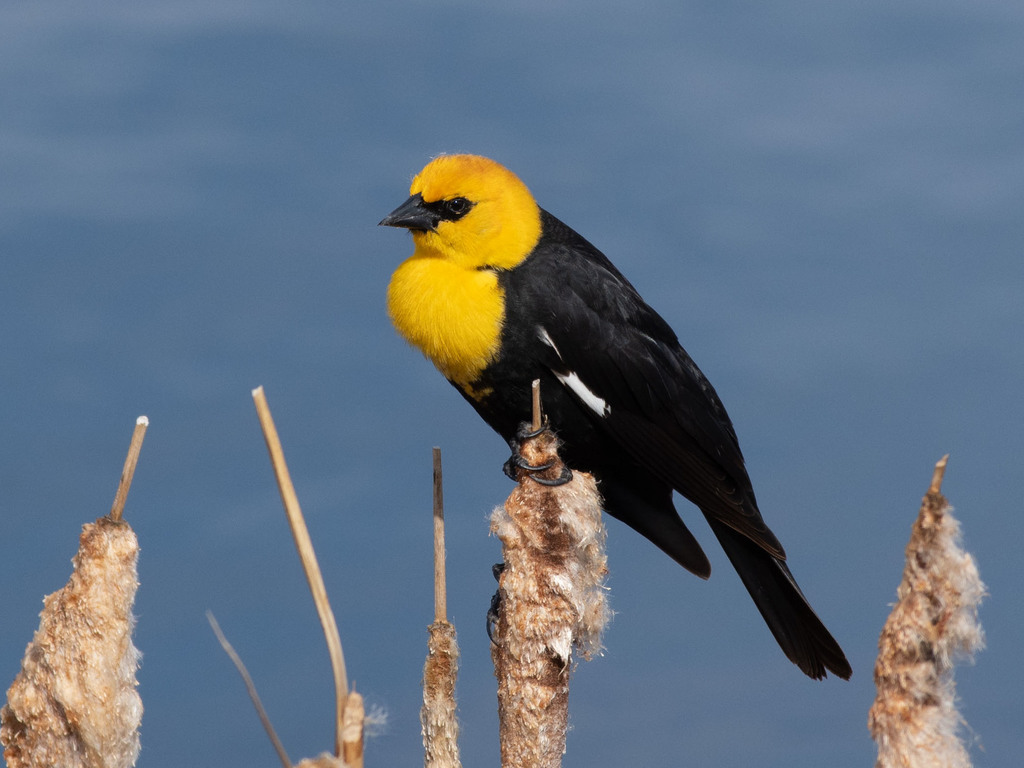
Yellow-headed Blackbird
Photo © Kathlin Simpkins
Photo © Kathlin Simpkins — CC0 1.0 — Source: iNaturalist photo #195455944Identification
The Yellow-headed Blackbird is a relatively large blackbird measuring 8.3–10.2 inches (21–26 cm) in length, with a wingspan of 16.5–17.3 inches (42–44 cm). The most striking feature is the bright yellow head that gives this species its name. Adult males are predominantly black with a brilliant yellow head and breast, and display a white wing patch that is sometimes only visible in flight. Adult females are mainly brown with a dull yellow throat and breast. Immature birds of both sexes are brown with duller yellow plumage than adults; immature males also show some white patches on the wings. Both sexes have a pointed bill.
Range & Habitat
Yellow-headed Blackbirds breed in marshes across North America, primarily west of the Great Lakes. They migrate in winter to the southwestern United States and Mexico, often traveling in huge mixed flocks. The only regions where they are permanent residents year-round are the San Joaquin Valley and the Lower Colorado River Valley of Arizona and California. These birds favor marshes with cattails, bulrush, and common reeds, where they nest in colonies over open water, frequently sharing habitat with Red-winged Blackbirds.
Behaviour & Diet
During breeding season, males are highly territorial, spending much of their time perched on reed stalks displaying and defending their territory. Notably, males and females migrate separately, with males arriving at breeding marshes 2–3 weeks before females in spring. Research indicates that females select breeding sites based on the reproductive success of previous years. These birds feed primarily on seeds throughout most of the year, switching to insects during summer months. They forage in marshes, fields, and on the ground, sometimes catching insects in flight. Females feed newly-hatched young predominantly with dragonflies and damselflies. Outside the breeding season, they often feed in flocks, frequently with related species.
Best Time & Places to See It
Spring and early summer offer the best viewing opportunities at breeding marshes in the western United States and Canada. Migration periods—particularly spring—provide excellent chances to observe these birds, especially in large mixed flocks. Focus your search on freshwater marshes dominated by cattails, bulrush, and reeds, particularly in the Great Plains and intermountain regions. Males' territorial displays and perching behavior on reed stalks make them relatively easy to locate during breeding season.
Photography Tips
The male's bright yellow head and black body provide excellent contrast for photography. Photograph males perched on reed stalks during territorial displays in early morning light when they are most active. The white wing patches are a key identifying feature but may only be visible when the bird is in flight, so be prepared to capture both perched and airborne shots. For behavioral photography, focus on males defending territory or females tending to nests. The dense marsh habitat can be challenging; position yourself with the sun behind you to illuminate the birds' plumage clearly. Late spring and early summer provide the most vigorous territorial activity and the best light conditions.
Acadia National Park
Alaska Maritime National Wildlife Refuge
Alligator River National Wildlife Refuge
Arches National Park
Badlands National Park
Banff National Park
Bear River Migratory Bird Refuge
Big Bend National Park
Biscayne National Park
Nothing matches these filters.
No community photos yet. Log in to add the first one.
No community observations of this species yet.