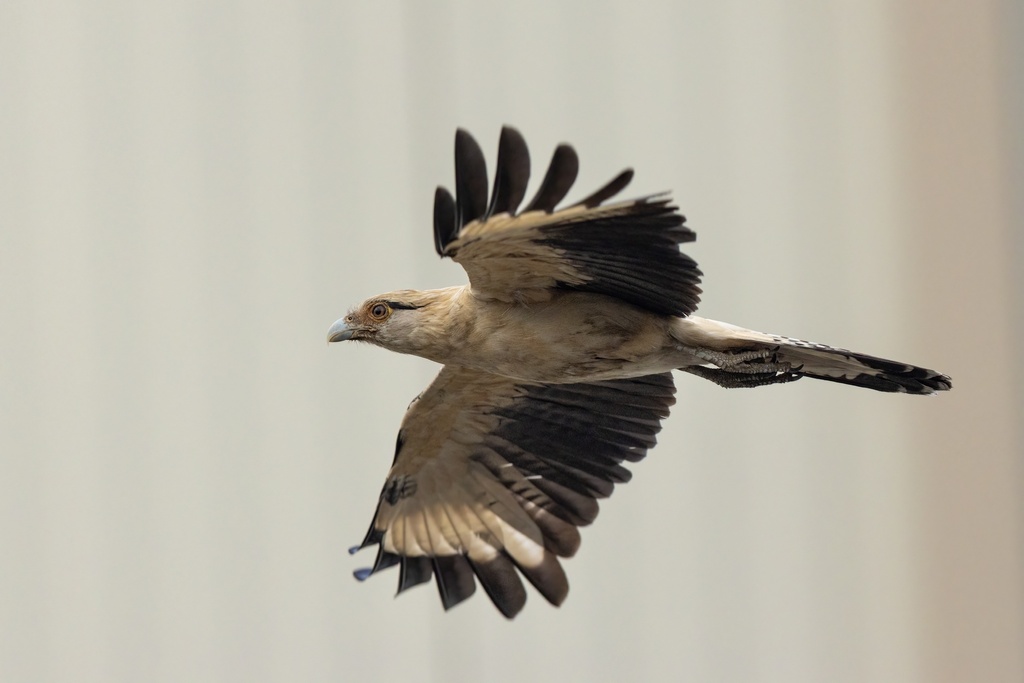
Yellow-headed Caracara
Identification
The yellow-headed caracara is a compact bird of prey, measuring 40 to 45 cm in length with a wingspan of 74 to 95 cm. Males weigh 277 to 335 g while females are slightly heavier at 307 to 364 g. The most distinctive feature is the bird's buff to creamy yellowish-white head, neck, and underparts, offset by a thin dark streak through the eyes. The back and wings are blackish brown, with a characteristic whitish patch at the base of the primaries that becomes visible in flight. The tail is buff with dusky bars and a black band near the tip. The bird's striking facial features include a reddish-brown iris surrounded by bare bright yellow skin, combined with distinctive pea-green legs and feet. Immature birds appear browner overall with streaked underparts, making them slightly less eye-catching than adults. The two subspecies show subtle differences: the nominate form is lighter on the head and underparts, while D. c. cordatus is darker buff with narrower tail bars.
Range & Habitat
The yellow-headed caracara is found throughout much of Central and South America, from Nicaragua to Uruguay. The species occurs in two subspecies with slightly different ranges: D. c. cordatus inhabits the region from southwestern Nicaragua and Costa Rica through most of Panama and across northern South America to Brazil north of the Amazon River, while D. c. chimachima occupies eastern Bolivia, Paraguay, and Argentina southward through Brazil south of the Amazon. The bird favors lightly treed open landscapes such as savannas with palms and scattered trees, ranchlands, pastures, gallery forests, and forest edges. It typically ranges from sea level to 1,000 meters in elevation, though records exist of birds at approximately 2,500 meters in Colombia's Cauca River valley.
Behaviour & Diet
The yellow-headed caracara is omnivorous and heavily reliant on scavenging, with a remarkably diverse diet that includes carrion, insects, crabs, fish, reptiles, amphibians, small mammals, bird eggs and nestlings, and various plant materials including oil palm, coconut, and maize fruits. Notably, the species takes ticks from cattle and other large mammals such as capybaras and tapirs, and has been observed foraging for small invertebrates in the fur of brown-throated three-toed sloths. While much of its feeding occurs on the ground, the bird also hunts on the wing. Interestingly, mixed-species feeding flocks do not regard it as a threat and do not make alarm calls during encounters.
Generally sedentary within its range, the yellow-headed caracara does occasionally wander, with records from northern Central America and islands off South America's north coast suggesting some individuals are more mobile. The bird's nesting season varies geographically, spanning December to April in Costa Rica and January to April (with a possible second season from July to September) in Colombia. It typically builds stick nests up to 15 meters high in trees or palms, though it has also nested in tree cavities, on ground mounds in marshy areas, and even in buckets and cans on house walls. Clutch size ranges from one to four eggs, with incubation lasting about 22 days and fledging occurring 17 to 20 days after hatching. Young remain dependent on parents for approximately three additional weeks.
Best Time & Places to See It
The yellow-headed caracara is most vocal and active during breeding season, making this the best time to locate birds by sound. Breeding periods vary by region: December to April in Costa Rica, January to April (and possibly July to September) in Colombia, and August in Venezuela. The species colonizes cleared areas within its range, making it easier to find in agricultural landscapes, ranchlands, and open savannas with scattered trees rather than dense forest. Northern South America, particularly regions north of the Amazon River, holds the most accessible populations for most travelers, while birds south of the Amazon are found in eastern Bolivia, Paraguay, and northern Argentina.
Photography Tips
The yellow-headed caracara's striking yellow head and facial markings make it visually distinctive and rewarding to photograph. The bird's habit of foraging on the ground provides excellent opportunities for close-range photography without the need for extreme telephoto lenses. The whitish patch on the wings is particularly striking in flight, so try to capture the bird in flight silhouettes against open sky. Early morning is typically best for both finding and photographing birds during breeding season when they are more vocal and active. The pea-green legs and bare yellow facial skin provide excellent detail shots when the bird is perched. Look for subjects walking through pastures, ranchlands, and savanna edges where they are most exposed and accessible to photographers.
Tijuca National Park
Brazil
+127 birds+30 mammals
Where Atlantic rainforest clings to steep granite slopes mere kilometres from Rio de Janeiro’s urban sprawl, one of Brazil’s most […]
VIEW NATIONAL PARKEmas National Park
Brazil
+128 birds+29 mammals
Vast grasslands ripple across the central Brazilian plateau, where fire has sculpted the landscape for millennia. Parque Nacional das Emas […]
VIEW NATIONAL PARKSerra do Cipó National Park
Brazil
+137 birds+24 mammals
Where granite peaks claw through the Brazilian cerrado and Atlantic Forest transition zones, crystalline streams cascade down escarpments carved over […]
VIEW NATIONAL PARKCorcovado National Park
Puerto Jiménez, Costa Rica
+132 birds+30 mammals
Rain hammers the canopy as moisture-laden clouds collide with the Osa Peninsula’s mountainous spine, birthing one of the planet’s most […]
VIEW NATIONAL PARKManuel Antonio National Park
Quepos, Costa Rica
+125 birds+30 mammals
White sand beaches curve between steep jungle walls where the Pacific laps against Costa Rica’s most biodiverse coastal sanctuary. Rainforest […]
VIEW NATIONAL PARKChirripó National Park
Rivas, Costa Rica
+132 birds+30 mammals
Where the Central American spine rises above the clouds, granite peaks puncture a realm of perpetual mist and montane forest. […]
VIEW NATIONAL PARKBraulio Carrillo National Park
Las Horquetas, Costa Rica
+132 birds+30 mammals
Steep volcanic slopes plunge into misty valleys where primary tropical rainforest cloaks the landscape in unrelenting green. Rising from 2,000 […]
VIEW NATIONAL PARKPiedras Blancas National Park
Golfito, Costa Rica
+132 birds+30 mammals
Where misty lowland rainforest plunges toward the Pacific through a labyrinth of river valleys, one of Costa Rica’s most pristine […]
VIEW NATIONAL PARKSanta Rosa National Park
Santa Elena, Costa Rica
+129 birds+30 mammals
Dawn breaks over a mosaic of dry forest and humid woodland where Costa Rica’s northwestern peninsula juts into the Pacific. […]
VIEW NATIONAL PARKYasuní National Park
Aguarico, Ecuador
+132 birds+30 mammals
Where the Napo and Curaray rivers carve through Ecuador’s vast Amazonian lowlands, one of Earth’s most biodiverse terrestrial ecosystems sprawls […]
VIEW NATIONAL PARKNatural Sierra de Chiribiquete National Park
Solano, Colombia
+130 birds+23 mammals
Where tabletop mountains rise abruptly from the Colombian Amazon, a landscape of almost alien majesty unfolds across nearly 87,000 square […]
VIEW NATIONAL PARKNatural Utría National Park
Alto Baudó (Pie de Pató), Colombia
+144 birds+15 mammals
Where the Chocó rainforest plunges headlong into the Pacific, a pristine coastal wilderness unfolds across 1,287 square kilometers of Colombia’s […]
VIEW NATIONAL PARKNatural Serranía de los Churumbelos National Park
Santa Rosa, Colombia
+145 birds+15 mammals
Where the Andes’ western cordillera surrenders to the Pacific watershed, a fortress of granite peaks and cloud-draped valleys rises across […]
VIEW NATIONAL PARKNatural Chingaza National Park
Junín, Colombia
150+ birds
Where the Andes rise steeply above the Bogotá plateau, cloud forests cling to slopes that oscillate between mist-shrouded valleys and […]
VIEW NATIONAL PARKNatural el Cocuy National Park
Güicán, Colombia
+139 birds+13 mammals
Where snow-capped peaks pierce the Colombian highlands at over 5,000 metres, a landscape of stark geological drama unfolds across nearly […]
VIEW NATIONAL PARKMorrocoy National Park
Municipio Silva
+91 birds+4 mammals
Where crystalline Caribbean waters meet Venezuela’s northern coast, a mosaic of coral reefs, white-sand beaches, and mangrove forests creates one […]
VIEW NATIONAL PARKPuracé National Natural Park
Puracé, Colombia
150+ birds+5 mammals
Where the Andes rear up in southwestern Colombia, volcanic peaks pierce clouds at over 4,700 metres, their flanks cloaked in […]
VIEW NATIONAL PARKNatural Uramba Bahía Málaga National Park
Buenaventura, Colombia
+75 birds+4 mammals
Where misty lowland rainforest plunges into the Pacific’s embrace, a 990-square-kilometre sanctuary guards one of Colombia’s most biodiverse coastal ecosystems. […]
VIEW NATIONAL PARKNatural Sumapaz National Park
Cubarral, Colombia
150+ birds+12 mammals
Where páramo grasslands rise and mists cling to crystalline peaks, one of South America’s most biodiverse mountain reserves unfolds across […]
VIEW NATIONAL PARKEl Tamá National Park
Toledo, Colombia
+37 birds+2 mammals
Where the Andes plunge steeply into Venezuela’s borderlands, a vast montane wilderness unfolds across nearly 3,800 square kilometers of pristine […]
VIEW NATIONAL PARKAmacayacu National Park
Leticia, Colombia
+133 birds+29 mammals
Where the Amazon’s dark waters merge with flooded forest and terra firme upland, five thousand square kilometres of pristine wilderness […]
VIEW NATIONAL PARKNatural Nevado del Huila National Park
Planadas, Colombia
+32 birds+2 mammals
Where glacier-fed torrents carve through Andean wilderness, Colombia’s high-altitude treasure spans 3,023 square kilometers of vertical drama. The snow-capped summit […]
VIEW NATIONAL PARKItatiaia National Park
Brazil
+141 birds+19 mammals
Where granite peaks thrust through Atlantic Forest mist, Brazil’s oldest national park commands the border between Rio de Janeiro and […]
VIEW NATIONAL PARKSuperagui National Park
Brazil
+43 birds+1 mammals
Where the Atlantic rainforest meets the subtropical coast of southern Brazil, a labyrinth of islands, mangrove channels, and pristine beaches […]
VIEW NATIONAL PARKSerra da Bocaina National Park
Brazil
+132 birds+30 mammals
Where Atlantic rainforest meets coastal escarpment, a landscape of dramatic elevation transforms within mere kilometers from sea level to peaks […]
VIEW NATIONAL PARKViruá National Park
Brazil
+103 birds+14 mammals
Where granite inselbergs rise dramatically from the Amazon’s northern fringe, a 3,651-square-kilometre wilderness unfolds across Roraima State. This Category II […]
VIEW NATIONAL PARKIguaçu National Park
Brazil
+133 birds+29 mammals
Where the Paraná Plateau drops away in a thunderous cascade, one of Earth’s most spectacular waterfall systems tears through subtropical […]
VIEW NATIONAL PARKSão Joaquim National Park
Brazil
+50 birds+18 mammals
Where granite peaks rise abruptly from the Atlantic Forest’s verdant embrace, a mosaic of ecosystems unfolds across nearly 1,000 square […]
VIEW NATIONAL PARKSerra dos Órgãos National Park
Brazil
+130 birds+30 mammals
Dramatic peaks of Precambrian granite thrust skyward from the Atlantic Forest floor, their weathered faces etched by millennia of wind […]
VIEW NATIONAL PARKChapada dos Veadeiros National Park
Brazil
+143 birds+19 mammals
Where granite plateaus rise abruptly from central Brazil’s cerrado savanna, ancient quartzite formations create a landscape of breathtaking geological drama. […]
VIEW NATIONAL PARKLençóis Maranhenses National Park
Brazil
+60 birds+3 mammals
Across 3,670 square kilometres of northeastern Brazil, an improbable landscape unfolds: a vast mosaic of freshwater lagoons, palm-studded dunes, and […]
VIEW NATIONAL PARKSerra do Gandarela National Park
Brazil
150+ birds+9 mammals
Where granite peaks thrust upward through Atlantic Forest mist, the landscape reveals itself in dramatic relief—a montane wilderness sprawling across […]
VIEW NATIONAL PARKBrasília National Park
Plano Piloto, Brazil
+122 birds+30 mammals
Where granite escarpments rise above the cerrado grasslands of central Brazil, a vast sanctuary unfolds across 1,077 square kilometres of […]
VIEW NATIONAL PARKAraucárias National Park
Brazil
+54 birds+2 mammals
Where subtropical mountain forests rise above the Brazilian plateau, ancient Araucaria angustifolia trees tower like cathedral pillars through the mist. […]
VIEW NATIONAL PARKSerra Geral National Park
Brazil
+124 birds+14 mammals
Where granite escarpments rise abruptly from the Atlantic Forest canopy, a landscape of dramatic canyons and windswept plateaus defines one […]
VIEW NATIONAL PARKJaú National Park
Brazil
+31 birds+5 mammals
Where the Rio Negro and its tributaries carve through northwestern Brazil, one of the Amazon’s most pristine wilderness sanctuaries unfolds […]
VIEW NATIONAL PARKAnavilhanas National Park
Brazil
+132 birds+30 mammals
Where the Rio Negro braids into a labyrinth of islands and waterways, one of the Amazon’s most pristine archipelagos unfolds […]
VIEW NATIONAL PARKYaguas National Park
Yaguas, Peru
+14 birds+1 mammals
Where the Amazon’s northwestern reaches sprawl across Peru’s remote border country, a vast mosaic of flooded forests, blackwater rivers, and […]
VIEW NATIONAL PARKCoiba National Park
Montijo, Panama
+104 birds+7 mammals
Where the Pacific swallows a crown of emerald islands and pristine jungle canopy, one of Central America’s most biodiverse sanctuaries […]
VIEW NATIONAL PARKSarigua National Park
Parita, Panama
+69 birds+3 mammals
Where the Pacific’s tidal rhythms sculpt Panama’s coastline, a mosaic of mangrove forests, deciduous woodlands, and seasonally flooded wetlands creates […]
VIEW NATIONAL PARKBaru Volcano National Park
Cerro Punta, Panama
+146 birds+16 mammals
Where mist clings to volcanic slopes and cloud forest canopy rises above 3,500 metres, Panama’s highest peak dominates a landscape […]
VIEW NATIONAL PARKSoberanía National Park
Cristóbal, Panama
+132 birds+30 mammals
Where the Chagres River cuts through lowland tropical forest mere kilometres from Panama City’s skyline, one of Central America’s most […]
VIEW NATIONAL PARKChagres National Park
Caimitillo, Panama
+131 birds+30 mammals
Where rainforest canopy meets mountain spine, the Chagres River carves through some of Central America’s most pristine tropical wilderness. Spanning […]
VIEW NATIONAL PARKDarién National Park
Tucutí, Panama
+132 birds+30 mammals
Where rainforest swallows the horizon and rivers carve through primordial wilderness, one of Central America’s last great untamed frontiers unfolds […]
VIEW NATIONAL PARKPortobelo National Park
Portobelo, Panama
+115 birds+16 mammals
Where Caribbean waters dissolve into rainforest, a protected realm of pristine coastal wilderness unfolds across 570 square kilometers of northern […]
VIEW NATIONAL PARKMarino Golfo de Chiriquí National Park
Boca Chica, Panama
+94 birds+8 mammals
Where mangrove-fringed islands emerge from turquoise shallows and volcanic peaks anchor the horizon, Panama’s Gulf of Chiriquí reveals one of […]
VIEW NATIONAL PARKEl Palmar National Park
Distrito Sexto, Argentina
+132 birds+21 mammals
Where the Paraná River winds through northern Argentina, vast groves of yatay palms rise from rolling grassland like a botanical […]
VIEW NATIONAL PARKRío Pilcomayo National Park
Argentina
150+ birds+10 mammals
Where wetlands sprawl across the Argentine Chaco, the Pilcomayo River carves a vital ribbon of life through one of South […]
VIEW NATIONAL PARKParque Provincial Pampa del Indio
Laguna Limpia, Argentina
+60 birds+2 mammals
Where the Paraná Plateau descends into humid subtropical lowlands, 240 square kilometers of pristine Argentine wilderness unfold across rolling terrain […]
VIEW NATURE RESERVEChaco National Park
Municipio de Presidencia de la Plaza, Argentina
+142 birds+20 mammals
Where the Gran Chaco’s thornforests meet wetland mosaics, a landscape of profound ecological contrast unfolds across northwestern Argentina. This 151-square-kilometre […]
VIEW NATIONAL PARKNo community photos yet. Log in to add the first one.
No community observations of this species yet.