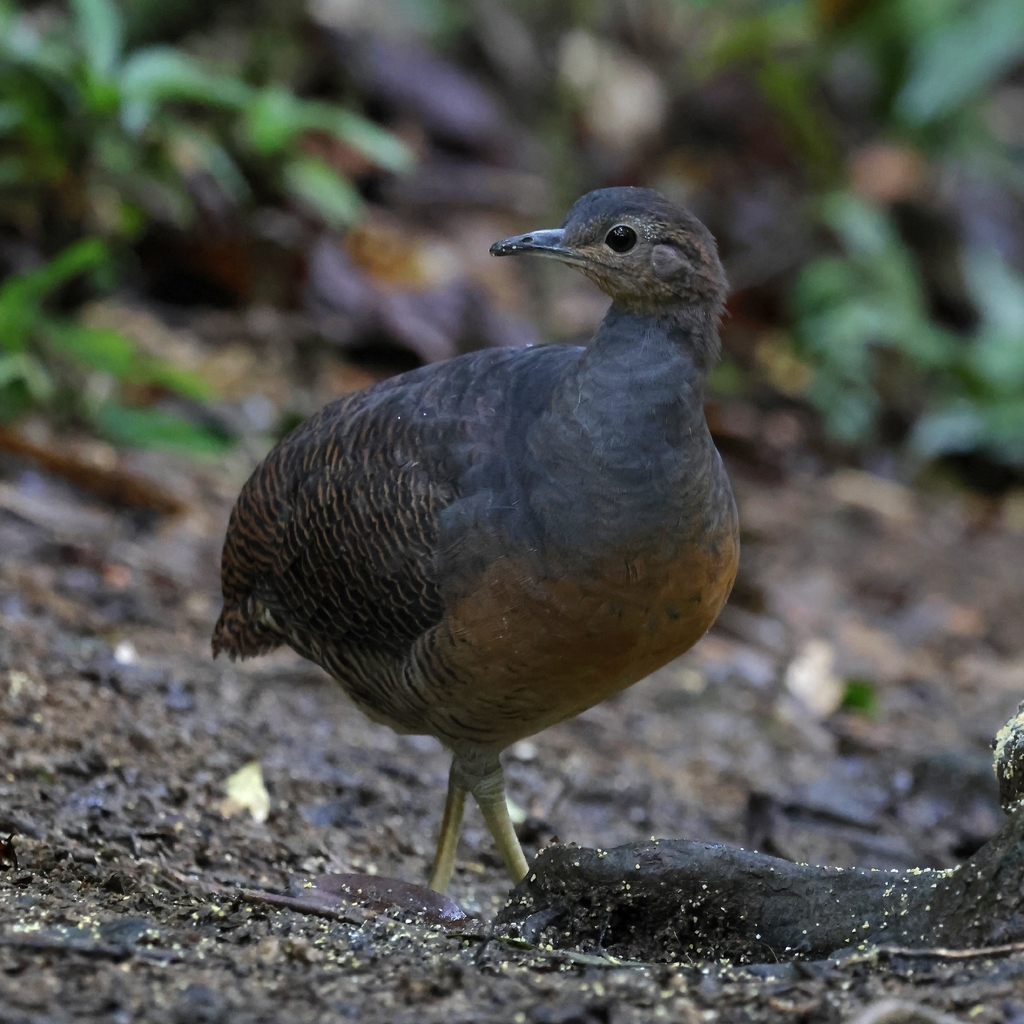
Yellow-legged Tinamou
Photo © Miguel
Photo © Miguel — CC BY-SA 4.0 — Source: iNaturalist #361869168Identification
The yellow-legged tinamou is a small, quail-like bird measuring approximately 28 to 31 cm in length. It displays subtle but distinctive plumage: grey upperparts with black barring on the lower back and wings, a greyish neck and upper breast transitioning to rufous on the lower breast, and a whitish belly. The species sports a blackish cap and a buffy supercilium (eyebrow stripe), giving it a characterful expression typical of tinamous.
Two subspecies are easily separated by trained observers. The nominate race (C. n. noctivagus) of southeastern Brazil shows more rufescent tones and duller yellow legs. The northeastern race (C. n. zabele) is noticeably paler overall, with a whiter throat, brighter yellow legs, and a more prominent supercilium—useful field marks when the bird is glimpsed in its preferred habitats.
Range & Habitat
The yellow-legged tinamou is endemic to eastern Brazil, with two geographically distinct populations. The nominate race inhabits southeastern Brazil from Minas Gerais (Doce River area) through Bahia, Espírito Santo, Rio de Janeiro, São Paulo, Paraná, Santa Catarina, and Rio Grande do Sul. The subspecies zabele occupies the northeast, from northern Minas Gerais and Bahia extending to Paraíba and Piauí.
This species favours humid forest habitats, though the northeastern race (zabele) adapts to drier wooded environments including savanna-woodland and Caatinga scrubland. The bird occurs at elevations of 700 m or less. Sadly, it has been extirpated from parts of its former range, including Rio de Janeiro state.
Behaviour & Diet
Like other tinamous, the yellow-legged tinamou is primarily a ground forager, pecking for fruit fallen from trees or accessible on low-lying bushes. Its diet is supplemented with small invertebrates, flower buds, tender leaves, seeds, and roots—a varied diet reflecting its role as a generalist feeder in woodland ecosystems.
The species exhibits the remarkable breeding system characteristic of tinamous: males are solely responsible for incubating and raising chicks, which may originate from as many as four different females. Nests are simple scrapes on the ground, concealed in dense brush or between raised root buttresses. Chicks fledge and become independent after 2–3 weeks, at which point the male's parental duties end.
Best Time & Places to See It
The yellow-legged tinamou's elusive nature and preference for dense, brushy understory make it challenging to locate, even within its range. The species is most reliably encountered in protected humid forest reserves and wooded habitats across southeastern and northeastern Brazil. Early morning visits to quiet forest edges and scrubby areas may increase your chances of observation, though patience is essential.
Since the species has disappeared from some historical localities, consult recent birding records and local guides before planning a specific trip. The broad occurrence range of 2,230,000 km² suggests populations persist across much of eastern Brazil, though habitat destruction and hunting pressure continue to erode numbers.
Photography Tips
Photographing the yellow-legged tinamou presents considerable challenges due to its cryptic behaviour and preference for dense cover. Success requires patience, early morning visits when birds are most vocal and active, and familiarity with its preferred habitats of wooded and shrubby terrain. A telephoto lens (at least 300–400 mm) is essential, as the bird typically allows only distant approach before retreating into brush.
The subtle plumage differences between subspecies—particularly the brightness of the yellow legs, throat coloration, and supercilium prominence—make this species rewarding for photographers able to document both races. Soft, diffused light during overcast mornings will best reveal the fine details of the bird's grey and rufous tones.
Superagui National Park
Brazil
+246 birds+2 mammals
Where the Atlantic rainforest meets the subtropical coast of Paraná, Superagui National Park sprawls across more than 1,000 square kilometres of one of Brazil's most biodiverse…
VIEW NATIONAL PARKSaint-Hilaire/Lange National Park
Brazil
+225 birds
Subtropical Atlantic forests rise and fall across the plateaus of inland Paraná, where Saint-Hilaire/Lange National Park protects nearly 578 square kilometres of Brazil's most biodiverse woodland…
VIEW NATIONAL PARKSerra da Capivara National Park
Brazil
+156 birds+6 mammals
Across the semi-arid plateaus and deeply incised canyons of northeastern Brazil, where Piauí's ancient sandstone formations rise and fall in weathered waves, Serra da Capivara National…
VIEW NATIONAL PARKChapada Diamantina National Park
Brazil
+346 birds+5 mammals
Where granite peaks and sandstone cliffs rise abruptly from the Brazilian interior, Chapada Diamantina National Park sprawls across 4,215 square kilometers of some of Brazil's most…
VIEW NATIONAL PARKNo community photos yet. Log in to add the first one.
No community observations of this species yet.