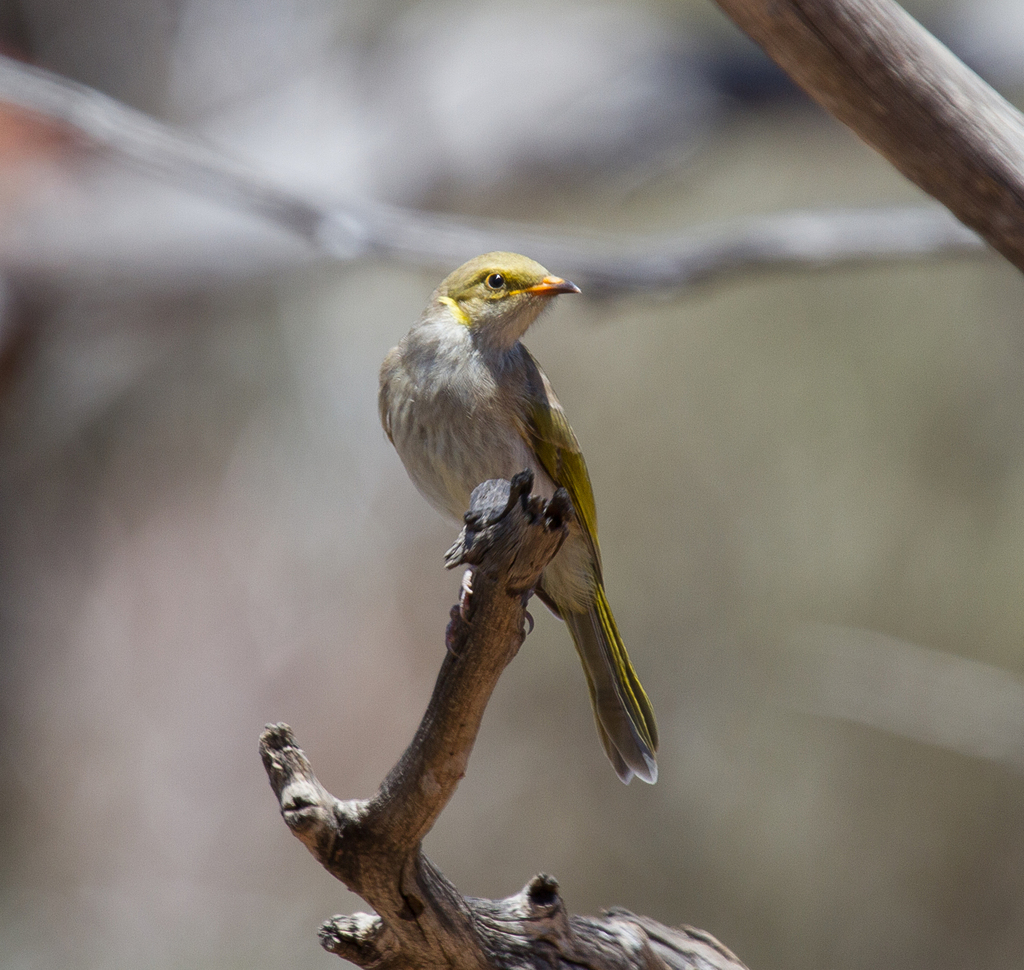
Yellow-plumed Honeyeater
Photo © Kym Nicolson
Photo © Kym Nicolson — CC BY 4.0 — Source: iNaturalist #290348249Identification
The yellow-plumed honeyeater is a medium-sized honeyeater distinguished by its most striking feature: a distinctive, upswept yellow neck plume. Other key identifying marks include a relatively long, down-curved black bill, a dark face, and an olive-green head. The bird's upperparts are grey-green, while the underparts are heavily streaked grey-brown. A faint yellow line runs beneath the dark eye, adding subtle character to its appearance. Young birds are somewhat easier to spot, displaying a yellow bill base and eye-ring that make them stand out from adults.
Several similar species share overlapping ranges, including the purple-gaped honeyeater, grey-fronted honeyeater, and fuscous honeyeater, so careful observation of the upswept yellow plume and facial pattern is essential for confident identification.
Range & Habitat
The yellow-plumed honeyeater is endemic to southern mainland Australia, occurring from western New South Wales and Victoria, through South Australia to south-west Western Australia. This distribution spans diverse landscapes across the continent's temperate regions.
The species primarily inhabits mallee, though it occupies a broader range of habitats in the western portions of its range, including dry eucalypt woodland and eucalypt open-forest. Beyond these core habitats, yellow-plumed honeyeaters occasionally venture into Acacia and Callitris woodland, and seasonally exploit flowering red ironbark forests, as well as grey box and yellow box woodlands. They favour temperate forests and Mediterranean-type shrubby vegetation.
Behaviour & Diet
Yellow-plumed honeyeaters are highly social and noisy birds, occurring in sedentary, colonial groups that may relocate when conditions become harsh. They are conspicuous and vocal, performing a loud, clear three-note song—rendered as "chier wit chier"—often delivered before dawn and during males' display flights. The birds jointly defend nesting and feeding territories through striking communal wing quivering displays.
These honeyeaters are mainly insectivorous, foraging actively in the outer and upper foliage, branches, and trunks of eucalypts, and capturing insects on the wing by hawking. They also opportunistically feed on nectar from various mallee eucalypts, yellow gum, grey box, red ironbark, and box mistletoe. Both parents feed young in open, cup-shaped nests, sometimes aided by helper birds. Nests are crafted from wool, green grass, and spider webs, lined with wool, grasses, plant-down, and brightly-coloured feathers, and suspended from mallee eucalypts and other small shrubs.
Best Time & Places to See It
Yellow-plumed honeyeaters can be found year-round within their range, though seasonal movements to flowering woodlands may influence local availability. The birds' noisy, conspicuous nature makes them relatively straightforward to locate once you're in suitable habitat. Their vocal activity peaks before dawn, making early mornings an excellent time to search for them.
Several protected areas support populations of this species across its range, including Pulletop Nature Reserve in New South Wales; Gluepot Reserve in South Australia; and Greater Bendigo National Park, Inglewood Nature Conservation Reserve, and Wychitella Nature Conservation Reserve in Victoria.
Photography Tips
The upswept yellow neck plume is the defining feature to capture, so position yourself to backlight or side-light this striking adornment when possible. The bird's active foraging behaviour in foliage and its hawking flights offer dynamic photo opportunities, though patience and tracking skills will serve you well. Early morning sessions will reward you with better light and increased vocal activity, making birds more active and easier to locate.
These gregarious birds often occur in small groups, creating opportunities for dynamic compositional choices beyond simple portraits. Focus on capturing the distinctive head pattern and the characteristic upswept plume that separates this species from similar honeyeaters in the region.
Greater Bendigo National Park
Whipstick, Australia
+202 birds+8 mammals
Across the red volcanic plains of inland Victoria, Greater Bendigo National Park sprawls across more than 1,000 square kilometres of eucalyptus woodland, open grassland, and scattered…
VIEW NATIONAL PARKIkara-Flinders Ranges National Park
Australia
+149 birds+10 mammals
Where ancient quartzite ridges rise across the semi-arid heart of South Australia, Ikara-Flinders Ranges National Park unfolds across nearly two thousand square kilometres of one of…
VIEW NATIONAL PARKLittle Desert National Park
Australia
+200 birds+11 mammals
Across northwestern Victoria's semi-arid interior, sandstone ridges and heathland plateaus rise from red earth in a landscape sculpted by fire and drought rather than water. Little…
VIEW NATIONAL PARKBelair National Park
Adelaide, Australia
+126 birds+18 mammals
Eucalyptus woodland and native shrubland cloak the low hills of this Adelaide park, where ancient quartzite ridges rise above the plains of South Australia's densest metropolitan…
VIEW NATIONAL PARKLincoln National Park
Australia
+149 birds+5 mammals
Across the mid-north of South Australia, where the landscape transitions from coastal lowlands toward semi-arid interior plains, sprawls a wilderness of 2,671 square kilometres where red-earth…
VIEW NATIONAL PARKVulkathunha-Gammon Ranges National Park
Australia
+97 birds+8 mammals
Granite ridges and quartzite peaks rise abruptly from the red earth of South Australia's mid-north, their steep slopes carved into gorges where seasonal waterfalls cascade through…
VIEW NATIONAL PARKInnes National Park
Barcelona, Australia
+141 birds+10 mammals
Granite ridges and weathered stone outcrops rise across South Australia's Fleurieu Peninsula, defining a landscape where ancient rock formations meet open eucalypt woodland and heathland scrub.…
VIEW NATIONAL PARKFitzgerald River National Park
Fitzgerald River National Park, Australia
+209 birds+11 mammals
Where granite peaks rise above windswept heathlands and pristine river systems carve through untamed wilderness, one of Australia's most biodiverse landscapes unfolds across the southwestern corner…
VIEW NATIONAL PARKMungo National Park
Australia
+135 birds+7 mammals
Across the semi-arid inland plains of New South Wales, where sparse shrubland and scattered grassland stretch beneath enormous skies, lies a landscape shaped by ancient geological…
VIEW NATIONAL PARKGrampians National Park
Australia
+214 birds+18 mammals
Where sandstone ridges rise above the Western District of Victoria, Grampians National Park unfolds across rolling terrain sculpted by ancient geology and sustained by a temperate…
VIEW NATIONAL PARKMurray-Sunset National Park
Australia
+205 birds+2 mammals
Across the semi-arid borderlands of northwestern Victoria, where the Murray River defines the state's edge, sprawls a landscape of remarkable resilience and subtle beauty. Murray-Sunset National…
VIEW NATIONAL PARKCoorong National Park
Australia
+217 birds+15 mammals
Where the Murray River meets the Southern Ocean, a chain of shallow lagoons stretches across the South Australian coast, separated from the sea by a ribbon…
VIEW NATIONAL PARKStirling Range National Park
Australia
+149 birds+7 mammals
Where ancient quartzite ranges rise abruptly from the southwestern Australian plateau, Stirling Range National Park unfolds as a realm of dramatic escarpments, deep valleys, and surprising…
VIEW NATIONAL PARKNo community photos yet. Log in to add the first one.
No community observations of this species yet.