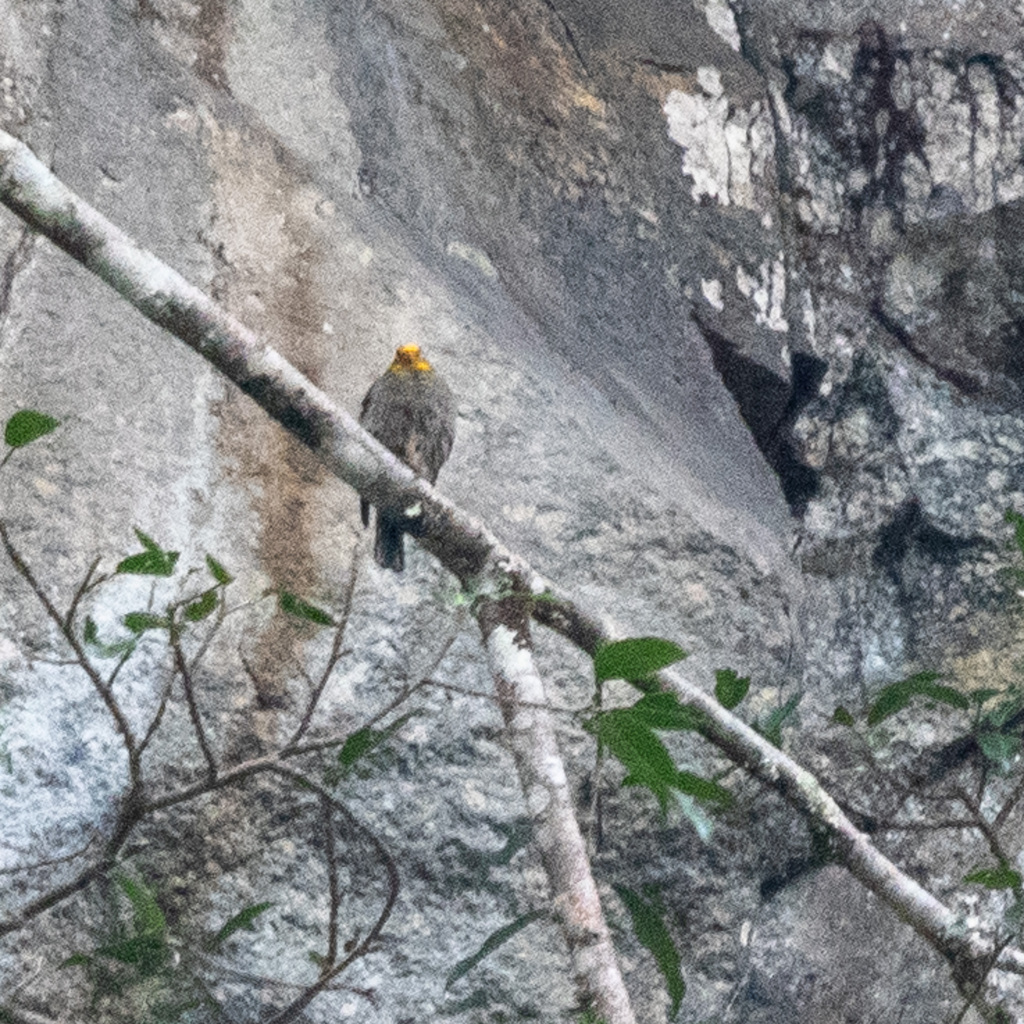
Yellow-rumped Honeyguide
Photo © Stefan C
Photo © Stefan C — CC0 1.0 — Source: iNaturalist #332670223Identification
The yellow-rumped honeyguide is a sparrow-sized bird with a distinctive finch-like appearance, featuring a stout yellow bill darkening toward the tip. Males are more boldly marked than females, with an orange forehead and lores, dusky olive plumage overall, and a striking deep orange rump that grades into sulphur yellow and extends up the back. The wing feathers show a streaked appearance, while the chin and throat are yellowish and the lower plumage pale grey with dark streaking. Females lack the extensive yellow facial markings and have a yellow rump without the orange coloration. The bird has a long, pointed wing, twelve tail feathers, and nine primaries, with characteristically strong, zygodactyl feet—two toes facing forward and two backward.
Range & Habitat
The yellow-rumped honeyguide is found primarily in montane forests along the Himalayas and adjacent regions. Its range extends from northern Pakistan (Hazara and Murree Hills, though this population may now be extirpated) through the Himalayan regions of India, including western Uttar Pradesh, Himachal Pradesh, and eastward into Nepal, Sikkim, Arunachal Pradesh, and Bhutan—where it is relatively common. The species also occurs in southeastern Tibet and northern Myanmar. It inhabits coniferous and dry-deciduous forests characterized by rocky boulders and cliff faces, and may undertake seasonal altitudinal movements.
Behaviour & Diet
The yellow-rumped honeyguide specializes in feeding on beeswax, particularly the foundation wax of Apis laboriosa honeybees that attach combs to rock faces. Remarkably, the bird clings tightly to honeycombs and presses its tail against the surface while feeding, managing to do so without disturbing the bees significantly. The species has even been observed exploiting attacks by Vespa mandarinia wasps on bee colonies to its advantage. Males are territorial and remain near honeycomb sites, while females and juveniles forage more widely. A male's display involves fluffing feathers, holding the bill high, and swaying side to side while flicking wings.
The yellow-rumped honeyguide employs a distinctive "resource-based, non-harem polygyny" mating system, where males defend exclusive three-dimensional territories around bee nests on cliff faces. Males allow only their mates and offspring to forage on defended nests, excluding other males and non-mate females. The species produces a chipping call in flight and when agitated, and flies in a straight or sometimes undulating manner, often in flocks of 20 to 30 birds. Unlike other honeyguide species, this bird has not been observed to lead humans or bears to bee hives. It is a brood parasite, laying eggs in the nests of tree-hole breeders, possibly barbets, though specific host species remain undocumented.
Best Time & Places to See It
Bhutan offers the most reliable opportunity to encounter this species, where it is relatively common in suitable montane habitat. Within India, the Himalayan regions—particularly Himachal Pradesh, Arunachal Pradesh, and Sikkim—provide good chances for sightings. The bird may be found year-round, though seasonal altitudinal movements suggest that different elevations may be optimal at different times of year. Look for birds in coniferous and dry-deciduous forests with rocky outcrops and cliff faces where Apis laboriosa colonies are established.
Photography Tips
Patience and careful positioning near active honeycomb sites on cliff faces offer the best opportunities for photography. Males are more visible than females due to their bolder plumage, and territorial birds near established bee nests are more likely to remain in one area. The bird's preference for clinging to vertical honeycomb surfaces means you should be prepared to photograph subjects against unusual angles. The striking orange-and-yellow rump is most visible when the bird is perched on or against honeycomb; frame shots to capture this diagnostic field mark. Early morning activity around bee nests may offer the most frequent sightings and active behavior for documentation.
Langtang National Park
Helambu, Nepal
+364 birds+14 mammals
Where the southern slopes of the Himalayan highlands descend toward the subtropical valleys of central Nepal, Langtang National Park sprawls across one of the subcontinent's most…
VIEW NATIONAL PARKKhangchendzonga National Park
Sakkyong, India
+290 birds+1 mammals
Where the eastern Himalayas surge toward their crowning peaks, Khangchendzonga National Park embraces a landscape of almost overwhelming vertical drama. Rising from subtropical river valleys into…
VIEW NATIONAL PARKNanda Devi National Park
Garpak, India
+218 birds+5 mammals
Where the Himalayas surge into their most dramatic alpine amphitheater, a wilderness of raw geological power unfolds across 624 square kilometers of pristine terrain. Nanda Devi,…
VIEW NATIONAL PARKValley of Flowers National Park
Ghangaria, India
+117 birds+1 mammals
Where alpine meadows explode with color each monsoon season, the Himalayan slopes of Uttarakhand rise to create one of Earth's most extraordinary floral displays. Perched between…
VIEW NATIONAL PARKGaoligong Mountain National Nature Reserve
Nujiang Lisu Autonomous Prefecture, China
+443 birds+13 mammals
VIEW NATURE RESERVENo community photos yet. Log in to add the first one.
No community observations of this species yet.