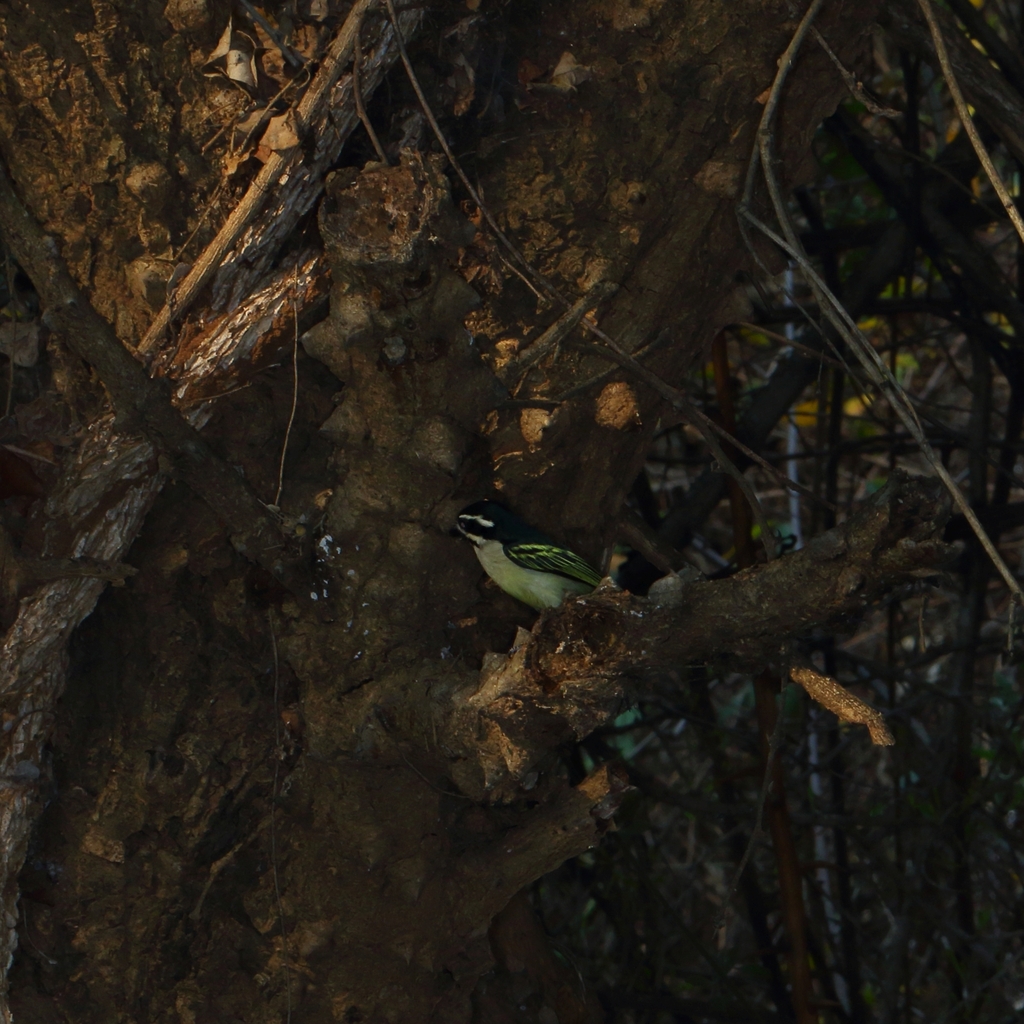
Yellow-rumped Tinkerbird
Photo © Alan Manson
Photo © Alan Manson — CC BY 4.0 — Source: iNaturalist #248896257Identification
The yellow-rumped tinkerbird is a small member of the African barbet family, distinguished by its characteristic yellow rump that gives the species its common name. The bird's plumage features distinctive bilineate (two-line) markings, which is reflected in its scientific name, bilineatus. Six subspecies are recognised across its range, showing minor plumage variations across different regions of sub-Saharan Africa.
Range & Habitat
This tinkerbird is native to the moist tropical and subtropical regions of sub-Saharan Africa, with an extensive range spanning from West Africa to South Africa. The species occurs across Angola, Benin, Burundi, Cameroon, Central African Republic, Republic of the Congo, Democratic Republic of the Congo, Ivory Coast, Equatorial Guinea, Eswatini, Gabon, Gambia, Ghana, Guinea, Guinea-Bissau, Kenya, Liberia, Malawi, Mozambique, Nigeria, Rwanda, Senegal, Sierra Leone, South Africa, South Sudan, Tanzania, Togo, Uganda, Zambia, and Zimbabwe. Different subspecies occupy distinct regions, including highland populations on Bioko Island and the highlands of East Africa, coastal populations along the Kenya-Tanzania coast, and lowland forest populations across central and West Africa.
Behaviour & Diet
As a member of the barbet family, the yellow-rumped tinkerbird shares the ecological role and feeding habits typical of this group. The species inhabits moist forests where it forages for food among the canopy and mid-storey vegetation. Its presence across such diverse habitats within tropical and subtropical regions indicates adaptability to various forest types within its preferred climatic zones.
Best Time & Places to See It
The yellow-rumped tinkerbird's wide distribution across sub-Saharan Africa offers numerous opportunities for observation. Birders and wildlife travellers visiting protected forests and woodland areas throughout its range—from West African countries like Ghana and Senegal to East African highlands in Kenya, Uganda, and Tanzania, through to southern African reserves—may encounter this species. The bird's presence in both lowland and highland forests suggests year-round residency in many parts of its range, though visiting during the local wet season when insect abundance peaks may improve sighting chances.
Photography Tips
The small size of the yellow-rumped tinkerbird requires patience and careful stalking through forest habitats. The bird's preference for moist tropical forests means photographers should prepare for challenging lighting conditions beneath dense canopy. The distinctive yellow rump provides an excellent identifying feature to focus on when composing shots. Early morning hours, when bird activity peaks, offer the best opportunities for photography. A telephoto lens will be essential for capturing detail of this small barbet without disturbing its natural behaviour in forest settings.
Bwindi Impenetrable National Park
Lake Mburo National Park
Mabamba Swamp
Murchison Falls National Park
Queen Elizabeth National Park
Aberdare National Park
Chyulu Hills National Park
Hell’s Gate National Park
Ithala Game Reserve
Nothing matches these filters.
No community photos yet. Log in to add the first one.
No community observations of this species yet.