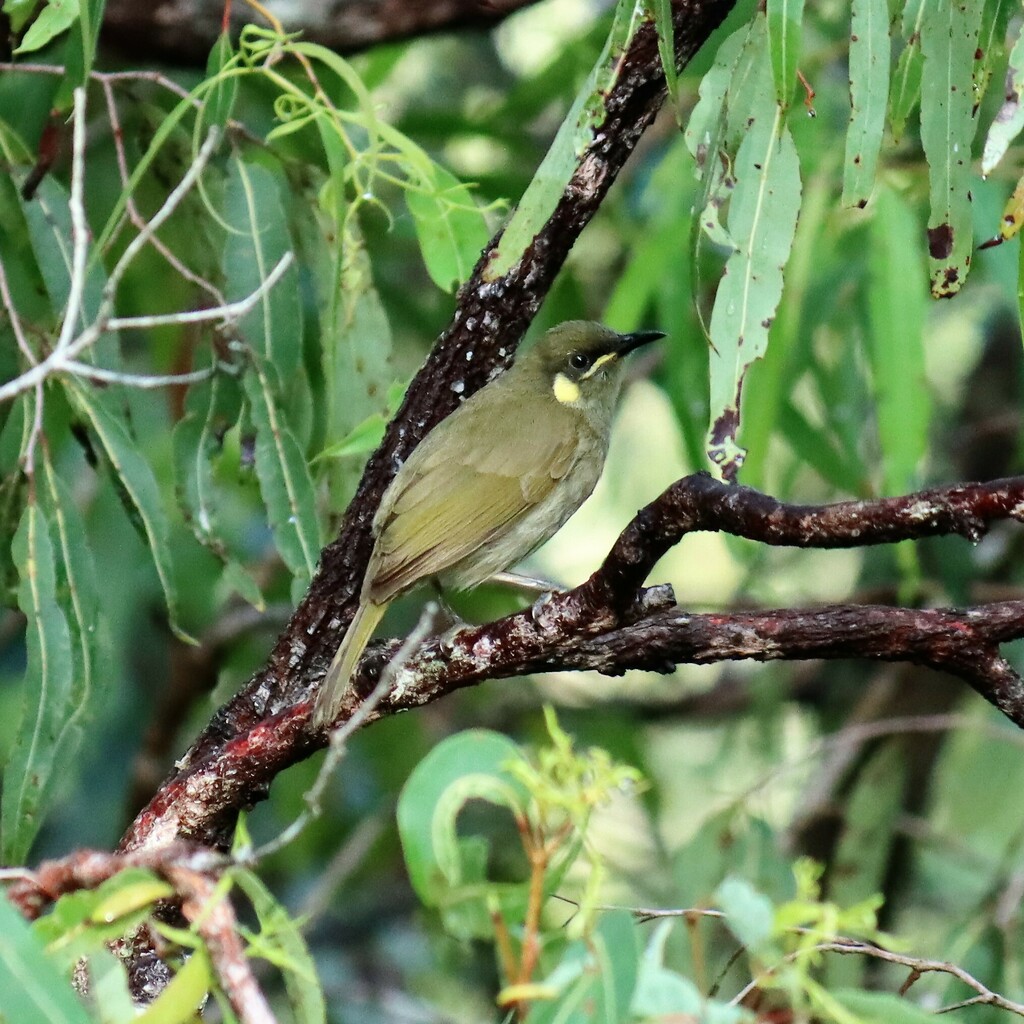
Yellow-spotted Honeyeater
Photo © Jane C Frost
Photo © Jane C Frost — CC BY 4.0 — Source: iNaturalist #124470029Identification
The yellow-spotted honeyeater is a small passerine measuring 16 to 20 centimetres in length, with a wingspan of 8 to 9 centimetres. The species weighs between 23 and 30 grams, with males slightly heavier than females on average. Its plumage is predominantly olive-brown on the upperparts and olive-gray below, but the bird's most distinctive feature is the bright yellow patch behind each eye, which gives the species its common name. The legs, feet, eyes, and beak are all brown. Two subspecies are recognised: Meliphaga notata notata and Meliphaga notata mixta, which differ slightly in size measurements.
Range & Habitat
The yellow-spotted honeyeater is endemic to northern Queensland, ranging between Mackay and northern Cape York Peninsula in extreme northeastern Australia. The species inhabits tropical rainforests, typically at elevations of 200 metres or greater, though it has been recorded as high as 1,200 metres above sea level. While forests remain its primary habitat, the bird is adaptable and has been observed in suburban areas with sufficient tree cover and even in cities that use local plants for landscaping. It occupies both open forests and forests with dense shrub understories, and co-exists with the graceful honeyeater in its range. The species' range exceeds 110,000 square kilometres, and its population is apparently stable.
Behaviour & Diet
The yellow-spotted honeyeater is a loud and aggressive bird with a distinctive metallic, high-pitched call consisting of four to five repetitions of 'ee-yeu' sounds, often described as resembling a "machine gun rattle." It is primarily solitary or found in small groups of two to several birds, and does not migrate. The bird feeds on a varied diet of insects, nectar, and fruit. When perching, it adopts a characteristically horizontal body posture. Breeding occurs between August and January; the species constructs small, cup-shaped nests of interwoven bark and plant material secured in bushes or trees. Eggs are typically laid two at a time and have a glossy white surface with purple or brown markings at the top. Chicks hatch after approximately two weeks of incubation and fledge after a similar period.
Best Time & Places to See It
The yellow-spotted honeyeater is best sought in the rainforests of north Queensland between Mackay and Cape York Peninsula. The breeding season from August to January offers good opportunities to locate birds through their loud, distinctive calls. Elevation of 200 to 500 metres provides the most reliable sightings, though the species can be found higher up. Suburban areas and parks with native tree plantings in northern Queensland towns may also reward patient observers.
Photography Tips
The small size and active nature of yellow-spotted honeyeaters demand a fast shutter speed and good autofocus capability. Focus on capturing the distinctive yellow eye-patches, which are the key identification feature. The bird's horizontal perching posture and preference for higher forest canopy mean a telephoto lens will be essential. Early morning when the bird is most vocal will help you locate individuals. The metallic call is a useful audio cue—listen carefully to track the bird's movements through the vegetation.
Herberton Range National Park
Australia
+115 birds+10 mammals
Rainforest-clad ridges and rocky outcrops define this 324-square-kilometre reserve in far north Queensland, where the mountainous terrain of the Herberton Range rises through layered eucalypt woodland…
VIEW NATIONAL PARKDaintree National Park
Dedin, Australia
+362 birds+37 mammals
Daintree National Park is one of the world’s oldest and most biologically diverse tropical rainforests, protecting an extraordinary landscape where ancient forests meet the Great Barrier…
VIEW NATIONAL PARKAnnan River (Yuku Baja-Muliku) National Park
Australia
+78 birds
Where the Annan River winds through northeastern Queensland's coastal hinterland, a compact national park of roughly 246 square kilometers protects a mosaic of subtropical rainforest, eucalypt…
VIEW NATIONAL PARKEndeavour River National Park
Philadelphia, Australia
+203 birds+1 mammals
Where the Endeavour River winds through northeastern Queensland's tropical lowlands, a compact mosaic of rainforest, open woodland, and riverine corridor creates one of Australia's most ecologically…
VIEW NATIONAL PARKRinyirru National Park
Lakefield, Australia
+258 birds+7 mammals
Where the savanna grasslands of far north Queensland meet seasonal wetlands and eucalypt woodlands, Rinyirru National Park sprawls across more than 12,500 square kilometres of rugged,…
VIEW NATIONAL PARKGirringun National Park
Australia
+231 birds+10 mammals
Where granite gorges cleave through subtropical woodland in North Queensland, Girringun National Park unfolds across rugged terrain shaped by millions of years of weathering and erosion.…
VIEW NATIONAL PARKWooroonooran National Park
Australia
+240 birds+28 mammals
Where the Great Dividing Range rises sharply inland from Queensland's tropical coast, Wooroonooran National Park encompasses a landscape of steep, forested gorges and cascading waterways carved…
VIEW NATIONAL PARKNo community photos yet. Log in to add the first one.
No community observations of this species yet.