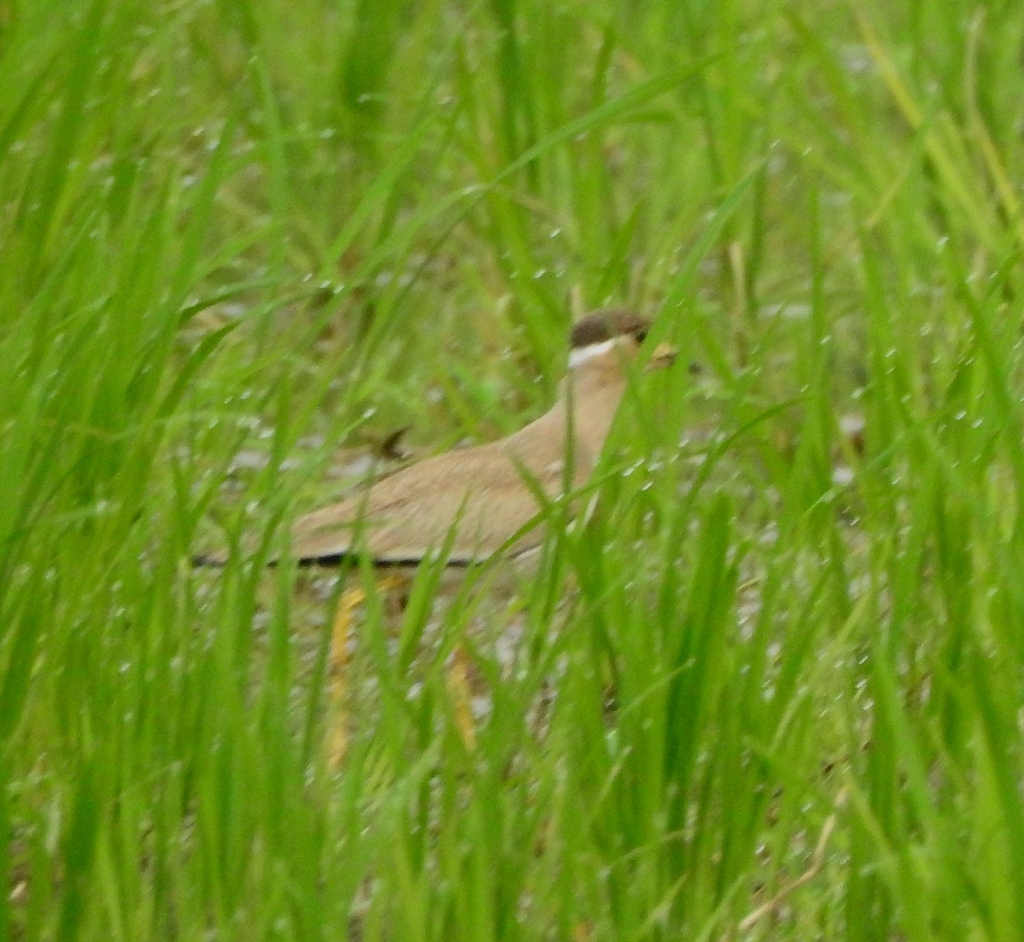
Yellow-wattled Lapwing
Photo © Afsar Nayakkan
Photo © Afsar Nayakkan — CC BY 4.0 — Source: iNaturalist #132246307Identification
The Yellow-wattled Lapwing is a conspicuous and unmistakable medium-sized wader with distinctive field marks that make identification straightforward. Look for a pale brown body contrasting with a black crown, which is separated from the brown neck by a narrow white band. The most striking feature is the large yellow facial wattles at the base of the bill. The chin and throat are black, while the belly is white, separated from the brown upper breast by a narrow blackish line. The bird also displays tiny yellow carpal spurs on the wings and a white wingbar on the inner half of the wing. In flight, note the tail's subterminal black band, which does not extend to the outer tail-feathers. Juveniles have a brown crown rather than black, though sexes are otherwise alike. These birds measure 260–280 mm in length and are known for their sharp tchee-it call.
Range & Habitat
The Yellow-wattled Lapwing is endemic to the Indian subcontinent, found across most of India, parts of Pakistan, Nepal, Bangladesh, and Sri Lanka. The species is common throughout much of this range and is typically seen in dry, open lowland habitats including stony plains, grasslands, and scrubland—preferring drier conditions than its close relative, the Red-wattled Lapwing. Although largely sedentary, these birds make seasonal movements in response to monsoon rains, with occasional visits recorded to Nepal's Kathmandu valley and rare vagrants reported as far as Malaysia.
Behaviour & Diet
Yellow-wattled Lapwings breed during the dry season, with peak breeding from March to May ahead of the monsoons. They are ground-nesting birds, laying four eggs in simple ground scrapes—occasionally in grass clumps—with clutches typically hatching simultaneously despite being laid over several days. Parents employ a remarkable cooling strategy, visiting water to soak their breast feathers and then returning to cool their eggs or chicks. Incubation lasts 27–30 days, and the precocial young leave the nest shortly after hatching to forage alongside their parents, crouching flat and freezing when parents sound alarm calls. Second broods may be raised, particularly after first-brood failures. Their diet consists of beetles, termites, and other invertebrates picked from the ground as they forage across open terrain.
Best Time & Places to See It
The Yellow-wattled Lapwing is common throughout its range in open, dry habitats across peninsular India and the broader Indian subcontinent. The dry season from March to May offers excellent viewing opportunities, particularly during peak breeding season when birds are most active and vocal. Look for them in stony plains, grasslands, and scrub habitats in lowland areas, particularly in drier regions where they are more likely to be found than in wetter habitats preferred by other lapwing species.
Photography Tips
Photograph these birds in open habitats where their distinctive plumage and yellow wattles stand out clearly against natural backgrounds. The black cap, white band on the neck, and bright yellow facial wattles provide excellent contrast for sharp images. During breeding season, patient photographers may capture parents performing their remarkable belly-soaking behaviour at water sources or tending to their camouflaged chicks in grassland settings. The birds' fast flight and sharp calls indicate when they are alert, providing opportunities to capture dynamic action shots.
Lunugamvehera National Park
Sri Lanka
+204 birds+14 mammals
Dry scrubland and shallow wetlands converge in Sri Lanka's southeastern lowlands, where Lunugamvehera National Park anchors one of the island's most ecologically vital landscapes. The park's…
VIEW NATIONAL PARKMinneriya National Park
Sri Lanka
+158 birds+9 mammals
Across the dry zone of Sri Lanka's North Central Province spreads a landscape of shallow tanks, grassland margins, and scattered dry forest—a mosaic of water and…
VIEW NATIONAL PARKWasgamuwa National Park
Sri Lanka
+156 birds+8 mammals
Dry deciduous forest and open grassland sweep across the North Central lowlands where Wasgamuwa National Park protects one of Sri Lanka's largest remaining tracts of this…
VIEW NATIONAL PARKAngamedilla National Park
Polonnaruwa, Sri Lanka
+40 birds+2 mammals
Ancient tanks and sal forests define this water-rich sanctuary in Sri Lanka's North Central heartland, where seasonal wetlands and dry deciduous woodland create a mosaic of…
VIEW NATIONAL PARKRanthambhore National Park
Sawai Madhopur, India
+294 birds+20 mammals
Granite ridges and ravines carved through the Aravalli Range frame this protected landscape in eastern Rajasthan, where deciduous forest mingles with open scrubland and seasonal water…
VIEW NATIONAL PARKKanha Tiger Reserve
Kanha Kisli F.V., India
+321 birds+23 mammals
Where sal forests give way to emerald meadows and crystalline streams carve through ancient valleys, one of India's finest wilderness reserves unfolds across the Maikal Range.…
VIEW NATIONAL PARKTadoba National Park
Palasgaon Singru, India
+270 birds+20 mammals
Where sal forests meet open grasslands and rocky outcrops rise from red laterite soil, central India's landscape unfolds in raw, untamed beauty. Ancient teak woodlands and…
VIEW NATIONAL PARKBandhavgarh National Park
Garhpuri, India
+285 birds+17 mammals
Where granite ridges rise dramatically above sal and bamboo forests, one of India's most pristine tiger reserves unfolds across the Vindhyan plateau. Ancient rock formations tower…
VIEW NATIONAL PARKPanna National Park
Badgadi Kalan, India
+271 birds+17 mammals
Where granite gorges slice through central India's Vindhyan plateau, a landscape of stark beauty unfolds across nearly six hundred square kilometers. The Ken River carves through…
VIEW NATIONAL PARKKeoladeo National Park
Shreenagar Rural, India
+326 birds+14 mammals
Where shallow wetlands shimmer beneath vast Rajasthani skies, one of Asia's finest bird sanctuaries pulses with extraordinary life. This former maharaja's hunting reserve, now spanning 29…
VIEW NATIONAL PARKBandipur National Park
Hirehalli, India
+302 birds+19 mammals
Where the Western Ghats descend into the Deccan plateau, ancient deciduous forests blanket a landscape carved by the Nugu River. Bandipur unfolds across 880 square kilometres…
VIEW NATIONAL PARKNagarahole Tiger Reserve
Nalkeri Forest, India
+323 birds+23 mammals
Where granite escarpments rise above dense deciduous forests and the Kabini River carves through pristine wilderness, one of India's most biodiverse landscapes unfolds across the Western…
VIEW NATIONAL PARKGir National Park
Asundrali, India
+258 birds+13 mammals
Dry deciduous forests cloak the rolling hills of western Gujarat where the Gir landscape rises as a final sanctuary for one of the world's rarest felids:…
VIEW NATIONAL PARKNo community photos yet. Log in to add the first one.
No community observations of this species yet.