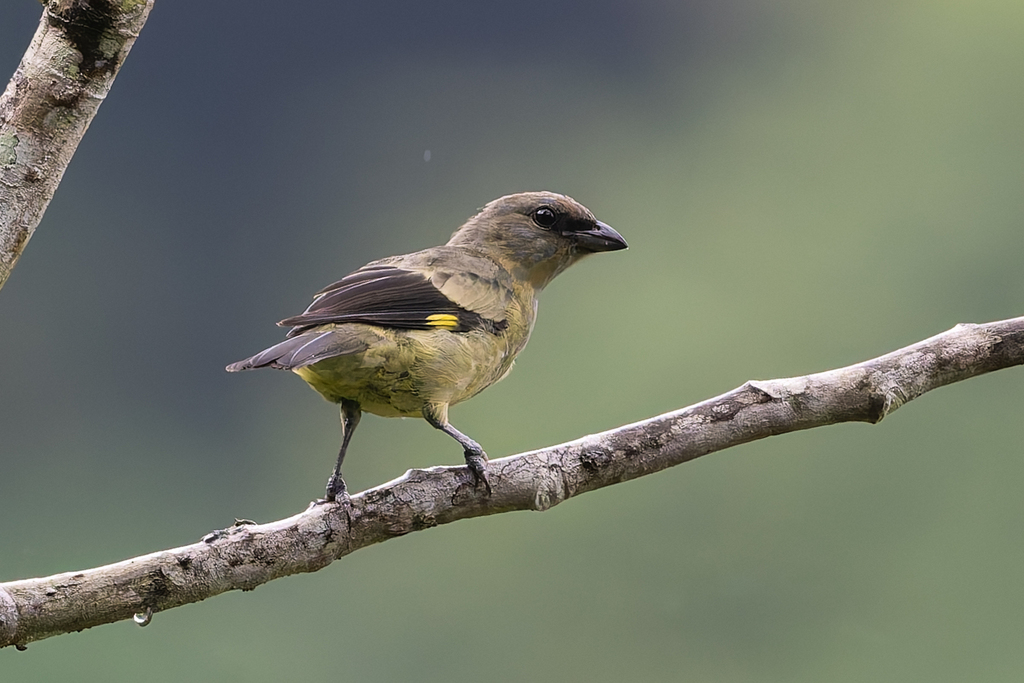
Yellow-winged Tanager
Photo © Adam Jackson
Photo © Adam Jackson — CC0 1.0 — Source: iNaturalist photo #441800332Identification
The yellow-winged tanager is a medium-sized tanager, approximately 18 centimetres long. It is readily identified by its striking yellow patches on the wings, which contrast sharply against an otherwise dark bluish-grey body and dusky green plumage. Adults display a distinctive pale lavender tone on the throat and breast. Juveniles lack these refined colours, instead showing an olive-green head and upper back, making them appear quite different from adults in the field.
Range & Habitat
This neotropical tanager inhabits the Gulf of Mexico and Caribbean coasts from Veracruz and extreme southern San Luis Potosí in Mexico, through the Yucatán Peninsula to Nicaragua. On the Pacific coast, its range extends from Chiapas, Mexico to Honduras. Since October 2010, it has also been recorded in Los Chiles, northern Costa Rica. The species favours open humid and mesic woodland habitats and is generally relatively common throughout its range.
Behaviour & Diet
Yellow-winged tanagers are highly gregarious birds, frequently forming flocks of 50 or more individuals. They are omnivorous feeders, consuming fruit, insects, and nectar. The species is vocal, producing high, sibilant calls that may be given either in flight or while perched, making them detectable by sound as well as sight.
Best Time & Places to See It
To observe yellow-winged tanagers, focus on open humid and mesic woodland habitats throughout their established range in Mexico, Central America, and now Costa Rica. Their gregarious nature and relatively common status make them reliable sightings in suitable habitat, particularly where fruiting trees and flowering vegetation attract feeding flocks.
Photography Tips
The yellow wing patches provide excellent photographic contrast and should be the focal point of your composition. Position yourself to capture both the lateral wing pattern and the lavender throat markings. Early morning light will enhance the subtle blue-grey tones of the plumage and make the yellow patches pop. Flocking behaviour offers opportunities for dynamic multi-bird compositions, though individual portraits showcasing the distinctive pale lavender breast are equally rewarding.
Arenal Volcano National Park
Barra del Colorado National Wildlife Refuge
Caño Negro National Wildlife Refuge
Laguna del Tigre National Park
Lagunas de Montebello National Park
Montes Azules
Ría Lagartos Biosphere Reserve
Sian Ka’an
Sierra del Lacandón National Park
Nothing matches these filters.
No community photos yet. Log in to add the first one.
No community observations of this species yet.