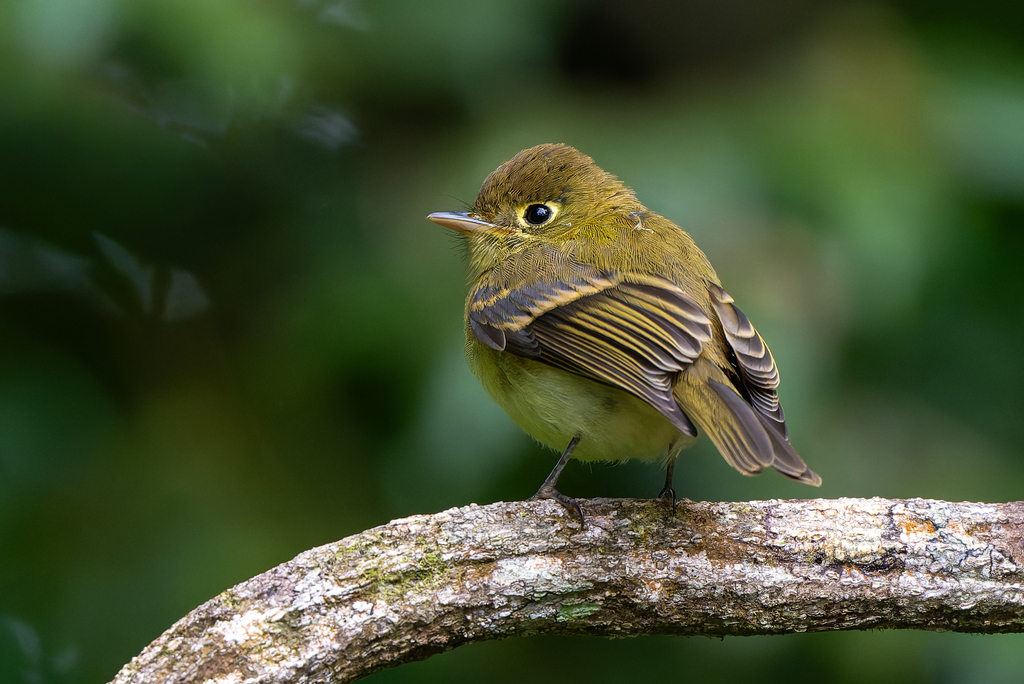
Yellowish Flycatcher
Photo © Adam Jackson
Photo © Adam Jackson — CC0 1.0 — Source: iNaturalist photo #560691743Identification
The Yellowish Flycatcher is a small passerine measuring 12.5 to 14 cm long, weighing just 9 to 16 grams. Adults display distinctive pale yellow almond-shaped eye-rings on yellowish-green faces, with olive-green crowns and upperparts. The tail is dusky to blackish with yellowish-green edges, while two prominent yellow wing bars are visible on grayish-brown wing coverts. The throat is yellowish-white, the breast deep yellow, and the underparts yellowish overall. All subspecies share a dark brown iris, black upper mandible, and pale pink to orange-yellow lower mandible. The Yellowish Flycatcher most closely resembles the Pine Flycatcher, but is brighter and greener; it also shares winter range with the Yellow-bellied Flycatcher, though the Yellowish ironically displays a yellower belly. Voice is the most reliable distinguishing feature from these similar species.
Range & Habitat
This species has a disjunct distribution across Mexico, Central America, and western Panama. The subspecies E. f. imperturbatus is restricted to Veracruz's Sierra de los Tuxtlas; E. f. salvini ranges from Chiapas through Guatemala, El Salvador, Honduras, and into northern Nicaragua; and the nominate E. f. flavescens occupies central Costa Rica and western Panama. The Yellowish Flycatcher inhabits highland subtropical and temperate zones, primarily in humid evergreen broadleaf forest rich with moss, lichen, and bromeliads, particularly cloudforest. It also frequents pine and pine-oak forests and adapts well to coffee and cacao plantations, scattered-tree pastures, and gardens. The species favors the forest understory and areas near running water, typically occurring between 800 and 2,500 meters elevation depending on location.
Behaviour & Diet
The Yellowish Flycatcher is essentially non-migratory, though minor elevational movements occur seasonally. It feeds primarily on arthropods, supplemented with small amounts of fruit. During breeding season, it typically forages in pairs; otherwise singly. Foraging occurs from the forest mid-story to canopy, though it regularly descends to the understory and ground. The bird captures prey through aerial hawking from exposed perches, gleaning from vegetation while perched, and picking from bare ground. Notably, it follows army ant swarms to capture fleeing prey, and occasionally joins mixed-species feeding flocks. After each sally, the bird typically lands on a different perch, quivering its wings and tail upon landing.
Best Time & Places to See It
The Yellowish Flycatcher breeds between January and August, with peak activity from mid-March to June, making these months optimal for observation. Visit highland cloudforests and humid montane forests in suitable elevation zones: Veracruz's Sierra de los Tuxtlas (900–1,660 m), Chiapas (1,200–2,400 m), Guatemala and Honduras (above 1,400 m), Nicaragua (800–1,800 m), Costa Rica (800–2,500 m), or Panama (1,050–2,225 m). Search the forest understory and mid-story, particularly near running water and in areas with dense moss and bromeliads. The species also inhabits well-vegetated coffee plantations and gardens within its highland range.
Photography Tips
Patient positioning near running water and shaded forest understory will reward photographers with opportunities to capture this species. The Yellowish Flycatcher's habit of returning to different perches after each sally provides repeated chances for photographs. Look for the distinctive yellow eye-ring, wing bars, and deep yellow breast in bright shade or dappled sunlight. The bird's small size (weighing less than half an ounce) and preference for dense vegetation demand fast shutter speeds and careful framing. Early morning foraging activity in breeding season offers the best light and activity levels. The species' characteristic wing- and tail-quivering upon landing provides a recognizable behavioral marker for identification in images.
Arenal Volcano National Park
Baru Volcano National Park
Braulio Carrillo National Park
Chirripó National Park
Guanacaste National Park
La Amistad International Park
Lagunas de Montebello National Park
Los Quetzales National Park
Parque Internacional la Amistad
Nothing matches these filters.
No community photos yet. Log in to add the first one.
No community observations of this species yet.