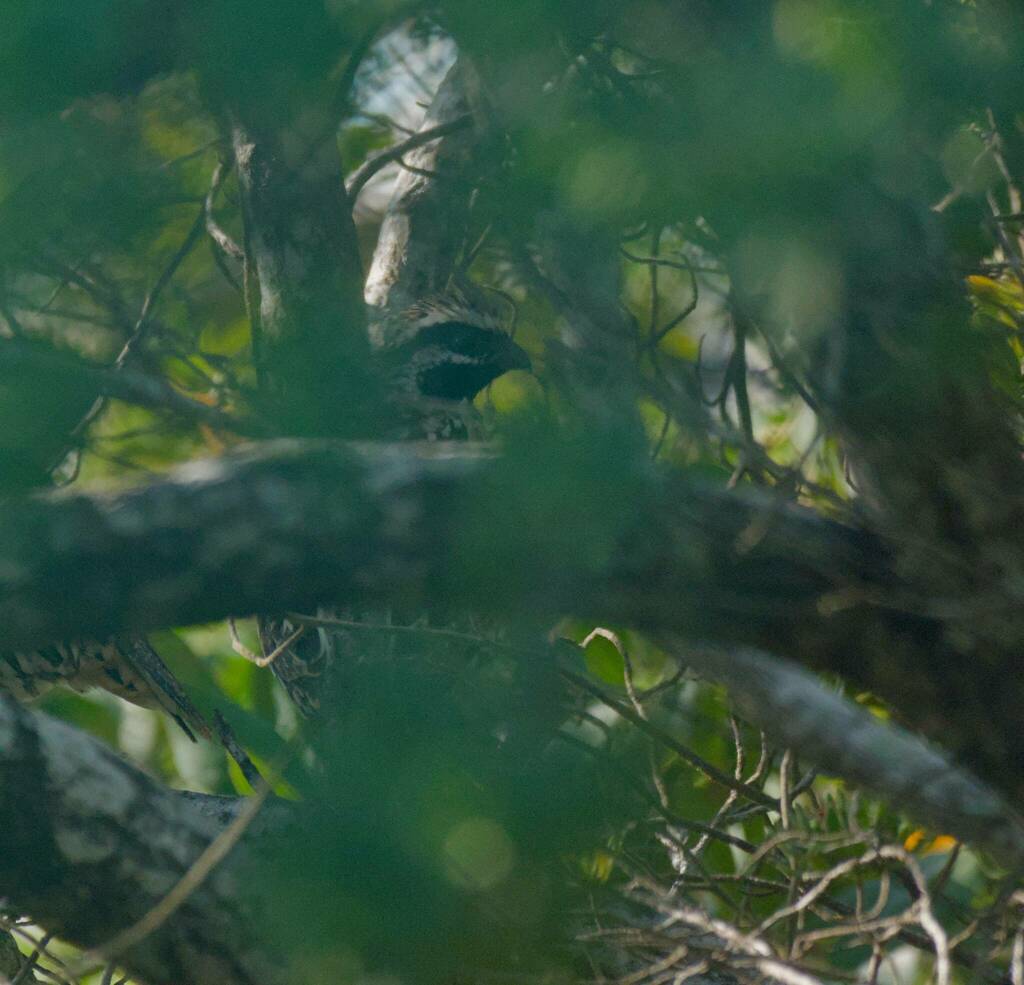
Yucatan Bobwhite
Photo © Blake Ross
Photo © Blake Ross — CC BY 4.0 — Source: iNaturalist #203052012Identification
The Yucatan bobwhite is a compact, ground-dwelling quail measuring about 20 centimetres in length. Sexual dimorphism is pronounced in this species, making identification of males and females straightforward. Males are distinctive, featuring a striking black throat edged with white, a white forehead, black eyestripe, and black crown. The upper neck, mantle, and flanks display reddish-brown plumage liberally speckled with white, while the remaining upper parts are brownish with barring of reddish-brown and grey. The underparts have a characteristic scalloped appearance, with white feathers edged in black, and the lower belly and under-tail coverts are cinnamon-coloured.
Females are similarly patterned but notably different in key areas: the hind neck and mantle are black with paler speckling rather than reddish-brown, the throat is buff rather than black, and the breast and belly are white barred with reddish-brown and black. These differences make it possible to distinguish males from females in the field, valuable information for photographers and birders seeking to document breeding behaviour or population composition.
Range & Habitat
The Yucatan bobwhite is found throughout Central America, with its range extending from the Yucatan Peninsula southwards through Belize, Guatemala, Honduras, Mexico, and Nicaragua. This wide distribution reflects the species' adaptability to diverse lowland habitats across the region. The bird occupies an impressive variety of environments, including subtropical and tropical dry shrubland, seasonally wet or flooded lowland grassland, and coastal mangroves. The Petenes mangroves of the Yucatan represent a notable example of the species' occurrence.
Within these broader habitat types, Yucatan bobwhites favour clearings in forests, pine savannah, rough grassland, weedy fields, and plantations of henequen—the agave plant traditionally harvested for fibre. This habitat flexibility allows the species to persist in both relatively undisturbed natural areas and heavily degraded former forest, demonstrating considerable ecological tolerance.
Behaviour & Diet
As members of the New World quail family (Odontophoridae) within the order Galliformes, Yucatan bobwhites are ground-dwelling birds adapted to life in open and semi-open habitats. While detailed behavioural and dietary information is limited in available sources, their habitat preferences suggest they forage on the ground in grasslands and scrub, as is typical for bobwhail species. Their presence in agricultural areas such as henequen plantations indicates they may supplement their natural diet with cultivated plants.
Best Time & Places to See It
The Yucatan bobwhite has an extensive range and is relatively common throughout its distribution, making it a reliable species for visiting birders and wildlife enthusiasts. The bird's stable population status and "least concern" conservation rating by the International Union for Conservation of Nature suggest consistent presence and accessibility. The Petenes mangroves of the Yucatan, along with pine savannah, rough grasslands, and forest clearings across the Yucatan Peninsula and Central America offer the best opportunities for encounters.
Photography Tips
Photographers should focus on the striking plumage differences between males and females to capture compelling images. Males, with their distinctive black-and-white throat markings and contrasting crown, present bold photographic subjects, while females offer more subtle patterns in buff and barred plumage. Ground-level photography will be necessary given the species' terrestrial habits, and early morning visits to grasslands and clearings will likely yield the best opportunities for locating and photographing these compact quails in their natural habitat.
Dzibilchantún National Park
Barcelona, Mexico
+144 birds+2 mammals
Across the limestone plains of Yucatán, where cenotes pierce the bedrock and tropical forest clings to shallow soils, lies Dzibilchantún—a modest yet ecologically vital national park…
VIEW NATIONAL PARKSian Ka’an
Chunyaxché, Mexico
+350 birds+16 mammals
Where the Yucatán Peninsula dissolves into wetland and mangrove, a vast mosaic of forest, lagoon, and coastal margin creates one of Mexico's most biodiverse strongholds. Across…
VIEW BIOSPHERE RESERVETikal National Park
Tikal, Guatemala
+399 birds+16 mammals
Dense rainforest canopy rises above the limestone plateau of Petén, where archaeological wonder and ecological richness merge seamlessly across one of Central America's most biodiverse landscapes.…
VIEW NATIONAL PARKSierra del Lacandón National Park
Petén, Guatemala
+348 birds+7 mammals
Where the Petén rainforest rises into limestone ridges and deep ravines, Sierra del Lacandón National Park protects one of Central America's most intact tropical wilderness zones.…
VIEW NATIONAL PARKNo community photos yet. Log in to add the first one.
No community observations of this species yet.