Yucatan Jay
Photo © Adam Jackson
Photo © Adam Jackson — CC0 1.0 — Source: iNaturalist photo #339619349Identification
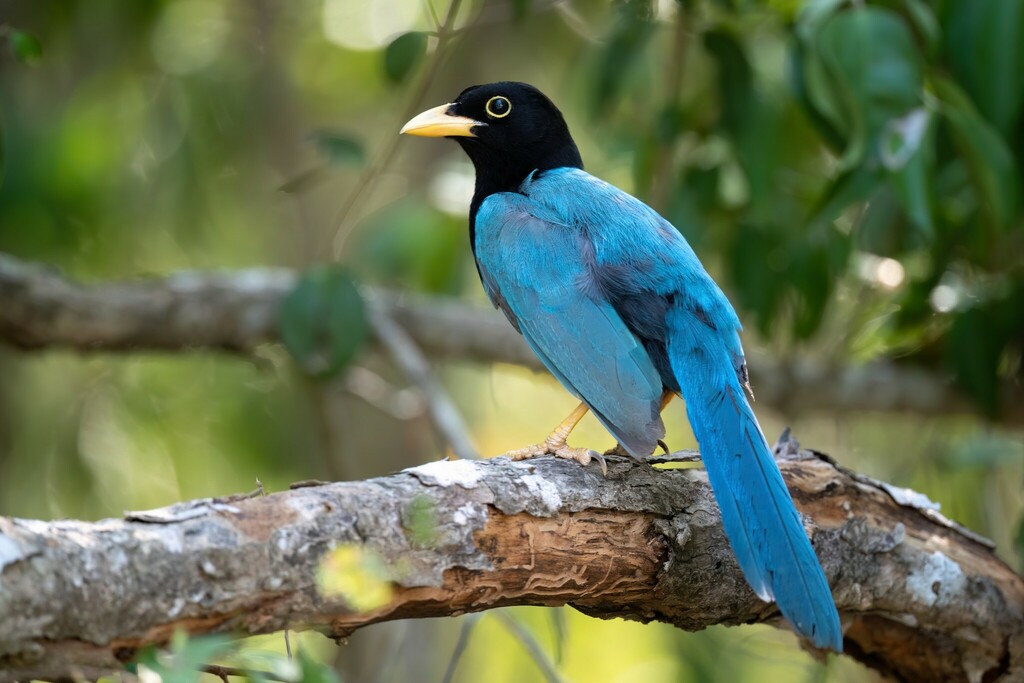
The Yucatan Jay is a striking medium-sized jay, averaging 31–33 cm (12–13 in) in length. Adults are unmistakable: black head, nape, and underparts contrasting sharply with brilliant blue back, wings, and tail. The bird has distinctive yellow eye rings and yellow legs and feet, with a black bill and black irises. There is no visible difference between males and females.
Immature birds look quite different, with white heads and bodies, soft blue backs, and soft grey wings and tails. Their beaks, legs, and feet are yellow-tinged pink. The dramatic transformation to adult plumage occurs over approximately four years, with progressive darkening of the head and body, deepening of blue tones in the wings and tail, and gradual blackening of the bill and eye rings. Within its range, the Yucatan Jay is visually unique—no similar species share its habitat.
Range & Habitat
This jay is endemic to the Yucatán Peninsula region, found across northern Belize, Guatemala's El Petén Department, and the Mexican states of Yucatán, Quintana Roo, Campeche, Tabasco, and Chiapas. The species occupies subtropical and tropical dry forests, plantations, and cleared areas up to 250 m (820 ft) in elevation.
Habitat preferences vary slightly between the two recognized subspecies. The nominate race (C. y. yucatanicus) favors both humid and scrubby forests as well as coastal scrub, while the larger subspecies C. y. rivularis, found in southwestern portions of the peninsula, adapts to virtually any forest type, including pine forests and swamps, though it remains less common in these latter habitats.
Behaviour & Diet
The Yucatan Jay is a common and widespread species throughout its range, indicating successful adaptation to its environment. However, specific details about its foraging behavior, social structure, and dietary preferences are not extensively documented in available field guides.
Best Time & Places to See It
As a common species with a wide range across the Yucatán Peninsula, the Yucatan Jay should be regularly encountered in appropriate habitat throughout the year. Look for it in subtropical and tropical dry forests, as well as in plantations and cleared areas within its range across Mexico, Guatemala, and Belize.
Photography Tips
The Yucatan Jay's striking black-and-blue plumage offers excellent photographic potential, particularly in bright tropical light that highlights the iridescent blue of the wings, back, and tail. The distinctive yellow eye rings and legs provide strong color contrast. Immature birds, with their pale plumage, present a completely different photographic challenge and opportunity for documentation of this species' remarkable transformation to adult plumage over four years.
Dzibilchantún National Park
Barcelona, Mexico
+144 birds+2 mammals
Across the limestone plains of Yucatán, where cenotes pierce the bedrock and tropical forest clings to shallow soils, lies Dzibilchantún—a modest yet ecologically vital national park…
VIEW NATIONAL PARKSian Ka’an
Chunyaxché, Mexico
+350 birds+16 mammals
Where the Yucatán Peninsula dissolves into wetland and mangrove, a vast mosaic of forest, lagoon, and coastal margin creates one of Mexico's most biodiverse strongholds. Across…
VIEW BIOSPHERE RESERVETikal National Park
Tikal, Guatemala
+399 birds+16 mammals
Dense rainforest canopy rises above the limestone plateau of Petén, where archaeological wonder and ecological richness merge seamlessly across one of Central America's most biodiverse landscapes.…
VIEW NATIONAL PARKLaguna del Tigre National Park
Petén, Guatemala
+399 birds+29 mammals
Where the Petén lowlands dissolve into wetland and forest, Laguna del Tigre National Park protects one of Guatemala's most ecologically vital landscapes. This sprawling reserve encompasses…
VIEW NATIONAL PARKNo community photos yet. Log in to add the first one.
No community observations of this species yet.