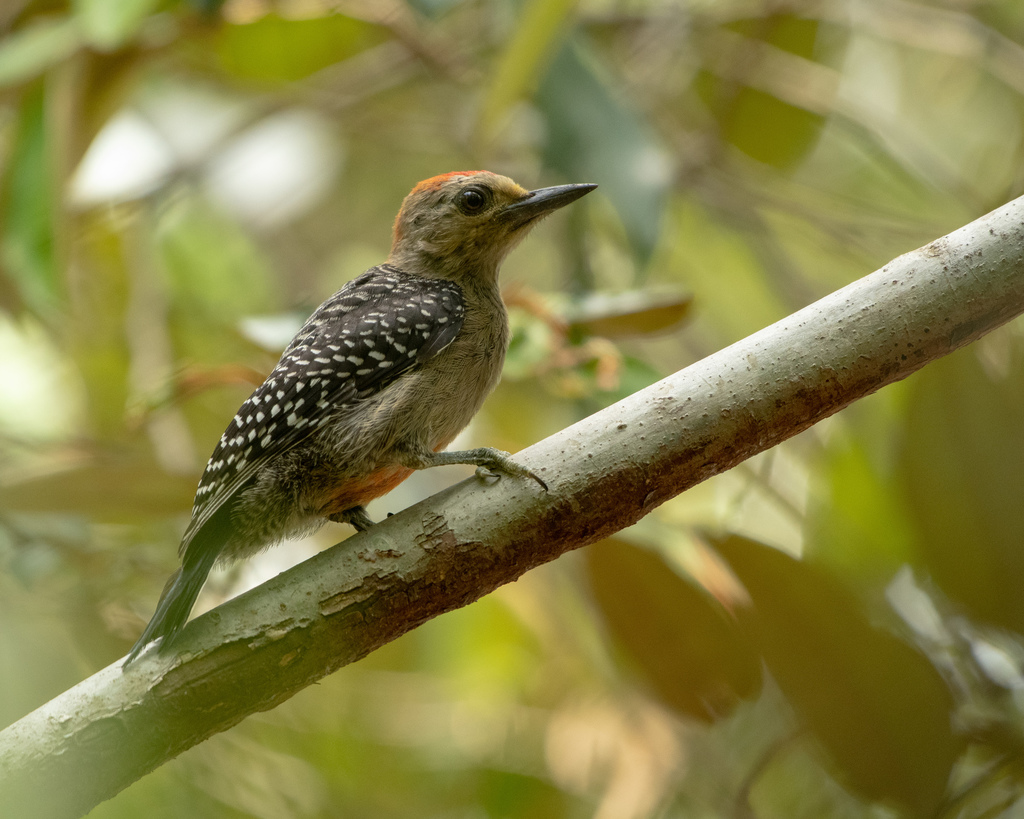
Yucatan Woodpecker
Photo © Court Harding
Photo © Court Harding — CC BY 4.0 — Source: iNaturalist #67625763Identification
The Yucatan woodpecker is a small woodpecker measuring 17 cm (6.7 inches) in length. Adults are predominantly light gray on the face and underparts, with distinctive black and white barred patterns across the back, wings, and tail. Males display a striking red cap extending from the eye to the nape, while females show red coloring only in the occipital area (rear crown). Both sexes feature yellow feathers around the base of the bill, and may display a yellowish tinge to the belly with a red wash around the vent area.
In the field, the Yucatan woodpecker can be easily confused with the more common golden-fronted woodpecker, which shares its range across the Yucatán Peninsula. Key differences include the Yucatan's smaller size and shorter beak, yellow (rather than reddish) feathers at the bill base, and a silvery appearance to the back's barring pattern—compared to the golden-fronted's blackish appearance from a distance. The two species also have distinctly different vocalizations, which can aid identification.
Range & Habitat
The Yucatan woodpecker is endemic to Central America, with its range centered on the Yucatán Peninsula and extending to adjoining offshore islands including Cozumel Island. The species is also found throughout Belize, northeastern Guatemala, and on Guanaja Island off the coast of Honduras. Three subspecies are recognized across this range, with populations showing geographic variation.
This woodpecker favors subtropical and tropical dry forests, dry shrubland, and clearings near the edges of dry woodland. It also frequents coastal scrub habitats and, while primarily associated with arid environments, occasionally inhabits damper woodland and heavily degraded former forest areas. The species has shown adaptability to human-modified landscapes, allowing it to maintain a stable population across its large range.
Behaviour & Diet
Like other woodpeckers, the Yucatan woodpecker is an active forager, though detailed information about its specific feeding behavior and diet is limited. Its presence in clearings and woodland edges suggests it exploits a range of microhabitats for food sources. The species' distinctive vocalizations differ notably from those of the similar golden-fronted woodpecker, making sound a useful identification tool for birdwatchers in areas where both species occur.
Best Time & Places to See It
The Yucatan woodpecker is found year-round throughout its range on the Yucatán Peninsula and in Belize. To locate this species, focus on dry forest edges, coastal scrub, and woodland clearings, where it is most commonly encountered. The species' stable population and large range mean reasonably consistent sightings are possible across its distribution, though the golden-fronted woodpecker remains more abundant and may be seen more frequently in the same habitats.
Photography Tips
Photographing the Yucatan woodpecker requires attention to the subtle plumage details that distinguish it from the golden-fronted woodpecker. Focus on capturing the silvery barring pattern on the back, the yellow feathers at the bill base, and the extent of red coloring on the crown—features that differ between males and females. The small size of this species (smaller than the golden-fronted) should be evident in images. Early morning visits to woodland edges and coastal scrub are likely to yield the best opportunities for observation and photography.
Dzibilchantún National Park
Barcelona, Mexico
+144 birds+2 mammals
Across the limestone plains of Yucatán, where cenotes pierce the bedrock and tropical forest clings to shallow soils, lies Dzibilchantún—a modest yet ecologically vital national park…
VIEW NATIONAL PARKArrecifes de Cozumel National Park
San Miguel de Cozumel, Mexico
+112 birds+4 mammals
Beneath the turquoise shallows of the western Caribbean, Arrecifes de Cozumel National Park protects a sprawling marine realm across 484 square kilometres off the Quintana Roo…
VIEW NATIONAL PARKSian Ka’an
Chunyaxché, Mexico
+350 birds+16 mammals
Where the Yucatán Peninsula dissolves into wetland and mangrove, a vast mosaic of forest, lagoon, and coastal margin creates one of Mexico's most biodiverse strongholds. Across…
VIEW BIOSPHERE RESERVETikal National Park
Tikal, Guatemala
+399 birds+16 mammals
Dense rainforest canopy rises above the limestone plateau of Petén, where archaeological wonder and ecological richness merge seamlessly across one of Central America's most biodiverse landscapes.…
VIEW NATIONAL PARKLaguna del Tigre National Park
Petén, Guatemala
+399 birds+29 mammals
Where the Petén lowlands dissolve into wetland and forest, Laguna del Tigre National Park protects one of Guatemala's most ecologically vital landscapes. This sprawling reserve encompasses…
VIEW NATIONAL PARKNo community photos yet. Log in to add the first one.
No community observations of this species yet.