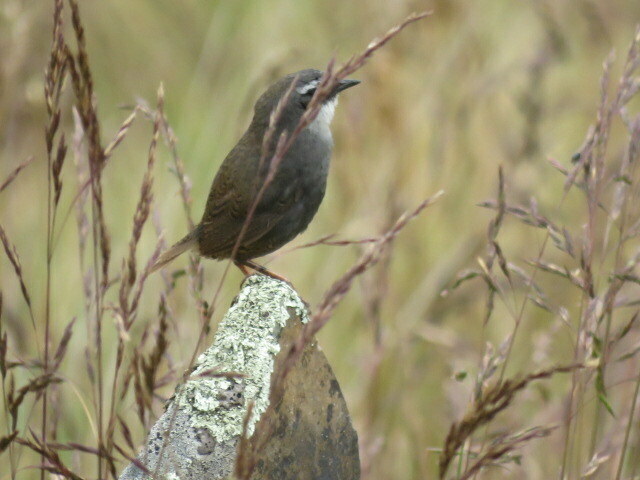
Zimmer’s Tapaculo
Photo © Diego Carús
Photo © Diego Carús — CC0 1.0 — Source: iNaturalist photo #339334734Identification
Zimmer's tapaculo is a tiny passerine, measuring just 10.5 cm in length and weighing between 15.9 and 19.9 grams—small enough to fit in your palm. The most distinctive feature of this species is its striking white supercilium (eyebrow stripe), throat, and upper breast, which contrasts sharply with the gray head, back, and wings. The back has a subtle brown wash, and the lower breast and belly are gray. The flanks and vent are olive-brown with dusky barring. Juveniles are less distinctive, with a faint buff supercilium, olive-brown upper parts marked with dusky bars, and buff flanks and lower belly also barred with dusky markings.
Range & Habitat
Zimmer's tapaculo is endemic to the high Andes of South America, found only in southern Bolivia (Chuquisaca and Tarija departments) and northwestern Argentina (Jujuy and Salta provinces). The species inhabits elevations between 1,700 and 3,200 meters, occupying a variety of vegetative communities across this elevation range.
This tapaculo favors seasonally humid woodlands dominated by Alnus, Podocarpus, and Polylepis trees, where it frequents ravines and shaded areas. It also adapts well to open wet rocky slopes dotted with bunch grass and shrubs, demonstrating considerable tolerance for habitat disturbance—a trait that likely contributes to its stable conservation status despite its restricted range.
Behaviour & Diet
True to the tapaculo family's secretive nature, Zimmer's tapaculo is a ground forager that spends much of its time hidden among roots, rocks, and ferns. While its diet is not well documented, the species appears to favor seeds, gleaning them from the forest floor and lower vegetation.
During breeding season, pairs work cooperatively, with both members observed tending nestlings in October. The species nests in crevices within earth and stone banks, providing safe shelter for their young. Vocally, Zimmer's tapaculo is more conspicuous than it is visually: its song consists of a series of three to five burry notes repeated at intervals, sometimes continuing for many minutes. Its call comprises one or two quick notes also repeated at intervals—vocalizations that often betray the bird's presence when visual sightings prove elusive.
Best Time & Places to See It
October appears to be an active breeding period when both members of a pair are engaged in parental care, potentially making birds slightly more visible as they shuttle between nest and foraging grounds. The species' restricted range in the Andes of Bolivia and Argentina limits options for viewing, but the steep terrain of its preferred habitat means the bird benefits from protection through inaccessibility.
Target the humid woodlands and rocky slopes of the southern Bolivian and northwestern Argentine highlands, focusing on elevations between 1,700 and 3,200 meters. Early morning is often rewarding for locating tapaculos, when vocalization activity peaks. Listen for the distinctive burry song as your primary detection method, then search carefully in dense vegetation, ravines, and rocky outcrops where the bird is most likely to be found.
Photography Tips
Photographing Zimmer's tapaculo presents significant challenges due to its small size, skulking behavior, and preference for dense, shadowy vegetation. Use a fast lens (f/2.8 or wider) to maximize light capture in the dimly lit understory and ravines where this species forages. A macro or telephoto lens in the 100–300 mm range will help you fill the frame with this diminutive bird.
Since the species remains largely hidden among roots and ferns, patience and listening skills are essential. Locate birds by their song, then approach slowly and quietly with your camera ready. Focus on capturing the bird's distinctive white supercilium and throat markings, which provide the most striking diagnostic features. Be prepared for high ISO settings and slower shutter speeds given the low-light conditions typical of its habitat; image stabilization will be invaluable for handheld shooting.
No community photos yet. Log in to add the first one.
No community observations of this species yet.