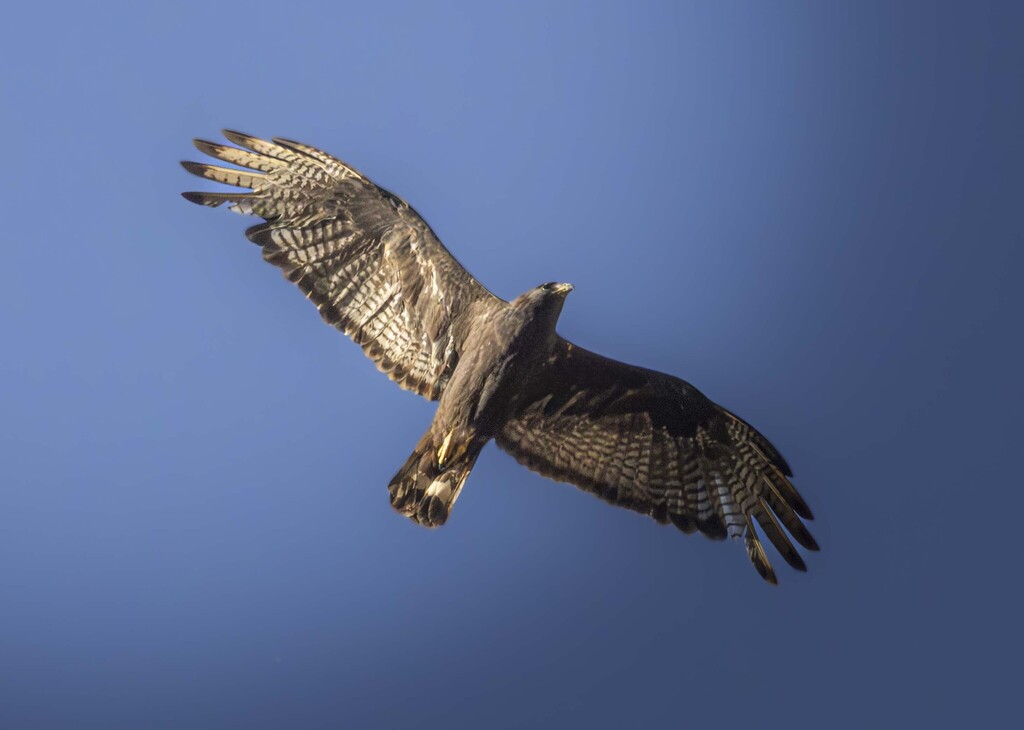
Zone-tailed Hawk
Photo © Brooke J.
Photo © Brooke J. — CC BY 4.0 — Source: iNaturalist photo #658748862Identification
The zone-tailed hawk is a fairly large but slender Buteo, measuring 46 to 56 cm in length with a wingspan of 117–140 cm. Adults are mostly blackish with distinctive barred flight feathers that appear silvery-gray from a distance. The tail displays three or four white bands (the "zones" that give the species its name), with the second band from the tip being particularly broad and conspicuous. The cere and legs are yellow, with light gray lores and a light touch of white on the face. Immatures are similar but show small white spots on the breast and narrower tail bands with a dark tip. Females are considerably heavier and bulkier than males, though measurements are similar. The species' slender profile and pale tail stripe distinguish it from the similar turkey vulture and other dark-phase Buteos.
Range & Habitat
Zone-tailed hawks range from southern Arizona, New Mexico, and western Texas through inland Mexico and Central America to eastern Colombia, Ecuador, and sporadically into Peru, southern Brazil, Paraguay, Bolivia, and northern Argentina. They are also native to Trinidad. Northern populations withdraw in winter, retreating mostly to Oaxaca and the Yucatán Peninsula. The species adapts to varied habitats including coniferous and pine-oak forests, timbered canyonlands, hilly riverine woods, dry scrub, and humid forests. The largest concentrations occur in rocky areas with water access. They forage over ranches and semi-desert but require scattered tree thickets for nesting, ranging from sea level to 3,000 m elevation, though typically below 1,500 m in the north and 500 m in southern breeding areas.
Behaviour & Diet
Zone-tailed hawks feed on small terrestrial tetrapods of all kinds. They may benefit from resembling turkey vultures, potentially allowing them to blend into vulture groups. The mating season varies geographically, occurring from mid-April through July in northern areas, and February through June in Trinidad and Ecuador. Pairs perform elaborate courtship displays involving aerial loops, dives, and rolls. Nests are bulky assemblages of sticks lined with green leaves, typically built 7.5 to 30 m high in tall trees such as cottonwood or pine, occasionally on cliffs. Clutches comprise one to three eggs, typically two, which are white and often marked with brown. Incubation lasts 28 to 35 days, usually performed by the female while fed by the male. The species produces a loud scream call with varying pitch, most often heard during breeding displays at the start of mating season.
Best Time & Places to See It
To observe zone-tailed hawks, visit rocky, well-watered habitats within their range, particularly in Mexico, Central America, and northern South America. In the United States, southern Arizona, New Mexico, and western Texas offer opportunities during breeding season (mid-April through July), though birds withdraw southward in winter. The Yucatán Peninsula and Oaxaca are reliable wintering grounds for northern populations. Central American locations and the foothills and canyonlands of Colombia and Ecuador provide year-round viewing opportunities. Look for them perched in tall cottonwoods and pines or soaring over forested and semi-open terrain. Listen for their distinctive loud scream calls during breeding season, particularly during courtship displays.
Photography Tips
Capture the zone-tailed hawk's distinctive field marks: the silvery-barred flight feathers visible in soaring birds, the characteristic banded tail with its broad second band, and the slender profile that distinguishes it from broader-winged Buteos. Photograph them in flight to showcase the pale undersides of the tail bands and the contrast between dark body plumage and gray-barred wings. Early morning provides optimal lighting for capturing the pale tail stripes against darker plumage. During breeding season, position yourself near known nesting territories to photograph courtship displays and feeding behavior. The yellow cere and legs are diagnostic details worth capturing in close portraits. Include habitat context—rocky terrain, river canyons, and tall cottonwoods—to convey the species' preferred environment.
Amacayacu National Park
Arenal Volcano National Park
Bahuaja Sonene National Park
Barra del Colorado National Wildlife Refuge
Baru Volcano National Park
Big Bend National Park
Bosque del Apache National Wildlife Refuge
Braulio Carrillo National Park
Cahuita National Park
Nothing matches these filters.
No community photos yet. Log in to add the first one.
No community observations of this species yet.