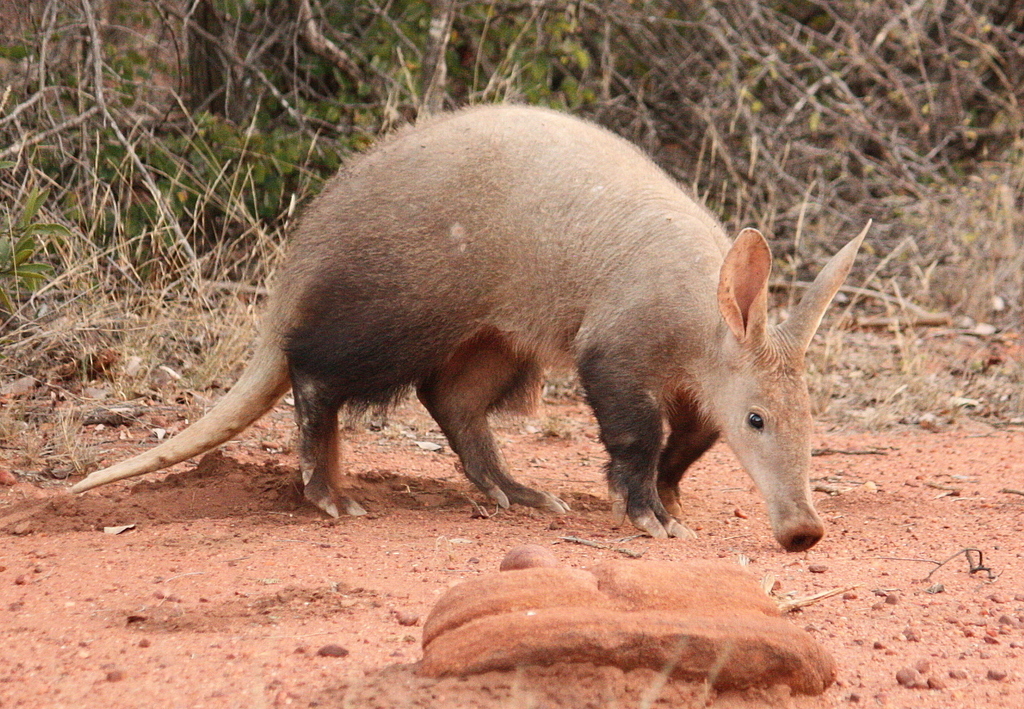
Aardvark
Photo © Kelly Abram
Photo © Kelly Abram — CC0 1.0 — Source: iNaturalist photo #175359469Identification
The aardvark is a medium-sized, burrowing mammal with a distinctly pig-like appearance, though it is not closely related to pigs. Its body is stout with a prominently arched back, sparsely covered in coarse hair that is typically pale yellowish-grey, often stained reddish-brown by soil. The animal weighs between 60 and 80 kilograms and measures 105 to 130 centimetres in body length, reaching up to 2.2 metres including its distinctive tail. Its most striking features are its greatly elongated head with a disc-shaped snout housing large nostrils, and powerful limbs equipped with large, shovel-like nails adapted for digging. The rear legs are longer than the forelegs, and the front feet have only four toes while the rear feet retain all five.
Range & Habitat
The aardvark is found across much of the southern two-thirds of the African continent. It avoids areas that are mainly rocky, preferring habitats where it can excavate burrows with relative ease. As the only living member of the order Tubulidentata and family Orycteropodidae, it occupies a unique ecological niche across this vast range.
Behaviour & Diet
The aardvark is strictly nocturnal, emerging under cover of darkness to forage. It is a specialized myrmecophage, subsisting almost entirely on ants and termites. Using its powerful legs and sharp claws, it methodically digs into ant and termite hills to extract its prey, while its elongated snout and keen sense of smell help it locate food sources. The aardvark digs extensive burrows not only to forage but also to serve as its home, where it rears its young in a secure underground environment.
Best Time & Places to See It
Observing aardvarks requires patience and nocturnal fieldwork, as they are exclusively night feeders. The best opportunities occur in the southern two-thirds of Africa, away from rocky terrain. Visiting suitable savanna and grassland habitats at night, particularly during seasons when termite and ant activity is high, offers the greatest chance of encounters. Local guides familiar with aardvark burrows and foraging patterns can significantly increase sighting success.
Photography Tips
Photographing aardvarks demands specialized night equipment, including infrared or thermal imaging technology, as these animals are strictly nocturnal and difficult to locate. Wide-angle lenses work well for capturing burrow entrances and the surrounding habitat context. The aardvark's compact, low-slung body and powerful digging posture make compelling subjects; focus on capturing the characteristic shovel-like nails and muscular forearms in action. Remote camera traps positioned near active burrows offer excellent opportunities for capturing natural behaviour without disturbance. Patience is essential, as aardvarks are solitary and wary animals.
Tsavo West National Park
Mwatate, Kenya
+513 birds+49 mammals
Where volcanic ridges and weathered lava flows meet the semi-arid lowlands of south-central Kenya, Tsavo West National Park unfolds across a landscape sculpted by fire and…
VIEW NATIONAL PARKCederberg Wilderness Area
Cederberg Local Municipality, South Africa
+136 birds+12 mammals
Where ancient sandstone ridges rise dramatically from the semi-arid lowlands of Western Cape, the Cederberg Wilderness Area spreads across nearly 1,700 square kilometres of some of…
VIEW NATIONAL PARKKruger National Park
Ba-Phalaborwa Local Municipality, South Africa
+540 birds+91 mammals
Across the low-lying savanna of northeastern South Africa unfolds one of Africa's largest and most ecologically intact protected areas, where acacia woodlands merge into mopane scrub…
VIEW NATIONAL PARKMountain Zebra National Park
Inxuba Yethemba Local Municipality, South Africa
+265 birds+35 mammals
Across the windswept plateaus and deeply incised valleys of the Eastern Cape's interior, Mountain Zebra National Park unfolds as a landscape of geological drama and ecological…
VIEW NATIONAL PARKAddo Elephant National Park
Sundays River Valley Local Municipality, South Africa
+388 birds+55 mammals
Where the Eastern Cape's semi-arid scrublands meet transitional woodland, Addo sprawls across 13,478 square kilometres of one of southern Africa's most biodiverse landscapes. The terrain rises…
VIEW NATIONAL PARKMarakele National Park
Modimolle Local Municipality, South Africa
+341 birds+36 mammals
Granite ridges and sprawling grasslands dominate this 1,176-square-kilometre reserve in Limpopo's heartland, where bushveld transitions between rocky outcrops and open savanna. The park's rugged topography creates…
VIEW NATIONAL PARKAwash National Park
Didiga, Ethiopia
+473 birds+23 mammals
Where the Ethiopian Rift Valley carves through volcanic plateaus, a ribbon of riverine forest winds through acacia scrubland and grassland, creating a mosaic of habitats that…
VIEW NATURAL PARKChyulu Hills National Park
Kibwezi East, Kenya
+232 birds+30 mammals
Volcanic cones rise abruptly from the Kenyan savanna floor, their flanks clothed in dense acacia woodland and grassland that transforms the Chyulu Hills into an ecological…
VIEW NATIONAL PARKNo community photos yet. Log in to add the first one.
No community observations of this species yet.