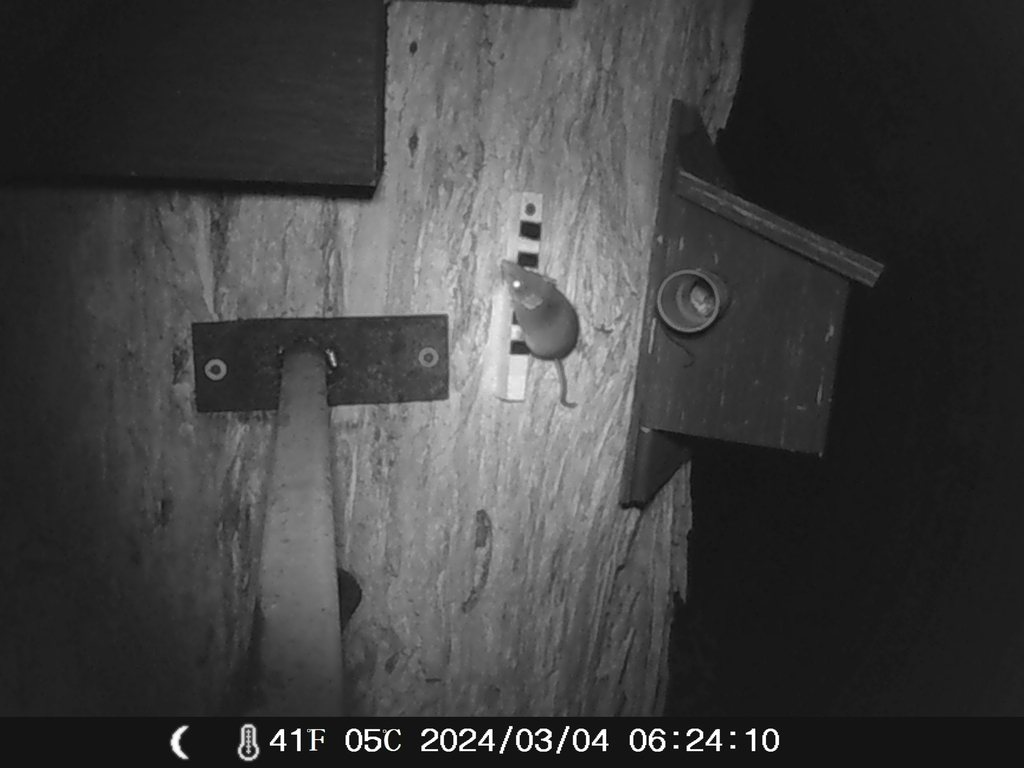
Agile Antechinus
Photo © graeme lunt
Photo © graeme lunt — CC BY 4.0 — Source: iNaturalist #202753356Identification
The agile antechinus is a small carnivorous marsupial that closely resembles its relative, the brown antechinus. However, this species is slightly smaller and distinguishable by its fur, which has a more greyish tinge compared to the brown antechinus's darker colouration. These tiny members of the Dasyuridae family are among Australia's smallest marsupial carnivores, making them a challenging but rewarding subject for keen-eyed naturalists and wildlife photographers.
Range & Habitat
The agile antechinus is found exclusively in the southeastern corner of Australia, where it inhabits wet or moist forests. The species is widely abundant throughout its range, though populations have declined in areas affected by forest clearing, plantation development, timber harvesting, controlled burning, and the introduction of invasive predators such as cats and red foxes. Despite these pressures, the species remains stable with no current conservation concerns.
Behaviour & Diet
This small marsupial is a dedicated insectivore, feeding primarily on invertebrates including beetles, spiders, and cockroaches. It will opportunistically consume small lizards and soft berries when available. Like other antechinuses, the agile antechinus exhibits a remarkable breeding strategy characterised by a short and intensely violent mating season, after which all males die. Females carry their young for a 27-day gestation before giving birth.
The species shows a fascinating adaptation to food scarcity: it can enter torpor, a state of reduced metabolic activity similar to hibernation, allowing it to survive periods when prey is scarce. Groups of up to 20 individuals have been observed nesting together, suggesting some degree of social tolerance despite their carnivorous nature.
Best Time & Places to See It
Finding agile antechinuses requires patience and access to southeastern Australian wet and moist forests. The species is nocturnal and cryptic, making daytime observation unlikely. Early mornings or dusk offer the best chances, particularly during warmer months when activity levels are higher. Your best opportunities lie in protected forest reserves and national parks within the species' southeastern range, where habitat remains intact and populations are well-established.
Photography Tips
Photographing agile antechinuses presents a genuine challenge due to their small size, nocturnal habits, and cryptic behaviour. A macro or telephoto lens is essential to capture detail without disturbing the animal. Night photography equipment, including infrared illumination or red-light torches, will prove invaluable for capturing these elusive marsupials in their natural state. Move slowly and deliberately through suitable forest habitat, watching carefully for movement among leaf litter and low vegetation. Early morning foraging expeditions offer your best window—position yourself quietly and allow the antechinus to approach rather than pursuing it directly. Patience and respect for the animal's space will yield the most natural, compelling images.
Lower Glenelg National Park
Australia
+161 birds+12 mammals
Where the Glenelg River carves through southeastern Victoria's limestone country, Lower Glenelg National Park unfolds across nearly 800 square kilometres of river gorge, eucalypt woodland, and…
VIEW NATIONAL PARKMorton National Park
Australia
+253 birds+57 mammals
Across nearly 4,800 square kilometers of New South Wales's Southern Tablelands, rugged sandstone plateaus rise above sheltered valleys where cool-climate eucalypt woodland meets grassy heath and…
VIEW NATIONAL PARKWilsons Promontory National Park
Australia
+210 birds+21 mammals
Where granite headlands plunge toward Bass Strait, Wilson's Promontory National Park sprawls across nearly 1,300 square kilometers of southeastern Victoria's most rugged coastal wilderness. The park's…
VIEW NATIONAL PARKKosciuszko National Park
Australia
+211 birds+52 mammals
Where the Great Dividing Range reaches its highest peaks in southeastern Australia, Kosciuszko National Park encompasses a landscape of windswept plateaus, rocky ridges, and deep river…
VIEW NATIONAL PARKBudawang National Park
Australia
+80 birds+17 mammals
Rugged sandstone ridges rise dramatically across the New South Wales Southern Tablelands, their weathered faces sculpted by millennia of wind and water into a landscape of…
VIEW NATIONAL PARKBen Boyd National Park
Eden, Australia
+255 birds+47 mammals
Where the temperate forests of the far south coast meet towering sea cliffs, Ben Boyd National Park unveils one of New South Wales' most dramatic coastal…
VIEW NATIONAL PARKGrampians National Park
Australia
+214 birds+18 mammals
Where sandstone ridges rise above the Western District of Victoria, Grampians National Park unfolds across rolling terrain sculpted by ancient geology and sustained by a temperate…
VIEW NATIONAL PARKGreat Otway National Park
Australia
+255 birds+42 mammals
Temperate rainforest and wet eucalyptus woodland cloak the ridges and gullies of Victoria's Great Otway National Park, where persistent moisture and mild year-round temperatures sustain a…
VIEW NATIONAL PARKNo community photos yet. Log in to add the first one.
No community observations of this species yet.