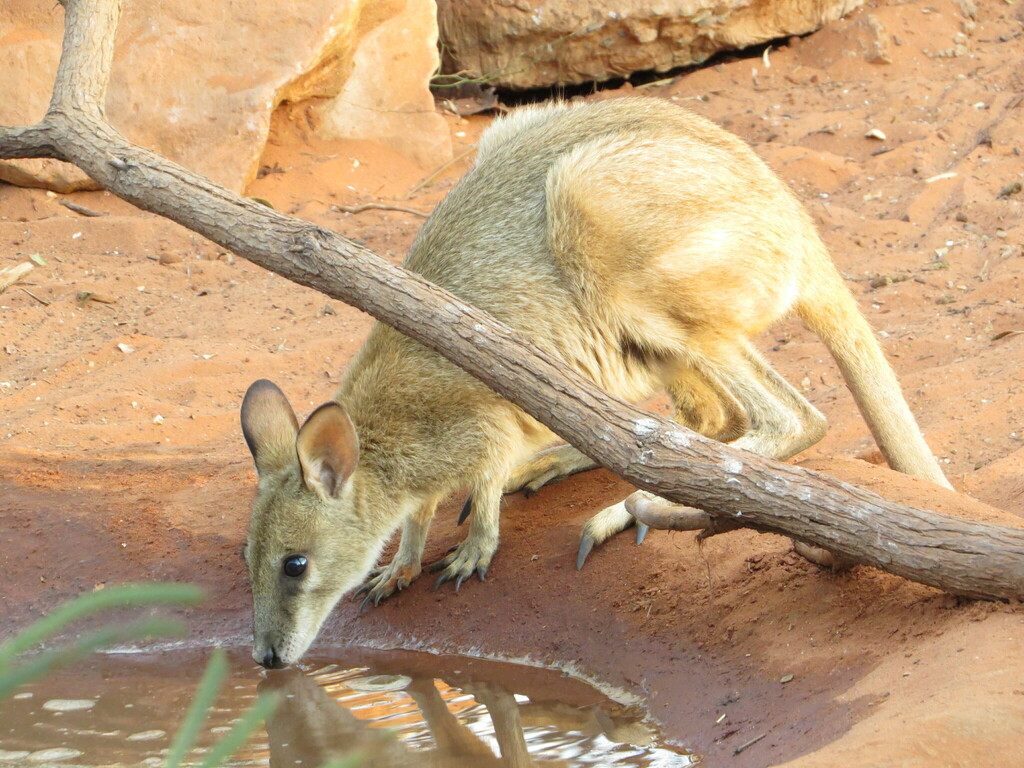
Agile Wallaby
Photo © pimelea
Photo © pimelea — CC BY 4.0 — Source: iNaturalist #206906495Identification
The agile wallaby, also known as the sandy wallaby, is a medium-sized marsupial with distinctive colouring and proportions that make it recognizable in the field. Males are considerably larger than females, reaching up to 85 cm in head and body length and weighing 16–27 kg, while females measure around 72 cm and weigh 9–15 kg. Both sexes possess notably long, flexible tails that roughly double their head and body length, giving them an overall stretched appearance characteristic of wallabies.
Their sandy-brown backs contrast sharply with whitish underparts, creating a two-toned effect. Key identifying features include relatively large ears edged with black, a black-tipped tail, a dark stripe running between the ears, pale cheek stripes on each side of the face, and pale streaks across the thighs. These markings, combined with their sandy colouration, distinguish them from other Australian wallaby species.
Range & Habitat
The agile wallaby is the most common wallaby across much of northern Australia, with its range extending into southern New Guinea and the Indonesian province of South Papua. In Australia, it is quite common throughout northern regions and down the eastern coast of Queensland, though isolated populations exist in southeastern Queensland around Coomera, Jacobs Well, and Hope Island. Small populations are also found on Stradbroke Island and Woogoompah Island in the Southern Moreton Bay Islands.
These wallabies favour dry open woodland, heaths, dunes, and grassland habitats, and are frequently encountered near rivers and billabongs where water and fresh vegetation are available. When natural grazing becomes scarce, they readily move onto agricultural land, including sugar cane plantations, where they may be viewed as pests by farmers.
Behaviour & Diet
Though generally solitary animals, agile wallabies sometimes gather in groups while feeding on open pastures, a behaviour thought to provide better predator awareness. They are primarily nocturnal foragers, feeding mainly at night on grasses, legumes, and herbaceous plants, though they may also forage during daylight hours, particularly in the wet season. Their diet shows seasonal flexibility: in the dry season, when grazing quality deteriorates and their range expands, they browse on flowers, fruit, twigs, fallen leaves, roots, and bark. They have even been observed pulling up seedling palms with their teeth to access roots and seeds.
Agile wallabies sometimes dig holes in dry creeks and billabongs to search for water, behaviour that may help them avoid saltwater crocodiles. Breeding occurs year-round, with females becoming receptive soon after giving birth. Males display elaborate courtship behaviour including play-fighting, leaping, and sinuous tail-lashing. After mating, embryonic diapause occurs before a 30-day gestation, and young remain in the pouch for 7–8 months before weaning at about 11 months.
Best Time & Places to See It
For the best chance of viewing agile wallabies, visit northern Australia, particularly the Northern Territory and the northern and eastern coasts of Queensland. They are most active during early morning and evening hours, and at night when they feed, though daytime sightings are possible, especially during the wet season. The wet season may offer better opportunities as wallabies are more likely to forage during daylight at this time. Several protected areas across Australia provide reliable viewing opportunities.
In Queensland, Boodjamulla National Park is a notable location where these animals have been well-documented. Look for them in open grasslands, near water sources such as billabongs and rivers, and in dry open woodlands. Patient observers who visit suitable habitats during dawn, dusk, or night will have reasonable chances of encountering these common northern marsupials.
Photography Tips
The agile wallaby's sandy colouration and distinctive markings photograph well in natural light, particularly during the warm tones of early morning and late afternoon. Their relatively large ears and facial stripes provide good detail for close-up portraits. Capture images that showcase the characteristic pale cheek stripe and dark facial marking, as these are key identification features. The long, flexible tail is an important element of their silhouette—try to include it in full-body shots to convey their proportions and grace.
Since these wallabies are most active at night and during low-light conditions, consider using higher ISO settings or supplementary lighting if photographing after dusk. Early morning or late afternoon visits to grasslands and open woodlands near water sources will yield the best natural-light opportunities. Groups feeding on open pastures offer chances for dynamic compositions showing multiple individuals and their social behaviour. Patience and stillness are essential, as they may be wary and quick to bound away if disturbed.
Kakadu National Park
Kakadu, Australia
+273 birds+46 mammals
Kakadu National Park is Australia’s largest national park and one of the world’s most remarkable protected areas, covering nearly 20,000 square kilometres in the tropical north…
VIEW NATIONAL PARKDaintree National Park
Dedin, Australia
+362 birds+37 mammals
Daintree National Park is one of the world’s oldest and most biologically diverse tropical rainforests, protecting an extraordinary landscape where ancient forests meet the Great Barrier…
VIEW NATIONAL PARKRinyirru National Park
Lakefield, Australia
+258 birds+7 mammals
Where the savanna grasslands of far north Queensland meet seasonal wetlands and eucalypt woodlands, Rinyirru National Park sprawls across more than 12,500 square kilometres of rugged,…
VIEW NATIONAL PARKWhitsunday Islands National Park
Whitsundays, Australia
+163 birds+9 mammals
Crystalline waters lap against seventy-four islands where rainforest canopies tumble down to pristine beaches and coral gardens flourish in the shallows. This archipelago off Queensland's coast…
VIEW NATIONAL PARKLitchfield National Park
Australia
+175 birds+15 mammals
Where weathered sandstone plateaus rise above the savanna woodlands of Australia's Top End, Litchfield National Park unfolds as a landscape of dramatic contrasts shaped by a…
VIEW NATIONAL PARKNitmiluk National Park
Australia
+186 birds+27 mammals
Dramatic sandstone gorges carved by the Katherine River slice through the tropical savanna of Australia's Top End, creating a landscape where escarpments tower above crystalline pools…
VIEW NATIONAL PARKGirringun National Park
Australia
+231 birds+10 mammals
Where granite gorges cleave through subtropical woodland in North Queensland, Girringun National Park unfolds across rugged terrain shaped by millions of years of weathering and erosion.…
VIEW NATIONAL PARKWooroonooran National Park
Australia
+240 birds+28 mammals
Where the Great Dividing Range rises sharply inland from Queensland's tropical coast, Wooroonooran National Park encompasses a landscape of steep, forested gorges and cascading waterways carved…
VIEW NATIONAL PARKBoodjamulla National Park
Australia
+142 birds+3 mammals
Where red sandstone gorges carve through the semi-arid interior of far north Queensland, Boodjamulla National Park reveals a landscape shaped by seasonal water availability and ancient…
VIEW NATIONAL PARKNo community photos yet. Log in to add the first one.
No community observations of this species yet.