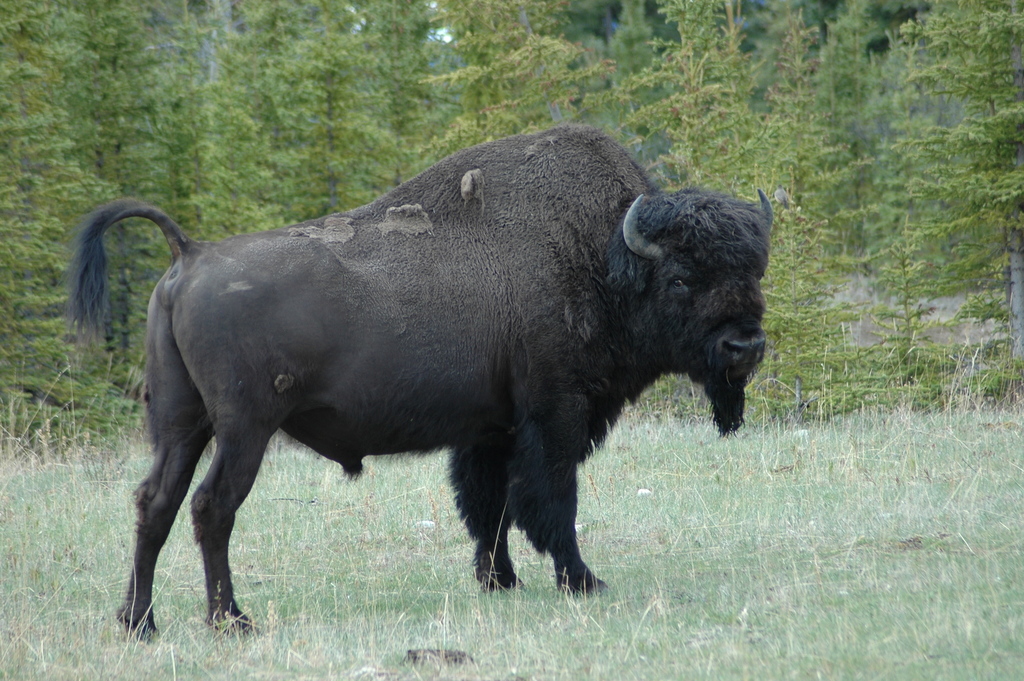
American Bison
Photo © Syd Cannings
Photo © Syd Cannings — CC BY 4.0 — Source: iNaturalist photo #14328398Identification
The American bison is instantly recognizable by its massive frame, distinctive hump, and shaggy coat. Two subspecies exist: the plains bison, which is smaller with a more rounded hump, and the wood bison, the larger of the two with a taller, square hump. Male bison are significantly larger than females, with head-rump lengths reaching up to 3.5 meters for males and 2.85 meters for females. Heights at the shoulder can reach 186 to 201 centimeters. The species exhibits a shaggy, long, dark-brown winter coat that transitions to a lighter-weight, lighter-brown summer coat. The wood bison is one of the largest wild bovids in the world, surpassed only by the Asian gaur, with wild animals weighing up to 1,270 kilograms.
Range & habitat
American bison are endemic to North America. Historically, their range circa 9000 BC spanned the great bison belt—a vast grassland tract extending from Alaska south to the Gulf of Mexico and east to the Atlantic Seaboard, as far north as New York and south to Georgia. Once roaming in vast herds across these rich grasslands, the species was nearly driven to extinction in the 19th century. Following recovery efforts that began in the mid-20th century, bison now freely roam wild in several regions across the United States, Canada, and Mexico, primarily within national parks and reserves, though some populations are maintained in smaller natural areas as conservation herds. The species has also been introduced to Russia, with an established population in Ingilor Nature Park in Yakutia.
Behaviour & diet
As the heaviest herbivore in North America, bison are adapted to grazing on grasslands and are primarily herbivorous. Historically, American bison roamed in vast herds that were central to the lives of Indigenous peoples of the Great Plains for millennia, serving as a major resource for food, hides for clothing and shelter, and bones and horns for tools. The species has deep cultural and spiritual significance to Plains Indian nations, reflected in their languages—for example, in Lakota, male bison (tȟatȟáŋka) and female bison (pté) have distinct names rather than a single generic term, underscoring their special importance.
Best time & places to see it
American bison can be observed in national parks and reserves throughout the United States, Canada, and Mexico. The resurgence to approximately 31,000 wild bison as of March 2019 means that populations are now more widely distributed than in the past century, when they were confined to a handful of protected areas. Visiting established bison ranges within national parks offers the best opportunities to see these magnificent animals in their natural habitat.
Photography tips
The bison's imposing size and distinctive features—its massive hump, shaggy coat, and powerful build—make it a compelling photographic subject. The seasonal coat change from the darker, heavier winter coat to the lighter summer coat provides varied photographic opportunities throughout the year. Photographing bison in herds captures their historical significance, while close-ups reveal the texture and character of their coats and distinctive facial features. Early morning and late afternoon light are ideal for highlighting the animal's contours and the richness of its dark coloring.
Grand Teton National Park
Teton County, United States
+247 birds+38 mammals
Where the Teton Range tears skyward in a dramatic escarpment above the Snake River valley, nearly 2,550 square kilometers of montane wilderness unfolds across Teton County,…
VIEW NATIONAL PARKYellowstone National Park
Park County, United States
+253 birds+43 mammals
Across nearly 11,400 square kilometres of the Rocky Mountain plateau, geothermal fury and pristine wilderness converge in one of Earth's most dynamic landscapes. Hot springs, geysers…
VIEW NATIONAL PARKWaterton Lakes National Park
Improvement District No. 04, Canada
+252 birds+31 mammals
Where the Continental Divide plunges toward the prairies of Alberta, glacier-carved valleys and emerald lakes pierce a landscape where montane forest meets alpine tundra. Waterton Lakes…
VIEW NATIONAL PARKNahanni National Park
Dehcho Region, Canada
+151 birds+11 mammals
Where the South Nahanni River carves through the Mackenzie Mountains, a landscape of extraordinary wildness unfolds across more than 61,000 square kilometres of boreal forest, alpine…
VIEW NATIONAL PARKWood Buffalo National Park
Improvement District No. 24, Canada
+187 birds+10 mammals
Across nearly 75,000 square kilometres of boreal forest, wetland and grassland in northern Alberta, the landscape unfolds in a mosaic of spruce and pine woodland interspersed…
VIEW NATIONAL PARKBadlands National Park
Wall, United States
+200 birds+14 mammals
Eroded badlands rise in jagged formations across northwestern South Dakota, where the White River has carved deep canyons through layers of sedimentary rock spanning millions of…
VIEW NATIONAL PARKGlacier National Park
United States
+246 birds+39 mammals
Where jagged peaks pierce a subarctic sky and glacial valleys carve through ancient rock, Glacier National Park spans the spine of the Northern Rockies along Montana's…
VIEW NATIONAL PARKGrand Canyon National Park
United States
+277 birds+35 mammals
A mile-deep chasm of rust-red rock and purple shadow cuts through the high desert plateau of northern Arizona, revealing nearly two billion years of geological history…
VIEW NATIONAL PARKWind Cave National Park
Custer County, United States
+175 birds+13 mammals
Beneath the rolling prairie of the Black Hills, a network of passages carved through limestone creates one of North America's most extensive cave systems. Wind Cave…
VIEW NATIONAL PARKWichita Mountains National Wildlife Refuge
Medicine Park, United States
+256 birds+17 mammals
Granite peaks rise abruptly from rolling prairie in southwestern Oklahoma, where the Wichita Mountains National Wildlife Refuge protects a rare collision of ecosystems. This sanctuary encompasses…
VIEW WILDLIFE SANCTUARYNational Elk Refuge
Jackson, United States
+230 birds+27 mammals
Where the sagebrush flats of northwestern Wyoming rise toward the Gros Ventre Mountains, winter transforms the landscape into a realm of survival and spectacle. The National…
VIEW WILDLIFE SANCTUARYNo community photos yet. Log in to add the first one.
No community observations of this species yet.