American Mink
Photo © Dan Vickers
Photo © Dan Vickers — CC BY 4.0 — Source: iNaturalist photo #586206878Identification
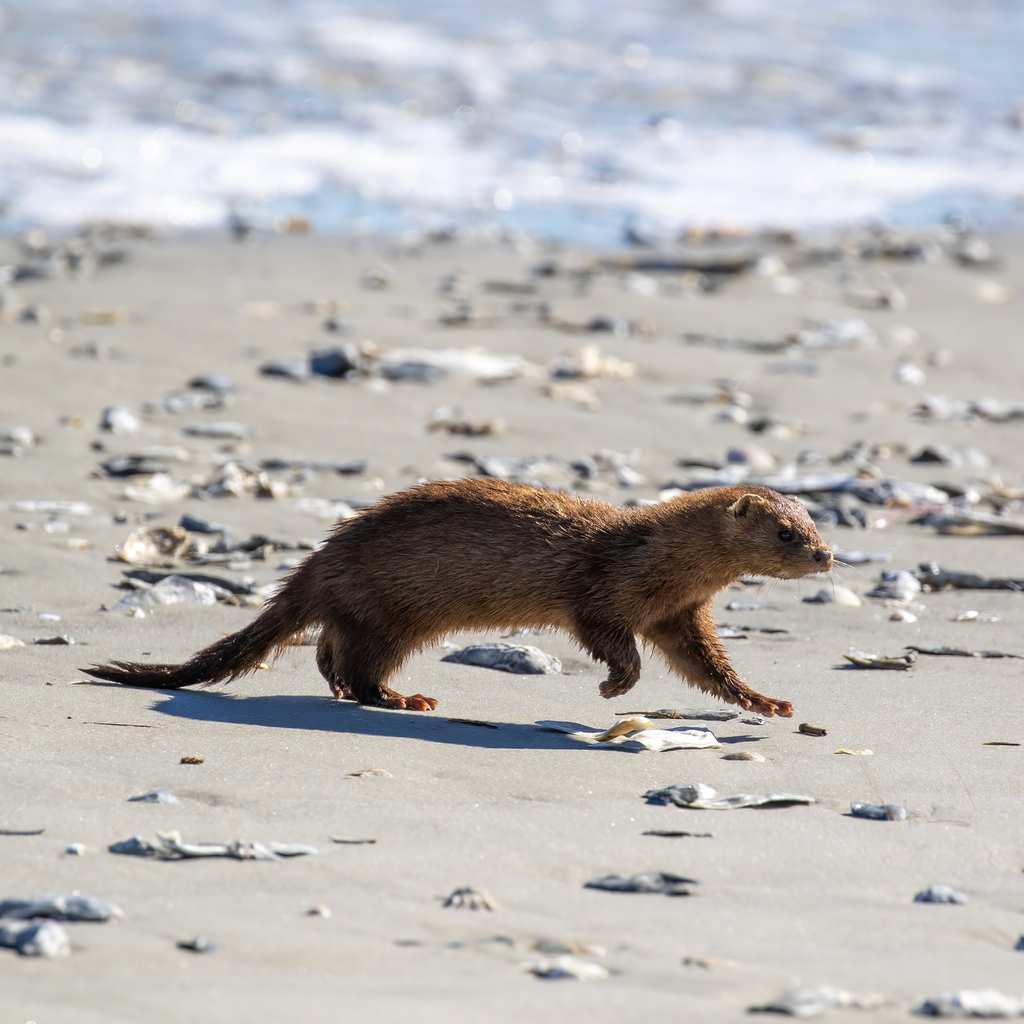
The American mink is a sleek, elongated mustelid with a distinctive larger and stouter build than its European counterpart. Males measure 13–18 inches in body length with tails of 6–10 inches, while females are slightly smaller at 12–15 inches with 6–8 inch tails. The species possesses broad, webbed feet and a long body perfectly adapted for entering prey burrows and moving through water with minimal resistance.
Winter fur is dense, soft, and dark blackish-tawny to light-tawny, evenly distributed across the body with only a slightly lighter underside. The chin and lower lip characteristically display white markings. The tail is typically darker than the trunk and may become pure black at the tip. Summer fur is noticeably shorter, sparser, and duller. Unlike many northern mammals, the American mink does not turn white in winter. The thick underfur and oily guard hairs provide excellent water resistance, positioning the mink as incompletely adapted to aquatic life—more specialized than weasels but less so than otters.
Range & Habitat
Native to North America, the American mink's range has been dramatically expanded through human introduction to many parts of Europe, Asia, and South America. This range expansion has resulted in the species being classified as least-concern by the IUCN. However, in its introduced European range, the American mink is recognized as an invasive species with documented impacts on native wildlife populations.
Behaviour & Diet
The American mink is a dedicated carnivore with a diverse diet including rodents, fish, crustaceans, frogs, and birds. The species relies heavily on sight when foraging, though its eyesight is clearer on land than underwater. It possesses acute auditory perception capable of detecting the ultrasonic vocalizations of rodent prey. On land, the mink moves with a bounding gait at speeds up to 4 miles per hour and is also an accomplished climber.
In water, the mink propels itself primarily through undulating trunk movements and typically dives to depths of 12 inches for approximately 10 seconds, though depths of 3 meters lasting 60 seconds have been recorded. Fish are typically caught after five- to 20-second chases. The species undergoes bradycardia while diving—a physiological adaptation to conserve oxygen. In warm water, American minks can swim for 3 hours continuously, but cold water presents serious danger, with fatal outcomes possible within 27 minutes.
Best Time & Places to See It
American minks are semiaquatic and therefore most reliably encountered near freshwater habitats including streams, rivers, marshes, and lake margins throughout their native North American range and introduced populations elsewhere. Since they are carnivorous predators of small mammals and fish, areas with healthy populations of rodents, frogs, and fish offer the best viewing opportunities. The species' adaptability and expanding range mean populations now occur across diverse regions beyond their original distribution.
Photography Tips
Photographing American minks requires patience and an understanding of their aquatic habits. Position yourself near water edges where minks hunt for fish and other prey. Early morning and dusk often provide the best lighting and increased mink activity. Their streamlined shape and graceful swimming motion make for compelling action shots, particularly when diving or pursuing prey underwater. The contrast between their dark fur and white chin markings can be striking in good light. Be prepared for quick movements—their bounding gait on land and rapid aquatic pursuits demand fast camera settings and autofocus capabilities.
Söderåsens National Park
Skåne län, Sweden
+136 birds+18 mammals
Steep beech-clad ravines and limestone escarpments carve through the landscape of southern Sweden's Skåne region, creating Söderåsens—a textbook example of temperate woodland gorge habitat. The park's…
VIEW NATIONAL PARKEryri National Park
Gwynedd, United Kingdom
+199 birds+36 mammals
Where granite peaks rise abruptly from the Snowdonia landscape, Eryri National Park encompasses one of Britain's most dramatic mountain terrain. The park's rugged plateaus, deep glacial…
VIEW NATIONAL PARKLake District National Park
Westmorland and Furness, United Kingdom
+209 birds+36 mammals
Where slate fells rise steeply from mirror-still waters, the Lake District unfolds as one of Britain's most ecologically intricate mountain landscapes. The park's patchwork of deep…
VIEW NATIONAL PARKBannau Brycheiniog National Park
Powys, United Kingdom
+178 birds+36 mammals
Where sandstone ridges rise above the rolling moorlands of mid-Wales, Bannau Brycheiniog National Park protects one of Britain's most compelling upland landscapes. The park's dramatic peaks,…
VIEW NATIONAL PARKSouth Downs National Park
Chichester, United Kingdom
+298 birds+45 mammals
Chalk downland ridges rise and fall across the South Downs, their open grasslands and beech hangers creating a mosaic of habitats that has shaped human settlement…
VIEW NATIONAL PARKFrontenac National Park
Sainte-Praxède, Canada
+178 birds+11 mammals
Where the Canadian Shield's ancient granite ridges meet coniferous forest and freshwater lakes, Frontenac National Park embraces a landscape carved by millennia of glacial movement. The…
VIEW NATIONAL PARKMont-Saint-Bruno National Park
Saint-Bruno-de-Montarville, Canada
+200 birds+13 mammals
Hardwood forests rise steeply from the suburbs of Montreal to crown a distinctive peak in the Monterégian Hills, their ancient geology pushing through mixed deciduous woodland…
VIEW NATIONAL PARKGrand Teton National Park
Teton County, United States
+247 birds+38 mammals
Where the Teton Range tears skyward in a dramatic escarpment above the Snake River valley, nearly 2,550 square kilometers of montane wilderness unfolds across Teton County,…
VIEW NATIONAL PARKRedwood National Park
Humboldt County, United States
+343 birds+43 mammals
Where the Pacific fog rolls deep into northern California's coastal valleys, some of the tallest trees on Earth rise from a landscape shaped by tectonic forces…
VIEW NATIONAL PARKOlympic National Park
Jefferson County, United States
+263 birds+35 mammals
Where temperate rainforest meets alpine wilderness, Olympic National Park sprawls across nearly 11,000 square kilometers of the Pacific Northwest's most pristine landscape. The park's three distinct…
VIEW NATIONAL PARKNo community photos yet. Log in to add the first one.
No community observations of this species yet.