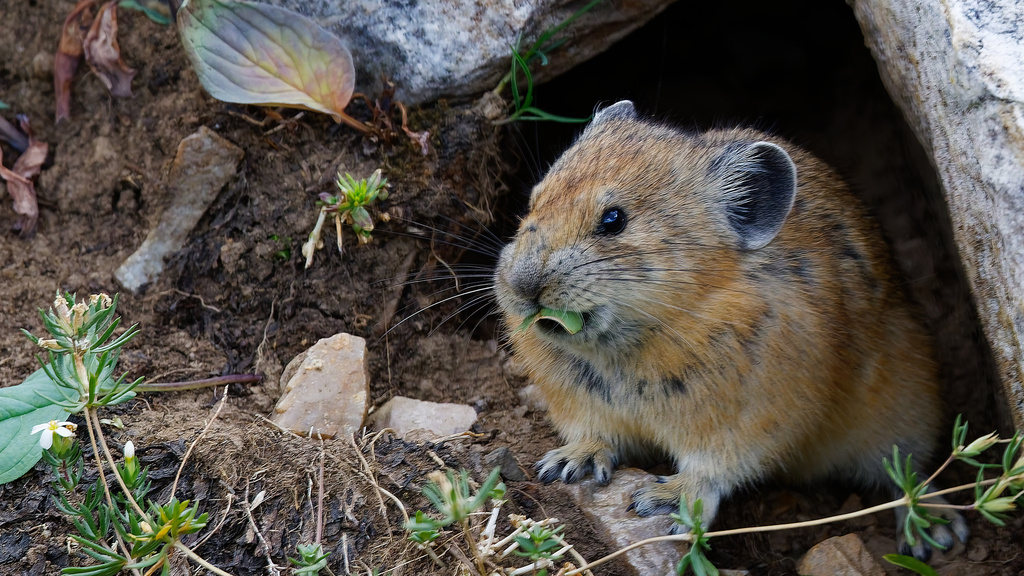
American Pika
Photo © Daughter Dad
Photo © Daughter Dad — CC BY 4.0 — Source: iNaturalist photo #566893759Identification
The American pika is a small, compact mammal weighing between 121 and 176 grams, measuring 16.2 to 21.6 centimetres in length. Its rounded body is densely furred from head to foot, providing excellent insulation for life in cold alpine environments. The species is easily recognized by its moderately large, rounded ears with dark fur and distinctive white margins, and its suborbital skull structure that differs from related species.
The pika's fur changes seasonally: in summer it ranges from grayish to cinnamon-brown with tawny tones, while in winter it becomes grayer and longer, with a slate-gray or lead-colored dense undercoat. The soles of its feet are densely furred except for black pads at the toes. Most distinctively, the pika possesses a very short tail so completely buried in fur that it appears hidden within the body rather than projecting outward—an adaptation providing extra insulation and protection from alpine winds.
Range & Habitat
The American pika is native to the mountainous regions of western North America, with its range extending from central British Columbia and Alberta in Canada southward through the U.S. states of Oregon, Washington, Idaho, Montana, Wyoming, Colorado, Utah, Nevada, California, and New Mexico. It is one of only two pika species native to North America. The species typically inhabits rocky slopes and talus fields at or above the tree line, often surrounded by alpine vegetation.
Pikas establish dens and nests in spaces within rock surfaces, usually between 20 and 100 centimetres in diameter, and frequently perch on larger, more prominent rocks. They favor cool, moist microhabitats such as high peaks and areas along watercourses. The species is highly sensitive to heat stress and has occasionally colonized man-made substrates such as mine tailings or lumber piles, though such populations remain secondary to natural rocky habitats.
Behaviour & Diet
Unlike most mammals of similar size, the American pika is diurnal, remaining active primarily during daylight hours. The species is notably vocal, employing a variety of calls and songs both to warn of approaching predators and during the breeding season. Pikas face predation from coyotes, martens, and hawks, and their vocal communication provides a crucial defense strategy.
American pikas are herbivorous and employ two distinct foraging strategies. They directly consume vegetation when conditions permit, and they also gather and store plant materials in structures known as "haypiles," which sustain them through the winter months. This haying behavior is essential for survival in alpine environments where food availability becomes severely limited during the cold season.
Best Time & Places to See It
American pikas are most active during daylight hours throughout the year, though they are most visible and vocal during the breeding season. They are common throughout the northwestern United States and Canada, making destinations in these regions reliable for observation. Alpine and subalpine rocky habitats—talus fields, scree slopes, and rocky peaks near or above the tree line—are the primary locations to search for this species.
Recent studies indicate that populations in the southwestern United States are declining due to habitat loss and global warming, making sightings less reliable in that region. Despite these regional declines, the American pika remains overall assessed as a species of Least Concern and remains common across much of its range, particularly in cooler northwestern locations with intact alpine habitat.
Photography Tips
Photographing pikas requires patience and an understanding of their habitat preferences. Position yourself near rocky outcrops and talus fields during midday hours when pikas are most active. The species' small size and tendency to perch on prominent rocks can make them visible from a distance, but a telephoto lens is essential for capturing detailed images without disturbing the animals.
The pika's coloration provides natural camouflage against rock and scree, so look for movement rather than shape. Their seasonal color changes—from cinnamon-brown in summer to grayer tones in winter—offer opportunities to document variation. Early morning and late afternoon light works best for highlighting the fine detail of their fur and the distinctive white ear margins. Since pikas are vocal animals, listening for their calls can help locate them before attempting photography.
Glacier National Park
Glacier, Canada
+162 birds+12 mammals
Where granite peaks pierce the clouds above the Columbia River valley, Glacier National Park protects one of the most dramatic mountain wilderness areas in western Canada.…
VIEW NATIONAL PARKKootenay National Park
Area G (Forster Creek/Mount Assiniboine), Canada
+181 birds+23 mammals
Where the spine of the Canadian Rockies rises above 3,000 metres, the high alpine realm around Forster Creek and Mount Assiniboine reveals one of the continent's…
VIEW NATIONAL PARKMount Revelstoke National Park
Area B (Shelter Bay/Mica Creek), Canada
+155 birds+8 mammals
Where the Columbia River carves through the western ranges of British Columbia, Shelter Bay and Mica Creek mark the entrance to a wilderness where subalpine meadows…
VIEW NATIONAL PARKBanff National Park
Improvement District No. 9, Canada
+264 birds+33 mammals
Where the Canadian Rockies thrust skyward in a cathedral of limestone and ice, Banff National Park preserves a wilderness of astounding vertical drama. Glacier-carved valleys cradle…
VIEW NATIONAL PARKJasper National Park
Improvement District No. 12, Canada
+235 birds+34 mammals
Where the Canadian Rockies rise in dramatic succession across western Alberta, Jasper National Park spans over 11,000 square kilometres of subalpine and alpine terrain, glaciated valleys,…
VIEW NATIONAL PARKLassen Volcanic National Park
Shasta County, United States
+239 birds+18 mammals
Volcanic peaks and geothermal upheaval have sculpted 545 square kilometers of Northern California into a landscape where fire and water engage in perpetual dialogue. Lassen Peak…
VIEW NATIONAL PARKYosemite National Park
Mariposa County, United States
+224 birds+28 mammals
Granite cliffs soar nearly a kilometer above the valley floor in this expanse of high Sierra wilderness, where glacial U-shaped valleys sculpt a landscape of dramatic…
VIEW NATIONAL PARKGrand Teton National Park
Teton County, United States
+247 birds+38 mammals
Where the Teton Range tears skyward in a dramatic escarpment above the Snake River valley, nearly 2,550 square kilometers of montane wilderness unfolds across Teton County,…
VIEW NATIONAL PARKYellowstone National Park
Park County, United States
+253 birds+43 mammals
Across nearly 11,400 square kilometres of the Rocky Mountain plateau, geothermal fury and pristine wilderness converge in one of Earth's most dynamic landscapes. Hot springs, geysers…
VIEW NATIONAL PARKMount Rainier National Park
Pierce County, United States
+187 birds+25 mammals
A volcanic colossus dominates the Cascade Range in western Washington, its 4,392-meter summit crowned year-round with glacial ice that cascades down toward temperate rainforest and subalpine…
VIEW NATIONAL PARKCrater Lake National Park
Klamath County, United States
+174 birds+13 mammals
At 1,949 metres above sea level, a volcanic caldera of impossible clarity holds one of North America's deepest and most pristine alpine lakes, ringed by pumice-and-ash…
VIEW NATIONAL PARKRocky Mountain National Park
Larimer County, United States
+259 birds+33 mammals
Where granite peaks rise above 12,000 feet and alpine tundra gives way to subalpine forest, Rocky Mountain National Park spans the Continental Divide across nearly 1,600…
VIEW NATIONAL PARKSequoia National Park
Tulare County, United States
+187 birds+27 mammals
Granite peaks rising above 3,600 meters dominate the southern Sierra Nevada, where Sequoia National Park sprawls across one of North America's most vertically compressed wilderness zones.…
VIEW NATIONAL PARKKings Canyon National Park
Fresno County, United States
+186 birds+20 mammals
Where granite peaks fracture the Sierra Nevada skyline and the Kings River has carved one of North America's most dramatic canyons, a landscape of extreme relief…
VIEW NATIONAL PARKWaterton Lakes National Park
Improvement District No. 04, Canada
+252 birds+31 mammals
Where the Continental Divide plunges toward the prairies of Alberta, glacier-carved valleys and emerald lakes pierce a landscape where montane forest meets alpine tundra. Waterton Lakes…
VIEW NATIONAL PARKYoho National Park
Area A (Kicking Horse/Kinbasket Lake), Canada
+207 birds+19 mammals
Where the Canadian Rockies meet the Columbia River watershed, a vast wilderness of 2,211 square kilometres unfolds across Yoho National Park in British Columbia. The landscape…
VIEW NATIONAL PARKGlacier National Park
United States
+246 birds+39 mammals
Where jagged peaks pierce a subarctic sky and glacial valleys carve through ancient rock, Glacier National Park spans the spine of the Northern Rockies along Montana's…
VIEW NATIONAL PARKNorth Cascades National Park
Whatcom County, United States
+120 birds+18 mammals
Jagged peaks rise abruptly from the western foothills of Washington's Cascade Range, where glaciers cling to elevations above 10,000 feet and meltwater feeds a landscape of…
VIEW NATIONAL PARKNational Elk Refuge
Jackson, United States
+230 birds+27 mammals
Where the sagebrush flats of northwestern Wyoming rise toward the Gros Ventre Mountains, winter transforms the landscape into a realm of survival and spectacle. The National…
VIEW WILDLIFE SANCTUARYNo community photos yet. Log in to add the first one.
No community observations of this species yet.