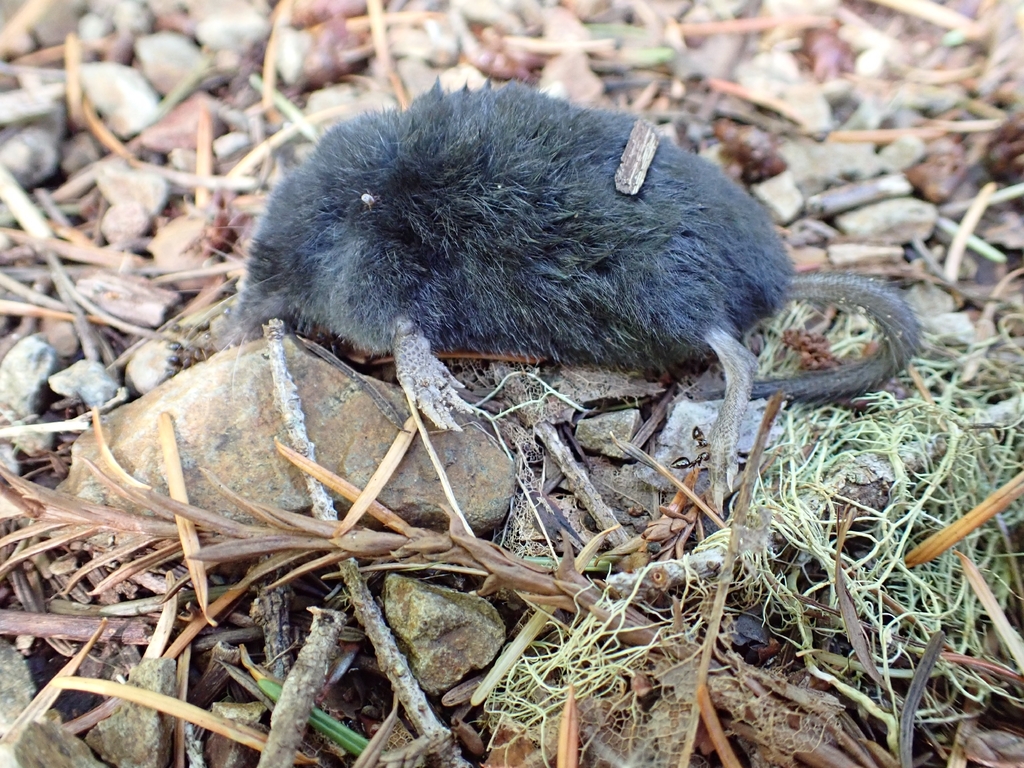
American Shrew Mole
Photo © Bennett Grappone
Photo © Bennett Grappone — CC BY 4.0 — Source: iNaturalist photo #633854192Identification
The American shrew mole is the smallest species of mole, weighing only about 10 grams with a body length of approximately 10 centimetres including its 3-centimetre tail. Despite its shrew-like appearance, it is a true mole with distinctive anatomical features that set it apart. Its dense, soft fur ranges from dark gray to sooty bluish-black, and it possesses a long, flattened snout coupled with a short, thick, bristled tail covered in scales and coarse hairs. The eyes are completely covered by skin, and it lacks external ear pinnae, adaptations that reduce drag while burrowing.
While superficially resembling shrews, the American shrew mole has skeletal features that confirm its mole lineage: a zygoma and auditory bullae absent in shrews, white enamel on its teeth rather than the reddish-brown of shrews, and a streamlined body with short appendages held close to the body. Its front paws are broad with bifurcate phalanges and elongated middle claws designed for digging, though they do not face outward as dramatically as in larger mole species.
Range & Habitat
The American shrew mole is found exclusively in the northwestern United States and southwestern British Columbia, inhabiting damp, forested or bushy areas with deep, loose soils. In the northern reaches of its range, it favours stream-side habitats and moist dense woods, while in the south it occupies swampy areas thick with vegetation such as sedges and shrubs.
Behaviour & Diet
This species is often active above ground, foraging in leaf litter for earthworms, insects, snails and slugs—with earthworms forming the most important part of its diet. It can also consume vegetation including mycorrhizal fungi and even small salamanders, and is capable of climbing bushes, though ground foraging remains its primary feeding strategy. Its diet varies with food availability; when insects and arthropods are scarce, it may rely more heavily on vegetation.
The American shrew mole constructs permanent tunnel networks using a unique lateral-stroke digging method, thrusting its forelimbs alternately to either side rather than directly downward as other fossorial mammals do. Its shallow tunnel systems rarely exceed 30 centimetres in depth, with burrows positioned beneath leaf litter and ventilation openings on the ceiling. Remarkably, these animals often reuse tunnels dug by other shrew-moles, as this requires less energy than creating new passages and may yield more prey.
Best Time & Places to See It
The American shrew mole is most readily observed in its preferred damp, forested habitats with loose soils in the Pacific Northwest. Look for evidence of its activity in the form of shallow surface runways and raised tunnel ridges beneath leaf litter in appropriate forest environments. Its habit of foraging above ground means it is occasionally encountered during wet weather or in shaded, moist microhabitats, particularly near streams and dense woody vegetation.
Photography Tips
Photographing the American shrew mole presents a considerable challenge due to its small size, cryptic habits, and preference for subterranean and nocturnal activity. Macro photography equipment is essential to capture detail of this ten-gram creature. Search in leaf litter and around tunnel entrances during or after rain when the soil is saturated and the animal may be more active near the surface. patience and keen observation are necessary, as encounters with this elusive species are far from guaranteed even in optimal habitat.
Mount Rainier National Park
Pierce County, United States
+187 birds+25 mammals
A volcanic colossus dominates the Cascade Range in western Washington, its 4,392-meter summit crowned year-round with glacial ice that cascades down toward temperate rainforest and subalpine…
VIEW NATIONAL PARKRedwood National Park
Humboldt County, United States
+343 birds+43 mammals
Where the Pacific fog rolls deep into northern California's coastal valleys, some of the tallest trees on Earth rise from a landscape shaped by tectonic forces…
VIEW NATIONAL PARKOlympic National Park
Jefferson County, United States
+263 birds+35 mammals
Where temperate rainforest meets alpine wilderness, Olympic National Park sprawls across nearly 11,000 square kilometers of the Pacific Northwest's most pristine landscape. The park's three distinct…
VIEW NATIONAL PARKNo community photos yet. Log in to add the first one.
No community observations of this species yet.