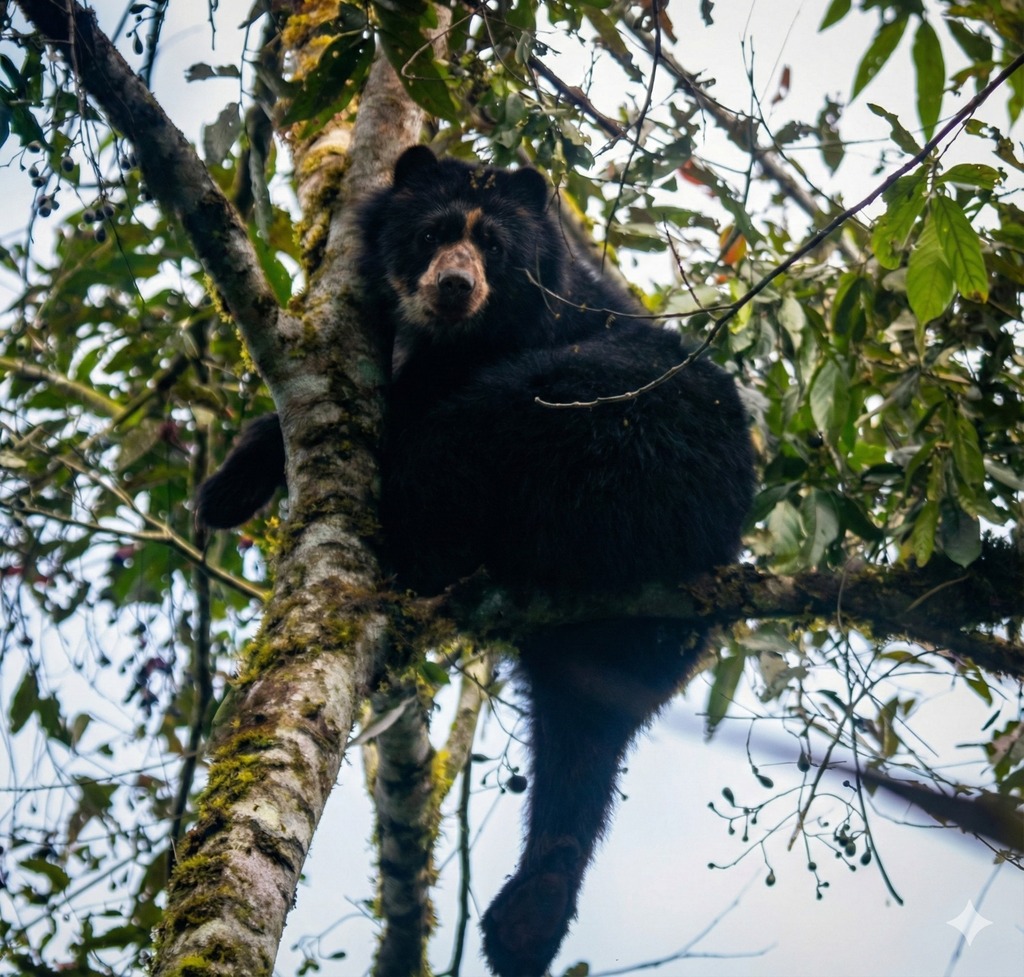
Andean Bear
Photo © Sidnei Dantas
Photo © Sidnei Dantas — CC BY-SA 4.0 — Source: iNaturalist photo #596244727Identification
The Andean bear, or spectacled bear, is South America's only living native bear species and the last surviving member of the short-faced bear subfamily. It is named for the distinctive light-coloured markings on its chest, neck, and face that resemble spectacles, though these facial patterns vary between individuals. The bear's scientific name, Tremarctos ornatus, reflects both an unusual hole on its humerus bone (tremarctos from Greek "hole") and its decorative markings (ornatus meaning "decorated" in Latin). Locally, it is known as jukumari, ukumari, or ukuku in indigenous languages—names that translate to "hole bear," referencing the tan facial markings that create the appearance of holes where the eyes should be.
Range & Habitat
The Andean bear is native to the Andes Mountains in northern and western South America. It inhabits densely vegetated mountainous terrain throughout this range. The species is classified as vulnerable by the IUCN, with habitat loss being the primary threat to its survival.
Behaviour & Diet
Unlike most other bears, the Andean bear is predominantly herbivorous, making it exceptional among omnivorous bear species. Its anatomy reflects adaptations to its mountain forest environment, including relatively gracile limbs and forelimbs longer than hindlimbs—characteristics that suggest arboreal activity and climbing capability. As the last surviving member of the Tremarctinae subfamily, a lineage that diverged from other bears approximately 5.7 million years ago, the Andean bear represents a unique evolutionary lineage with no close living relatives.
Best Time & Places to See It
The Andean bear inhabits the dense vegetation of the Andes Mountains across northern and western South America. Its elusive nature and preference for heavily forested terrain make sightings challenging for travellers and wildlife enthusiasts.
Photography Tips
Photographing this species requires patience and preparation. The bear's dark coloration and densely vegetated habitat demand fast film speeds or high ISO settings. The distinctive chest and facial markings are key identifying features worth capturing, though close approaches are difficult and potentially dangerous given the species' vulnerable status and need for habitat protection.
Nothing matches these filters.
Antisana National Park
Llanganates National Park
Manu National Park
Natural Chingaza National Park
Natural Farallones de Cali National Park
Podocarpus National Park
Puracé National Natural Park
Sangay National Park
Nothing matches these filters.
No community photos yet. Log in to add the first one.
No community observations of this species yet.