Aoudad
Photo © Kevin Floyd
Photo © Kevin Floyd — CC BY 4.0 — Source: iNaturalist photo #110535403Identification
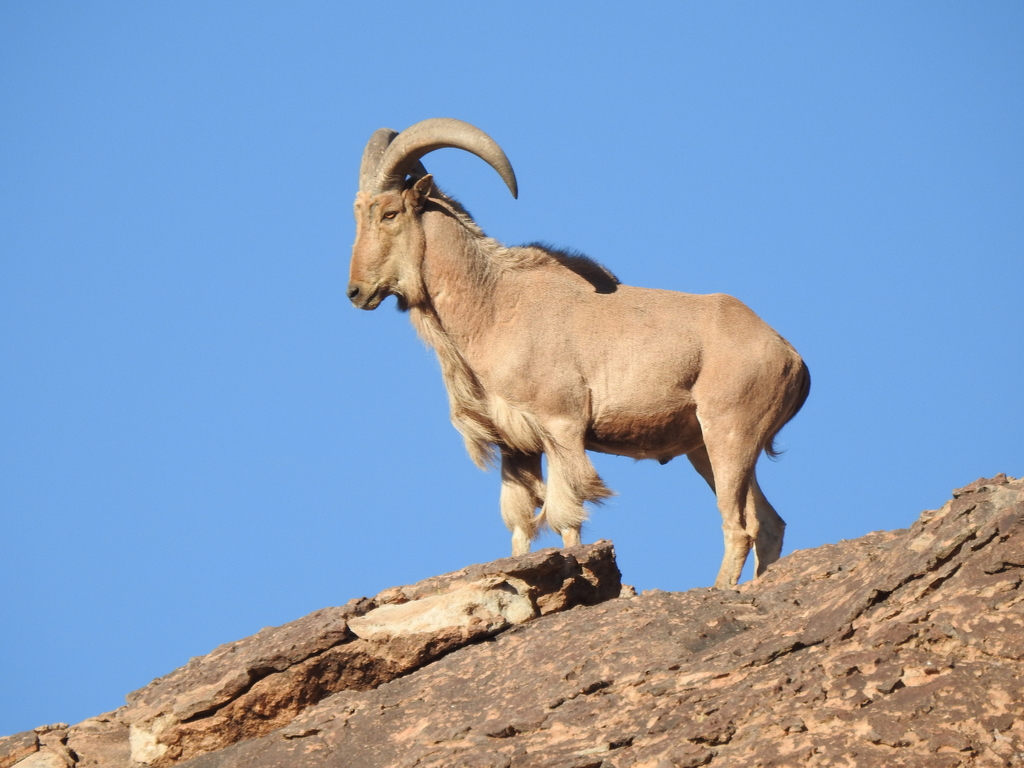
The aoudad is a sturdy caprine standing 75 to 110 cm at the shoulder with a body length around 1.5 m. Adults weigh between 30 and 145 kg, with colouration that is sandy-brown and darkens with age, complemented by a lighter underbelly and darker line along the spine. The upper parts and outer leg surfaces display uniform reddish- or grayish-brown tones. Males are distinguished by shaggy hair on the throat extending down the chest, while both sexes sport a sparse mane.
The most striking feature is the distinctive horns, which have a triangular cross-section and curve outward, backward, then inward, often exceeding 76 cm in length. The horns are fairly smooth with slight wrinkles appearing at the base as animals mature, making them a key identification feature from a distance.
Range & Habitat
The aoudad is endemic to rocky mountains across North Africa, including Algeria, Chad, Egypt, Libya, Mali, Mauritania, Morocco, Niger, Tunisia, Western Sahara, and Sudan. In North Africa, they inhabit arid mountainous terrain surrounding the Sahara Desert, particularly in steep, rocky mountains and canyons. However, populations in their native range have declined significantly due to hunting and habitat destruction.
The species has been introduced beyond its native range, establishing populations in southeastern Spain since 1970, particularly in Sierra Espuña Regional Park and expanding through Alicante, Almería, Granada, and Murcia provinces. Introduced populations also exist in the Canary Islands and in Palo Duro Canyon, Texas, where they were released in 1957–1958. These animals are extremely adaptable and have proven capable of colonizing new areas rapidly.
Behaviour & Diet
Aoudads are crepuscular, remaining active during early morning and late afternoon while resting during the heat of the day. They are remarkably agile, capable of standing jumps exceeding 2 m, and are supremely well-adapted to their steep, rocky terrain. When threatened, they typically flee uphill at the first sign of danger, relying on their mountainous habitat for refuge.
These sheep are herbivorous, grazing and browsing grasses, bushes, and lichens. Notably, they can obtain all necessary metabolic water from their food, though they will drink and wallow in liquid water when available. Aoudads are extremely nomadic, travelling constantly through mountain ranges. In their native North Africa, their main predators were the Barbary leopard, Barbary lion, and caracal, though today humans, feral dogs, and competition from domestic livestock overgrazing present the greatest threats to wild populations.
Best Time & Places to See It
In their native North African range, aoudads are now rare and populations are declining, making sightings challenging. However, introduced populations in southeastern Spain provide more reliable viewing opportunities. Sierra Espuña Regional Park in the Spanish provinces of Murcia, Alicante, Almería, and Granada represent key locations where populations have become established since 1970.
Early morning and late afternoon offer the best chances of observation, as aoudads are crepuscular and most active during these cooler periods. In North America, Palo Duro Canyon in Texas harbours an introduced population. Given their nomadic nature and preference for remote, steep terrain, patience and knowledge of local mountain habitats will significantly improve your chances of encountering these elusive animals.
Photography Tips
Photograph aoudads during early morning or late afternoon when they are most active and light conditions are optimal. Their sandy-brown colouration can blend seamlessly with rocky terrain, so scout high ridges and steep canyon walls where they typically seek refuge. A telephoto lens is essential given their wariness and tendency to flee uphill at the first sign of disturbance.
The animals' impressive curved horns and shaggy throat mane (particularly prominent in males) make excellent focal points. Capture them in their natural steep, rocky habitat to showcase their remarkable agility and adaptation. Position yourself lower in the terrain when possible to photograph them against the skyline, and remember that these nomadic creatures require active searching through mountainous terrain—expect to cover significant ground to locate them successfully.
Big Bend National Park
Brewster County, United States
+345 birds+34 mammals
Where the Chisos Mountains rise abruptly from the Sonoran Desert floor, Big Bend National Park spans over 7,300 square kilometers of one of North America's most…
VIEW NATIONAL PARKCarlsbad Caverns National Park
Eddy County, United States
+309 birds+18 mammals
Beneath the Chihuahuan Desert floor of southern New Mexico lies one of North America's most spectacular subterranean landscapes. Carlsbad Caverns National Park encompasses over 518 square…
VIEW NATIONAL PARKSerra de Mariola Natural Park
Bocairent, Spain
+164 birds+19 mammals
Where limestone ridges rise above the Valencian interior, Serra de Mariola unfolds across 225 square kilometers of Mediterranean mountain terrain that shifts between dense evergreen woodland,…
VIEW NATURE RESERVEGuadalupe Mountains National Park
Culberson County, United States
+262 birds+14 mammals
Where fossil-laden limestone ridges thrust skyward above the Chihuahuan Desert floor, Guadalupe Mountains National Park reveals a landscape sculpted by ancient seas and relentless aridity. These…
VIEW NATIONAL PARKNo community photos yet. Log in to add the first one.
No community observations of this species yet.