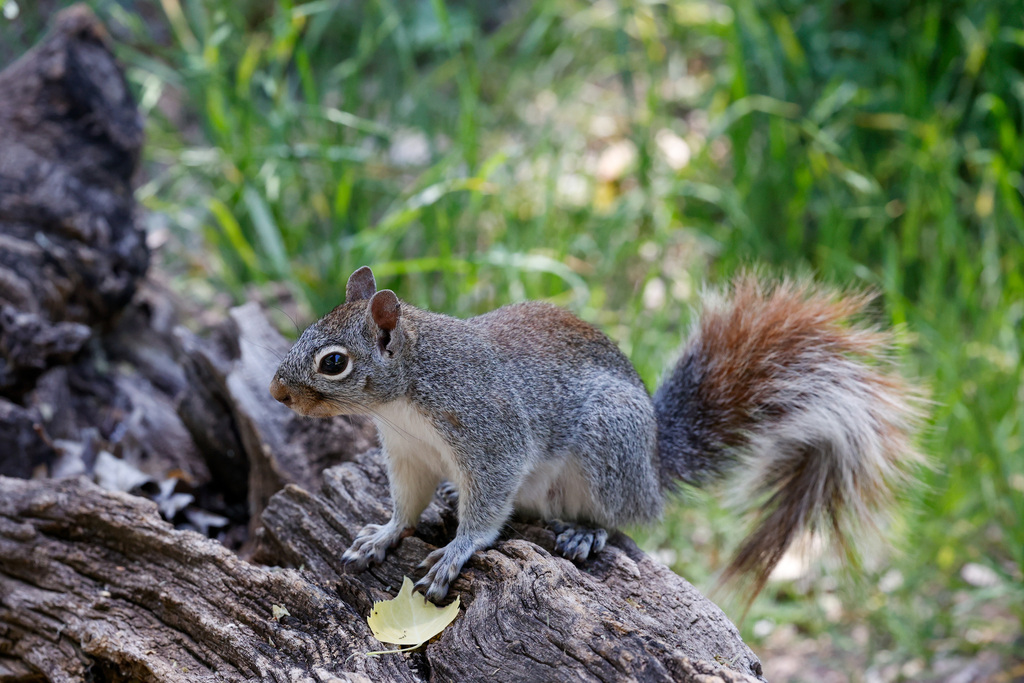
Arizona Gray Squirrel
Photo © Tom Field
Photo © Tom Field — CC BY 4.0 — Source: iNaturalist photo #612839266Identification
The Arizona gray squirrel is a medium-sized tree squirrel with a distinctive appearance that reflects its closest relationship to the fox squirrel, despite superficial similarities to other gray squirrels. Its primary coloring is silvery-gray with a white to cream-colored belly and a gray tail frosted with white. A distinguishing field mark is the red and black stripe on the underside of the tail. The head is relatively broad with a longer, flatter skull than its closest regional competitor, Abert's squirrel.
Arizona gray squirrels are most easily distinguished from Abert's squirrel by their smaller ears, which lack the prominent tufts characteristic of that species. They also have only one molar rather than two. Some sexual dimorphism exists within populations, though it varies geographically—in some areas males are larger, while in others females are larger.
Range & Habitat
This species is endemic to eastern Arizona, parts of New Mexico, and Sonora, Mexico, where it inhabits canyons and valleys surrounded by deciduous and mixed forests. Arizona gray squirrels occupy a range of elevations, from low-elevation pine-oak forests to higher elevation coniferous forests. They show a particular preference for mid-elevation riparian habitats, especially broadleaf riparian forests with large cottonwood and sycamore trees, which support the largest populations of the species.
While the species has experienced population decline in recent years due to habitat loss and competition from introduced Abert's squirrels, its range in New Mexico has remained stable with no significant recent expansion or reduction in overall distribution.
Behaviour & Diet
Arizona gray squirrels are active foragers with a remarkably broad diet. They feed on tree seeds, particularly pine cones, Douglas fir, and true firs—removing individual scales to access the seeds—as well as deciduous seeds such as acorns and walnuts. They also consume tree sap, bark, insect galls, flowers, and fungi. Unlike some squirrel species, they practice scatter-hoarding of seeds only rarely.
These squirrels nest in dreys woven from twigs and leaves high in tree canopies or in natural tree cavities. Males maintain much larger home ranges, averaging 113 hectares, while females typically occupy about 14 hectares. Males actively seek to maximize overlap with female territories, particularly during mating season. When alarmed, Arizona gray squirrels produce distinctive barking or chucking calls from elevated perches. They face predation from large raptors, foxes, and bobcats.
Best Time & Places to See It
The best opportunities to observe Arizona gray squirrels occur during late spring to early summer when young are born and family groups are most active. Riparian areas with mature cottonwood and sycamore trees in eastern Arizona and northern Mexico offer the highest probability of sightings, as these habitats support the largest populations. Mid-elevation mixed forests also provide good viewing opportunities.
Early morning hours, when squirrels are most active foraging, offer the best chances for encounters. Listen for their distinctive barking alarm calls, which often alert observers to their presence in the canopy.
Photography Tips
Photographing Arizona gray squirrels requires patience and positioning near large mature trees with closed canopies, where these squirrels feel secure. The silvery-gray coloring and distinctive tail markings photograph well in dappled sunlight filtering through the forest canopy. Pay attention to the red and black stripe on the tail's underside—positioning yourself to capture this diagnostic feature will help distinguish your images from other gray squirrel species.
Since males maintain large territories and are actively seeking females during mating season, spring may offer more frequent sightings and behavior opportunities. The contrast between their silvery coat and white belly provides good compositional opportunities, particularly when squirrels are perched against darker bark or foliage.
No community photos yet. Log in to add the first one.
No community observations of this species yet.