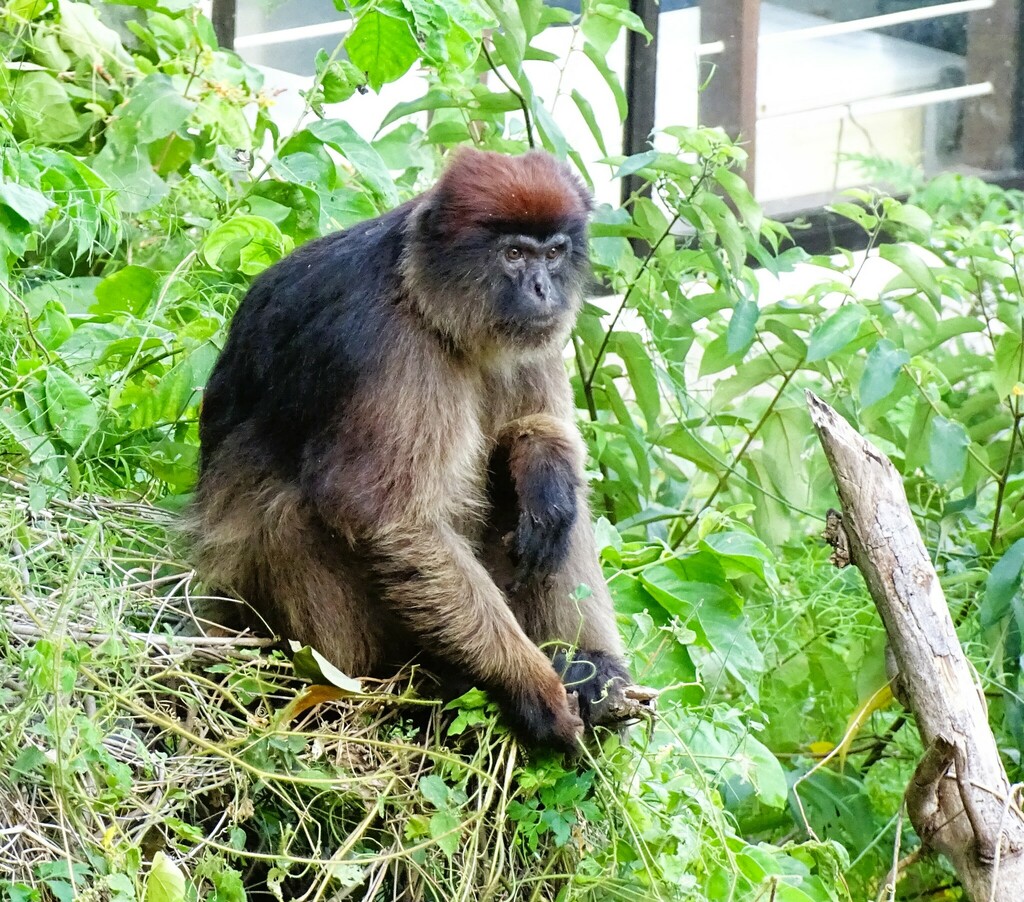
Ashy Red Colobus
Photo © Stan Rullman
Photo © Stan Rullman — CC BY 4.0 — Source: iNaturalist #228904502Identification
The Ugandan red colobus is a striking primate with a distinctive rust-red cap contrasting sharply against a dark grey to black face. Infants are born with completely black faces, gradually developing the adult coloration. The coat shows considerable variation: the back ranges from black through dark grey to reddish-brown, while the sides, arms and legs are light grey. A key identifying feature is their exceptionally long, dark to light brown tail, which they use for balance during their acrobatic canopy movements. These monkeys possess characteristic long feet that aid their impressive leaping ability, and like all colobus monkeys, they have thumbs reduced to near-absence—an adaptation that actually enhances their brachiating locomotion through the trees. Males are noticeably larger than females, weighing around 10.5 kg compared to females at approximately 7 kg.
Range & habitat
Found exclusively in East Africa, the Ugandan red colobus has a scattered distribution across 1,000 km spanning Uganda and Tanzania, with populations in only five separate forested areas. The largest and most viable population inhabits Kibale National Park in western Uganda, home to around 17,000 individuals. Other populations occur in the Gombe and Mahale Mountains bordering Lake Tanganyika, in forests at the edge of Lake Victoria in western Tanzania, and on the Ufipa Plateau. Kibale National Park, a protected area since 1993, features moist evergreen tropical forest with significant expanses of undisturbed woodland. In contrast, populations in other regions like the Mbisi Forest Reserve on the Ufipa Plateau inhabit fragmented and severely degraded habitats.
Behaviour & diet
These monkeys are folivores, meaning leaves form the main component of their diet. They are not selective about tree species, though different groups show individual preferences, and they particularly favor young leaves and petioles of mature leaves. Occasionally they supplement their diet with bark, seeds and fruits. Ugandan red colobus live in multi-male groups ranging from as few as three to as many as 85 individuals, with an average group size around 40. Group size is influenced by habitat quality and predation pressure, and is often determined by the number of resident males. Females outnumber males and can move between groups, being attracted to groups with more males. The species often exhibits fission-fusion behavior, splitting into smaller foraging parties when food is scarce. Grooming is frequent within groups, primarily performed by females.
Best time & places to see it
Kibale National Park in Uganda offers the best opportunity to encounter Ugandan red colobus, as it supports the largest and most stable population. The park's protected status and moist evergreen forest provide ideal viewing conditions. The Gombe and Mahale Mountains in Tanzania offer additional opportunities, though populations there are smaller and more fragmented. The Ugandan red colobus frequently associates with other primate species, particularly red-tailed monkeys, which can actually aid in locating groups. Visiting during periods of good forest productivity may yield better sightings, as group movements and visibility vary with seasonal food availability.
Photography tips
The striking contrast between the rust-red cap and dark facial markings makes for compelling portraits, especially in dappled canopy light. Their long tails and acrobatic movements through the trees offer dynamic action shots—position yourself to capture their powerful leaps between branches. Early morning light filtering through the canopy is ideal for highlighting the subtle variations in coat color. When photographing infants, note their completely black faces, which provide stark contrast to adult coloration. Since these monkeys often travel in association with red-tailed monkeys, you may capture interesting multi-species compositions. Their reduced thumbs are a distinctive detail worth documenting in close-up shots of hands gripping branches.
Toro-Semliki Proposed National Park
Uganda
+474 birds+5 mammals
Where the Albertine Rift's western escarpment rises above the Semliki River valley, a vast mosaic of forest, savanna and wetland converges to create one of East…
VIEW NATIONAL PARKQueen Elizabeth National Park
Uganda
+672 birds+30 mammals
Across the southwestern escarpment of Uganda, where the Western Rift Valley descends through ancient volcanic terrain, Queen Elizabeth National Park sprawls across more than 8,300 square…
VIEW NATIONAL PARKNo community photos yet. Log in to add the first one.