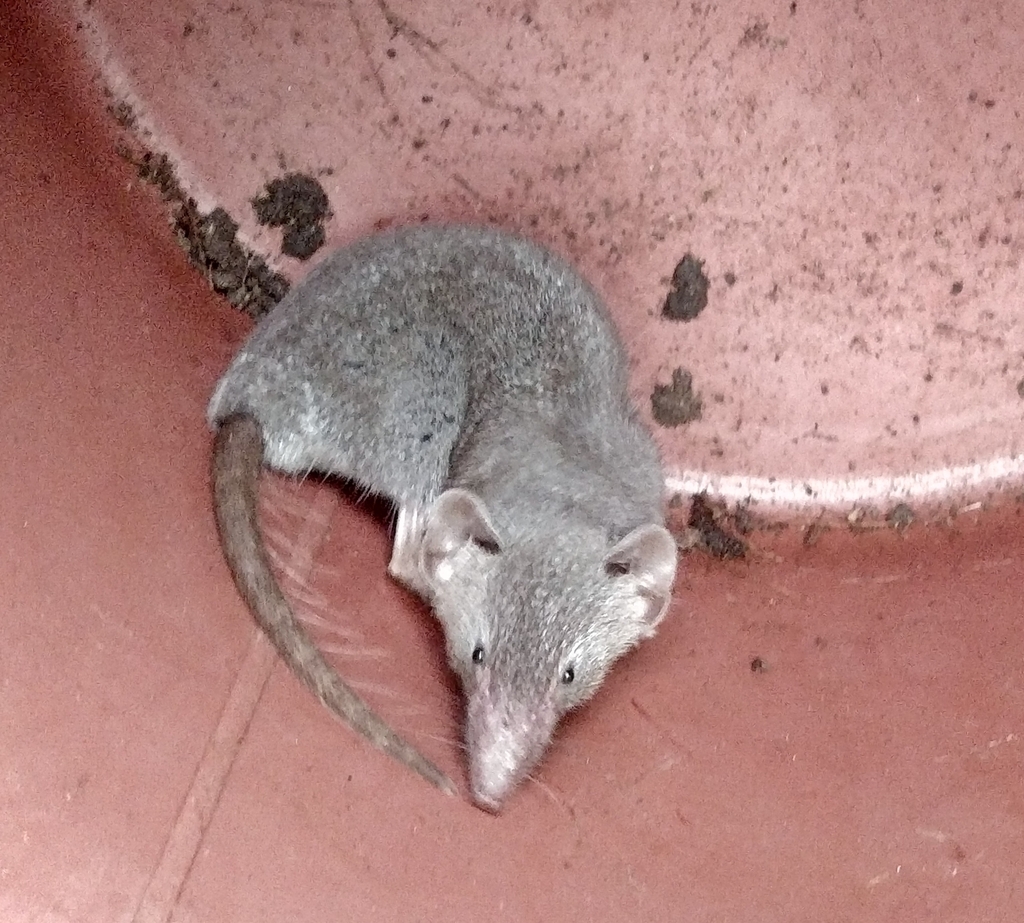
Asian House Shrew
The Asian house shrew (Suncus murinus) is a shrew species native to South and Southeast Asia that has been listed as Least Concern on the IUCN Red List since 2008 because of its large population and wide distribution. It has been introduced in several West Asian and East African countries. It is considered an invasive species and has been implicated in the demise of several island lizard species. It is also called house shrew, grey musk shrew, Asian musk shrew or Indian musk shrew. == Taxonomy == Sorex murinus was the scientific name proposed by Carl Linnaeus in 1766 for a house shrew from Java. In the late 18th to early 20th centuries, several house shrew zoological specimens were described as distinct species that are considered synonyms today: Sorex myosurus by Peter Simon Pallas in 1781; Sorex viridescens by Edward Blyth in 1859 was a house shrew from the Malabar coast, India; == Description == The house shrew has a uniform, short, dense fur of mid-grey to brownish-grey color. The tail is thick at the base and a bit narrower at the tip, and is covered with a few long, bristle-like hairs that are thinly scattered. They have short legs…
Valmiki National Park
Ramnagar, India
+128 birds+30 mammals
Where the Himalayan foothills soften into the Ganges plains, dense sal forests rise above meandering rivers and grassland mosaics that […]
VIEW NATIONAL PARKRanthambhore National Park
Sawai Madhopur, India
+126 birds+25 mammals
Where granite fortresses rise from the Aravalli Hills, a sprawling mosaic of dry deciduous forest, grassland, and ten interconnected lakes […]
VIEW NATIONAL PARKKhao Laem Ya-Mu Ko Samet National Park
Mueang Rayong District, Thailand
+132 birds+30 mammals
Where limestone cliffs plunge into crystalline waters and coastal forests merge with rocky outcrops, a mosaic of Thailand’s most pristine […]
VIEW NATIONAL PARKKomodo National Park
Komodo, Indonesia
+69 birds+14 mammals
Where volcanic peaks rise dramatically from turquoise waters, a primordial landscape unfolds across three main islands and countless smaller ones […]
VIEW NATIONAL PARKNo community photos yet. Log in to add the first one.
No community observations of this species yet.