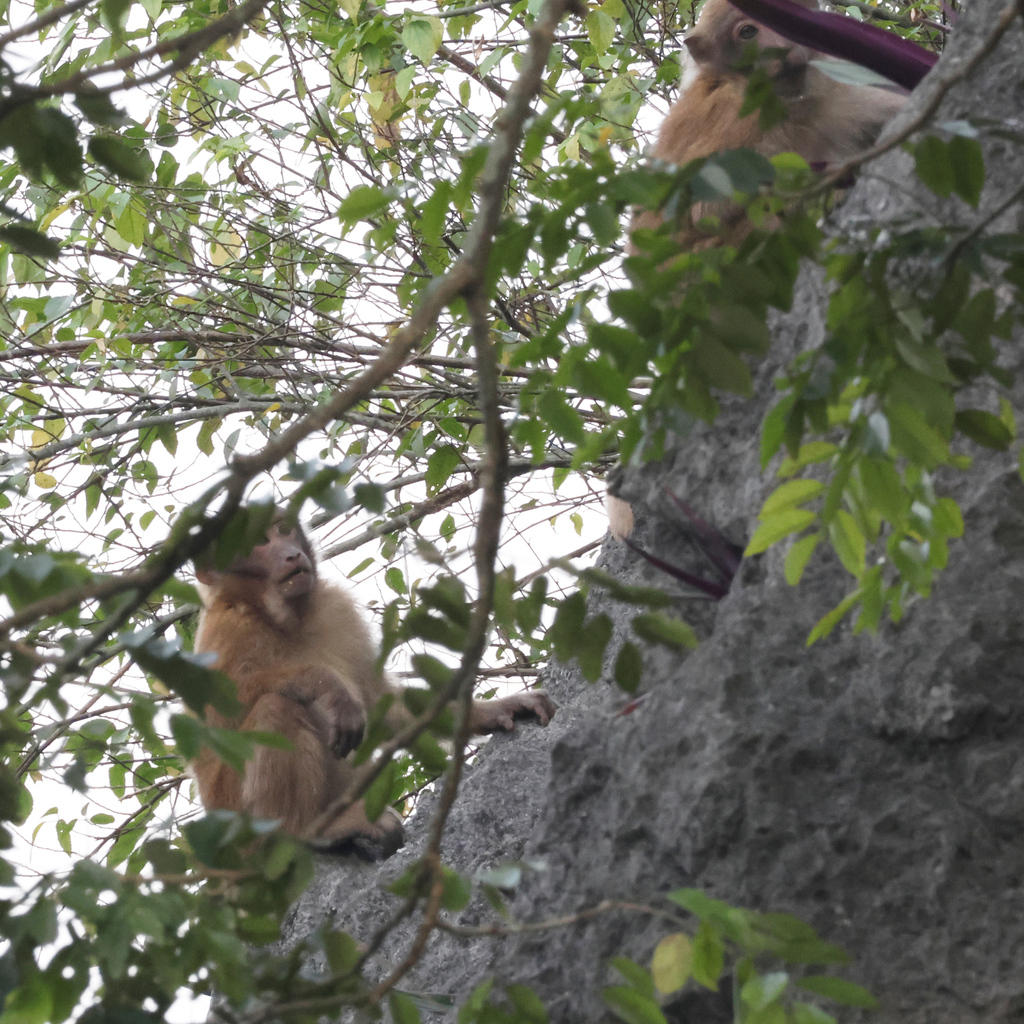
Assamese Macaque
Photo © Huey
Photo © Huey — CC BY 4.0 — Source: iNaturalist #252261068Identification
The Assam macaque is a stockily built Old World monkey with a distinctive yellowish-grey to dark brown coat. Its facial skin is dark brownish to purplish, and a characteristic dark fringe of hair on the cheeks is directed backwards towards the ears, while the crown hair is distinctly parted down the middle. The shoulders, head, and arms are noticeably paler than the greyish hindquarters. The tail is short and well-haired, measuring 15 to 30 cm long. Adult individuals measure 51 to 73.5 cm from head to body and typically weigh between 5 and 10 kg, making them relatively compact compared to larger macaque species.
Range & Habitat
The Assam macaque is native to South and Southeast Asia, with populations occurring across Nepal, northeastern India, Laos, and Vietnam. In Nepal, they inhabit areas east of the Kali Gandaki river between 200 and 1,800 metres elevation. In northeastern India, they favour tropical and subtropical semievergreen forests, dry deciduous and montane forests, ranging up to 4,000 metres. Across Laos and Vietnam, they prefer elevations above 500 metres, with a general preference for hilly terrain above 1,000 metres, though in wetter eastern regions they also occur in lowland areas and limestone karst forests at lower elevations.
Behaviour & Diet
Assam macaques are diurnal primates that move both through the trees and on the ground. They are highly social, living in groups that typically range from 13 to 35 individuals. These omnivorous monkeys feed on fruits, leaves, invertebrates, and cereals, and are known to raid agricultural areas. In Nepal's Langtang National Park, they showed a strong preference for maize kernels and potato tubers, but also consumed wheat, buckwheat, and millet when available. Groups maintain defined home ranges, with population densities varying by habitat quality and availability of resources.
Best Time & Places to See It
Key locations for encountering Assam macaques include Namdapha National Park in Arunachal Pradesh, India, and Nepal's Langtang National Park, both of which support substantial populations. The species thrives in montane and submontane forests throughout its range. Since these are diurnal animals, early morning hours typically offer the best viewing opportunities when groups are most active and vocal. The wetter months may concentrate them in higher elevations, while drier seasons may bring them to lower-altitude forests.
Photography Tips
The striking facial features and parted crown make individual portraits rewarding subjects. Their habit of moving between ground and canopy offers diverse compositional opportunities—capture them both on forest floors and in branches to showcase their semi-arboreal lifestyle. Early morning light enhances the subtle colour gradations between their paler shoulders and darker hindquarters. Group dynamics and social interactions, particularly within larger troops, provide compelling behavioural shots. Wide apertures help isolate subjects in dense forest environments, while patience during feeding sessions yields natural, unguarded moments.
No community photos yet. Log in to add the first one.
No community observations of this species yet.