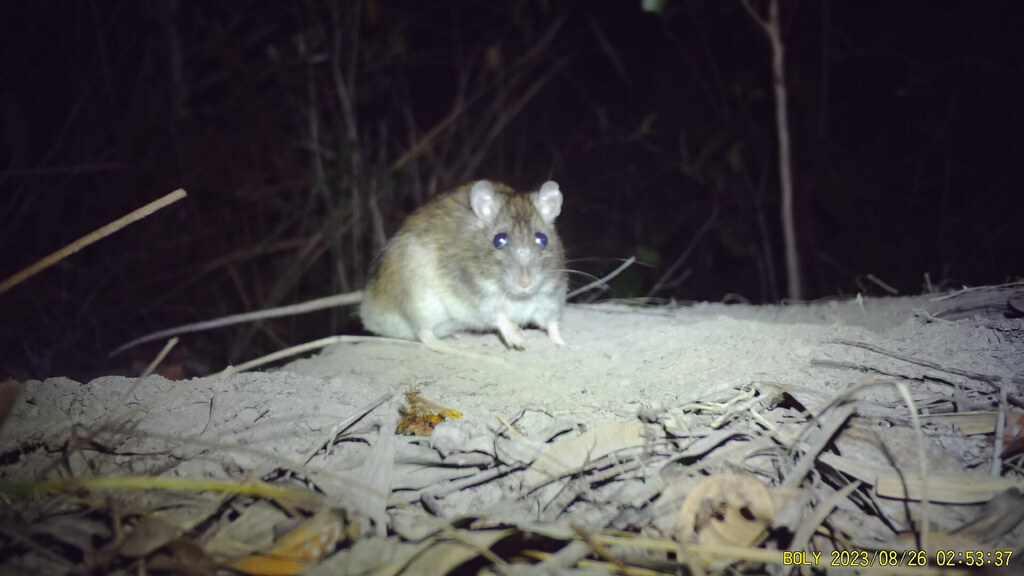
Australian Pale Field Rat
Photo © Scott W. Gavins
Photo © Scott W. Gavins — CC BY 4.0 — Source: iNaturalist photo #322893810Identification
The Australian pale field rat is a medium-sized rodent with distinctive colouring that makes it attractive to observe. Its upper fur is a toffee-like shade of yellow-brown, grading into cream or greyish-white on the underside. The hair across the upper back is slate-grey beneath with sandy-buff overlaying it. A defining feature is the tail, which at 80 to 150 mm is noticeably shorter than the combined head and body length of 120 to 195 mm. The species has pale pinkish ears measuring 15 to 20 mm and characteristically large, bulging eyes. Weight ranges from 50 to 210 grams, and the feet are covered with white hair on their upper surface.
Range & Habitat
Once widespread across mainland Australia, the pale field rat's range has contracted dramatically during the twentieth century and is now restricted to coastal and sub-coastal regions of the north and east. The eastern subspecies (R. tunneyi culmorum) occurs from Coffs Harbour in New South Wales to Coen in Queensland, while the nominate western subspecies (R. tunneyi tunneyi) is found in coastal northern regions through to the Kimberley in Western Australia, including offshore islands in the Pilbara. They inhabit tall grasslands, dense sedges, monsoon forest with grassy understorey, and wetter open grasslands, typically near watercourses with friable soils. They may also be found in sugar cane fields along the eastern coast and at rocky slopes in Kakadu National Park.
Behaviour & Diet
Pale field rats are nocturnal and herbivorous, spending daylight hours in shallow burrows dug in loose sand or crumbly soil. They are generally docile and live in loosely connected, scattered groups with runways linking their nests, though the degree of sociality remains unclear. They forage for grass stems, seeds, tubers and roots, digging to expose subsurface foods. The eastern subspecies breeds primarily during austral spring (September to November), while northern populations breed during the drier months (March to August). Litters typically contain around four young, though ranging from two to eleven, with a gestation period of 21 to 22 days.
Best Time & Places to See It
Spotting pale field rats requires nocturnal visits, as these rats are strictly active after dark. The best locations are the grasslands and coastal regions of northern Australia and the Queensland east coast. Kakadu National Park offers good opportunities, as do coastal and sub-coastal grassland areas from Coffs Harbour northward. The breeding seasons (September to November in the east, March to August in the north) may offer increased activity and visibility. Look near watercourses and in areas with dense vegetation and friable soils.
Photography Tips
Photographing this species requires night-time techniques and patience. Use a headlamp or red-light torch to avoid disturbing the rat, as these are less disruptive than white light. Position yourself near burrows or along known runways in suitable habitat, particularly near watercourses. The attractive yellow-brown colouring and distinctive short tail make good photographic subjects. A macro or telephoto lens will allow you to capture details of the pale ears, large eyes, and white-haired feet. Move slowly and quietly to avoid startling these generally docile animals, and allow time for them to emerge from their burrows and forage naturally.
Kakadu National Park
Kakadu, Australia
+273 birds+46 mammals
Kakadu National Park is Australia’s largest national park and one of the world’s most remarkable protected areas, covering nearly 20,000 square kilometres in the tropical north…
VIEW NATIONAL PARKNitmiluk National Park
Australia
+186 birds+27 mammals
Dramatic sandstone gorges carved by the Katherine River slice through the tropical savanna of Australia's Top End, creating a landscape where escarpments tower above crystalline pools…
VIEW NATIONAL PARKGreat Sandy National Park
Australia
+306 birds+40 mammals
Where coastal dunes rise inland from the Queensland coastline, Great Sandy National Park encompasses a landscape of remarkable ecological diversity shaped by subtropical humid conditions year-round.…
VIEW NATIONAL PARKNo community photos yet. Log in to add the first one.
No community observations of this species yet.