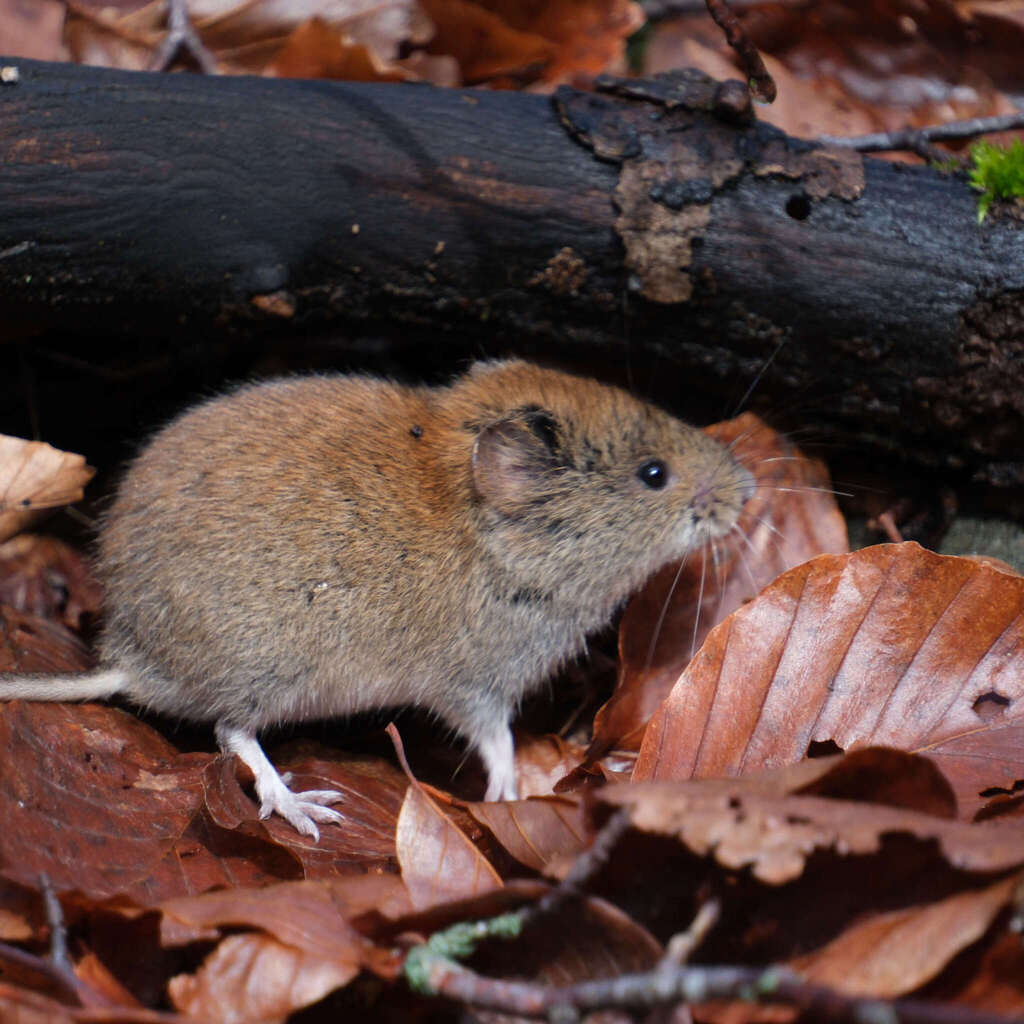
Bank Vole
Photo © Peter Crowcroft
Photo © Peter Crowcroft — CC BY 4.0 — Source: iNaturalist #268692759Identification
The bank vole is a small rodent, typically 83–121 millimetres in head and body length, with distinctive reddish-brown fur on the dorsal surface and grey flanks with a reddish-brown sheen. Its underparts are whitish-grey, sometimes with a dull yellow tinge. Young animals are darker with greyer underparts. The species has a notably hairy tail ranging from 38 to 76 millimetres—roughly half its body length—and larger ears than most other voles, giving it a slightly rounder head appearance than its mouse-like young. Adults weigh between 15.4 and 36 grams. In Great Britain, the bank vole is easily distinguished from the short-tailed vole by its chestnut-brown fur, more prominent ears, and proportionally longer tail.
Range & Habitat
The bank vole is found across much of Europe and northwestern Asia, with a Palearctic distribution spanning from Great Britain and continental Europe through Asia Minor and into Western Siberia. It is native to Britain but was accidentally introduced to Ireland in the 1950s, where it has colonised much of the south and southwest. The species does not occur in Iceland, northern Fenno-Scandia (except Finland), most of the Iberian Peninsula, or parts of Italy and the Balkans.
The bank vole inhabits forests—particularly deciduous and mixed woodland with scrub and leaf litter—as well as hedgerows, field verges, bracken and bramble patches, river banks, swamps, and parks. In mountainous regions and the northern part of its range, it occurs in coniferous woodland at altitudes up to 1,800 metres. It requires ample ground cover and does not occur on bare soil. In the Mediterranean region, it is a habitat specialist, found in moist woodland but avoiding grassland and bushy areas. At forest margins, populations may fluctuate seasonally, with some areas emptying in winter and repopulating in summer.
Behaviour & Diet
Bank voles are active both day and night and do not hibernate. They are generally bold but alert to alarm calls from other animals. They excavate long, shallow branching burrows with multiple exits, sometimes tunnelling beneath leaf litter, and construct nests with moss, dry grasses, and leaves either near the surface or above ground. These voles are primarily herbivorous, feeding on leaves, grasses, roots, buds, bark, fruits, nuts, grain, and seeds. They clip grass stalks and pile cut pieces, and they gather and store food in dedicated underground chambers. Occasionally, they consume insects, spiders, worms, and ground-nesting bird eggs. In winter, they climb trees to feed on bark of beeches, maples, and larch several metres above the ground. They can live 18 months to two years in the wild, and over 42 months in captivity.
Best Time & Places to See It
Bank voles are present year-round and active throughout the day and night, making them potentially observable in any season, though their visibility varies with habitat conditions. They are most abundant in deciduous and mixed woodlands with dense ground cover—particularly areas with brambles, bracken, hedgerows, and fallen leaves. Summer offers the best opportunity for observation, as populations are typically highest and breeding activity increases female visibility. Look along woodland edges, in dense scrub vegetation, and among leaf litter. In mountainous regions, check coniferous woodland areas. The Skomer vole subspecies in West Wales represents a notable concentration, with possibly 20,000 individuals present in late summer.
Photography Tips
Photographing bank voles requires patience and attention to their habitat preferences. Position yourself near areas of dense ground cover, particularly where brambles, bracken, and leaf litter are thick, as these provide security and feeding opportunities. Early morning and dusk may offer the best light, though these voles are active throughout the day. Move slowly and quietly to avoid alerting their sensitive predator-detection systems. Focus on capturing their distinctive features: the reddish-brown fur, prominent ears, and proportionally longer hairy tail. Macro photography equipment will be necessary given their small size. Patient observation of burrow entrances and feeding areas along woodland edges and hedgerows offers the greatest likelihood of capturing this elusive rodent.
No community photos yet. Log in to add the first one.
No community observations of this species yet.