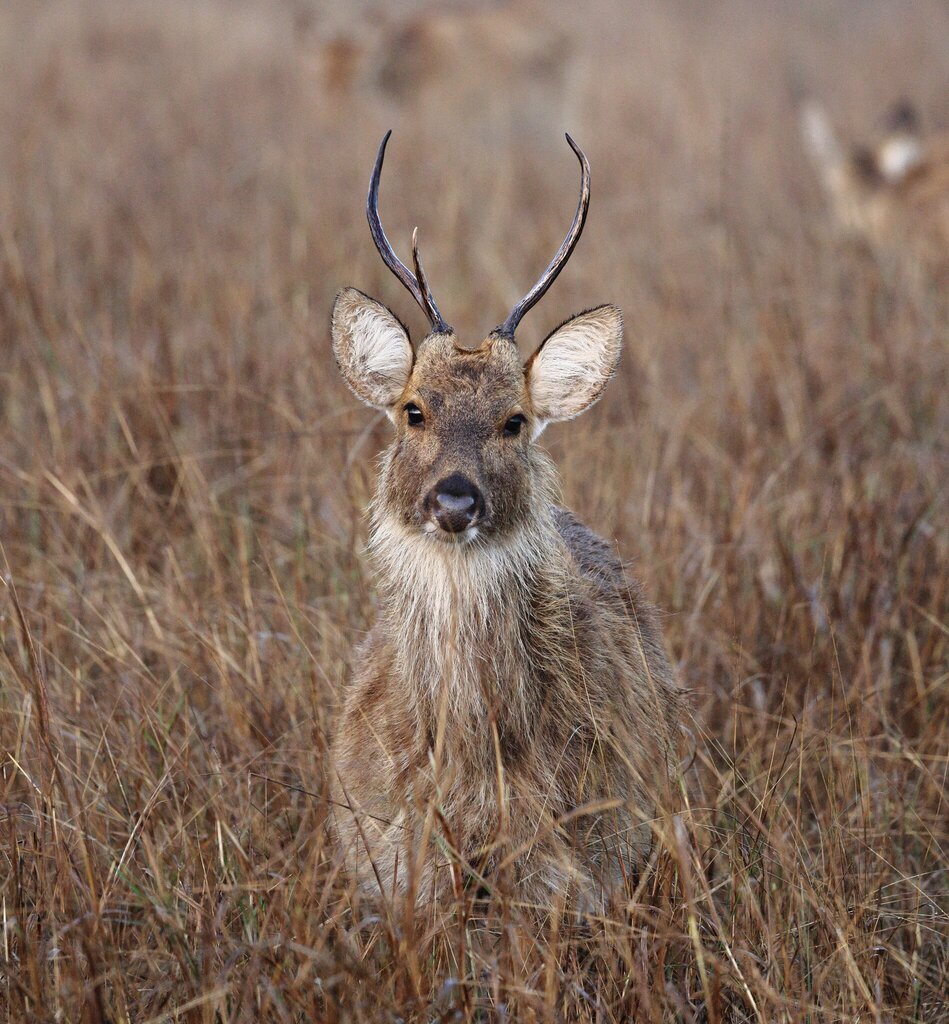
Barasingha
Photo © Darren Obbard
Photo © Darren Obbard — CC BY 4.0 — Source: iNaturalist #344966286Identification
The barasingha, or swamp deer, is a large Indian deer species distinguished by its impressive antlers, which carry more than three tines—a feature unique among Indian deer. The name "barasingha" means "twelve-horned" in Hindi, reflecting the typical antler structure. Mature stags usually display 10 to 14 tines, though some individuals have been recorded with up to 20. Average antlers measure around 76 centimetres round the curve, with a girth of 13 centimetres at the mid-beam.
The barasingha is a robust deer with a shoulder height of 110 to 120 centimetres and a head-to-body length of nearly 180 centimetres. Stags weigh between 170 and 280 kilograms, while females are considerably lighter at 130 to 145 kilograms. The coat is woolly and yellowish-brown above but paler below, with characteristic white spots along the spine. The throat, belly, inside of thighs, and area beneath the tail are white. In summer, the coat brightens to a rufous-brown hue. The neck is distinctly maned, and females are noticeably paler than males. Young animals are spotted.
Range & Habitat
Once common across many regions of the Indian subcontinent, the barasingha now occupies fragmented populations in northern and central India, with two isolated populations in southwestern Nepal. The species has been extirpated from Pakistan and Bangladesh, with its presence uncertain in Bhutan. In Nepal, populations survive in Shuklaphanta and Bardiya National Parks. In India, significant populations occur in Kanha National Park, parts of Uttar Pradesh, and Assam's Kaziranga and Manas National Parks, with a small population discovered in Jhilmil Jheel Conservation Reserve in Uttarakhand representing the northernmost range limit.
Barasingha favour flat or undulating grasslands, floodplains, and marshes, typically remaining on forest outskirts, though they are occasionally found in open forest. Three subspecies are recognized, each adapted to different habitats: the western swamp deer features splayed hooves suited to flooded grasslands of the Indo-Gangetic Plain; the southern swamp deer has hard hooves adapted to dry ground in open sal forest; and the eastern swamp deer occurs only in Assam.
Behaviour & Diet
Barasingha are primarily grazers, feeding extensively on grasses and aquatic plants including Saccharum, Imperata cylindrica, and various aquatic species. They feed throughout the day with peaks during morning and late afternoon to evening hours. In central India, herds typically comprise 8 to 20 individuals on average, though larger aggregations of up to 60 have been recorded, with approximately twice as many females as males. During the breeding season from September to April, herds form larger groups of adults.
Young are born singly after a gestation period of 240 to 250 days, with births occurring primarily from August to November, peaking in September and October. Compared to other Indian deer species, barasingha are notably relaxed and have fewer sentinel individuals, spending most of their time grazing. When alarmed, they produce distinctive shrill, baying alarm calls. Water consumption varies seasonally, with twice-daily drinking in winter and monsoon seasons, and three or more times daily in summer heat, when they rest in tree shade.
Best Time & Places to See It
Kanha National Park in Madhya Pradesh offers reliable opportunities for viewing barasingha, particularly the southern subspecies. In Nepal, Shuklaphanta and Bardiya National Parks support the most robust populations and are excellent destinations for observing this species. Kaziranga National Park in Assam provides chances to see the eastern subspecies, while various sites in Uttar Pradesh support western populations. The breeding season from September through April may offer particularly rewarding viewing as herds congregate.
Early morning and late afternoon visits to grassland and floodplain areas yield the best sightings, as barasingha feed during these peak hours. The wet monsoon season provides optimal habitat conditions, though winter months also present good opportunities in protected areas where populations are stable and habituated to human presence.
Photography Tips
The barasingha's impressive antlers and distinctive multi-tined structure are the primary photographic subjects—aim to capture the characteristic 10 to 14 points clearly silhouetted. The pale coloration along the spine and white markings on the underside provide compositional opportunities for side and rear-angle shots. Summer's bright rufous-brown coat offers warmer tones than the duller yellowish-brown winter pelage.
Herds of 8 to 20 individuals allow for dynamic group compositions, while the maned neck of stags merits close-up detail work. Early morning and late afternoon light suits grassland and floodplain habitats where these deer congregate. The species' relatively relaxed demeanour compared to other Indian deer may permit closer approach, though maintaining ethical distance remains essential. Photographing females and young alongside antlered males provides narrative context about herd composition and breeding status.
Where to stay to see the Barasingha
Kanha Tiger Reserve
Kanha Kisli F.V., India
+321 birds+23 mammals
Where sal forests give way to emerald meadows and crystalline streams carve through ancient valleys, one of India's finest wilderness reserves unfolds across the Maikal Range.…
VIEW NATIONAL PARKKaziranga National Park
Kohora, India
+422 birds+26 mammals
Dawn breaks over the floodplains of the Brahmaputra, where tall grasslands stretch endlessly beneath monsoon-heavy skies. This sprawling wilderness of northeastern Assam is a mosaic of…
VIEW NATIONAL PARKNo community photos yet. Log in to add the first one.
No community observations of this species yet.