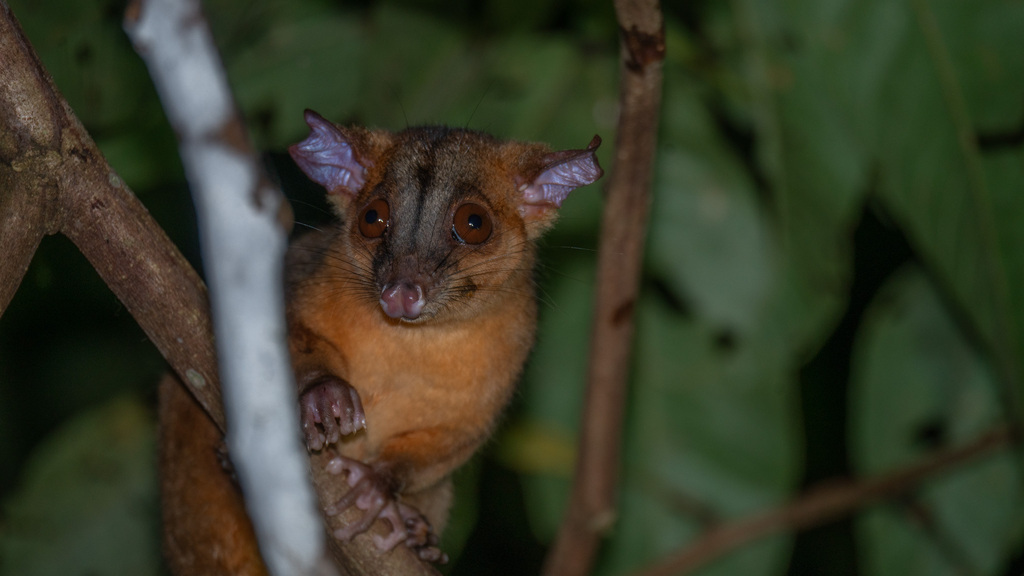
Bare-tailed Woolly Opossum
Photo © Sylvain Eichhorn
Photo © Sylvain Eichhorn — CC BY 4.0 — Source: iNaturalist photo #462911409The bare-tailed woolly opossum (Caluromys philander) is an opossum from South America. It was first described by Swedish zoologist Carl Linnaeus in 1758. The bare-tailed woolly opossum is characterized by a gray head, brown to gray coat, orange to gray underside and a partially naked tail. It is nocturnal (active mainly at night) and solitary; there is hardly any social interaction except between mother and juveniles and in mating pairs. The opossum constructs nests in tree cavities, and its litter size ranges from one to seven. Gestation lasts 25 days, and the juveniles exit the pouch after three months; weaning occurs a month later. The bare-tailed woolly opossum inhabits subtropical forests, rainforests, secondary forests, and plantations; its range extends from northern Venezuela to northeastern and southcentral Brazil. The IUCN classifies this opossum as least concern. == Names == It is called mucura-xixica in Portuguese, zarigüeya lanuda parda in Spanish, and wakaro in the Kwaza language of Rondônia, Brazil. == Taxonomy == The bare-tailed woolly opossum is one of the three members of Caluromys, and is placed in the family Didelphidae in the marsupial order Didelphimorphia. It was first described by Swedish zoologist Carl Linnaeus as Didelphis philander in the 10th…
No community photos yet. Log in to add the first one.
No community observations of this species yet.