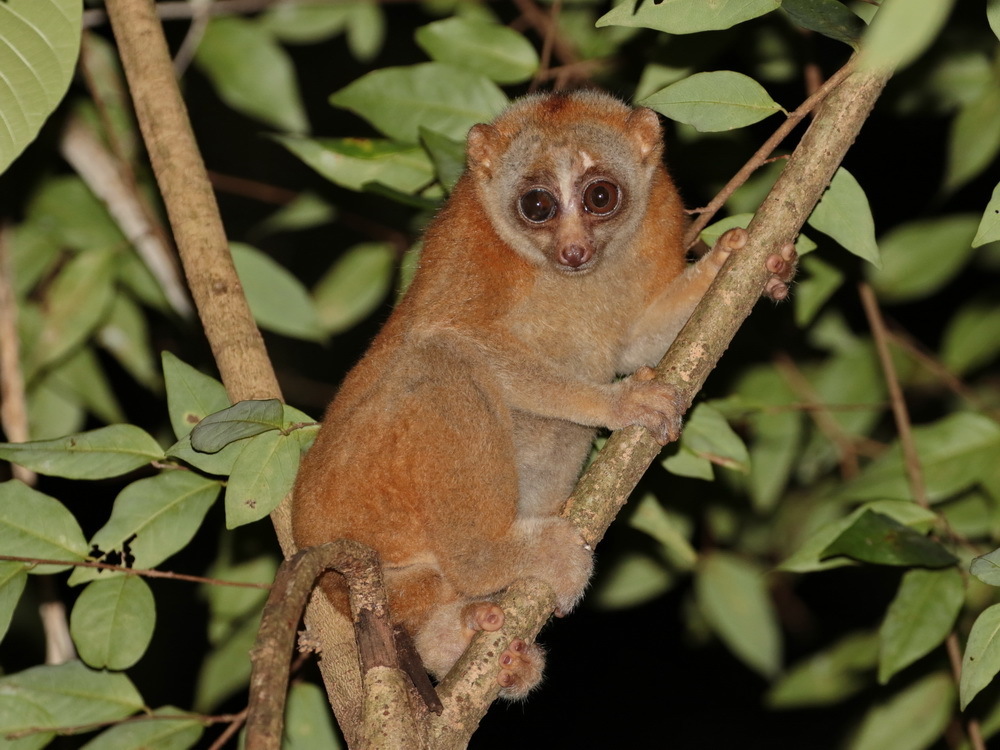
Bengal Slow Loris
Photo © Ian Dugdale
Photo © Ian Dugdale — CC BY 4.0 — Source: iNaturalist photo #86903726Identification
The Bengal slow loris is the largest species of slow loris, measuring 26 to 38 cm from head to tail and weighing between 1 and 2.1 kg. It has dense, woolly brown-gray fur on its back contrasting with white underside fur, and a distinctive dark stripe running up the centre of its head. Its forearms and hands are almost white, and its feet are pale. Like all slow lorises, it possesses a characteristic wet nose (rhinarium), a round head, large forward-facing eyes that reflect bright orange eye shine, and small ears. Its tail is vestigial, and its broad, flat face and large eyes give it an unmistakable appearance. The second digit on its front feet is noticeably smaller than the others, and its big toe opposes the other toes to enhance gripping power.
Range & Habitat
The Bengal slow loris has the largest geographic range of any slow loris species, occurring across Bangladesh, Northeast India, Cambodia, Laos, Burma, Vietnam, southern China, and Thailand. It is strictly nocturnal and arboreal, preferring rainforests with dense canopies, though it also inhabits evergreen and deciduous forests. Its presence in native habitat indicates a healthy ecosystem, as it plays important ecological roles as both a seed disperser and pollinator.
Behaviour & Diet
Bengal slow lorises are nocturnal and arboreal, living in small family groups and marking their territory with urine. During the day, they sleep curled up in dense vegetation or tree holes. They are not seasonal breeders, reproducing once every 12–18 months and typically giving birth to a single offspring. Mothers carry their young for the first three months, with offspring reaching sexual maturity at around 20 months. The species can live up to 20 years in the wild.
Their diet primarily consists of fruit, supplemented with insects, tree gum, snails, and small vertebrates. In winter months, they rely heavily on plant exudates such as sap and tree gum. The Bengal slow loris secretes a unique toxin from its brachial gland—a scent gland in its arm—which differs chemically from that of other slow loris species and may communicate information about sex, age, health, and social status.
Best Time & Places to See It
As a nocturnal species, the Bengal slow loris is best observed during night-time wildlife expeditions in its native rainforests throughout its range across Southeast Asia and southern China. The species is found within many protected areas, though poaching and illegal logging remain significant threats. Night walks in primary and secondary rainforests with dense canopies offer the best opportunities for encounters, though sightings remain challenging due to the animal's small size and arboreal habits high in the forest canopy.
Photography Tips
Photographing Bengal slow lorises requires night-vision equipment and infrared technology, as they are strictly nocturnal. A good headlamp with a red filter will help locate individuals without disturbing them excessively. Their large, reflective eyes are a striking photographic feature; look for the characteristic orange eye shine to locate them in the darkness. Wide aperture lenses and high ISO settings will be necessary for low-light conditions. Patient, stationary observation from a safe distance is essential, as sudden movements will cause them to retreat into the canopy. Photographing them in their natural forest habitat, curled in vegetation or climbing through branches, captures their true behaviour and ecological context far better than closer approaches would allow.
No community photos yet. Log in to add the first one.