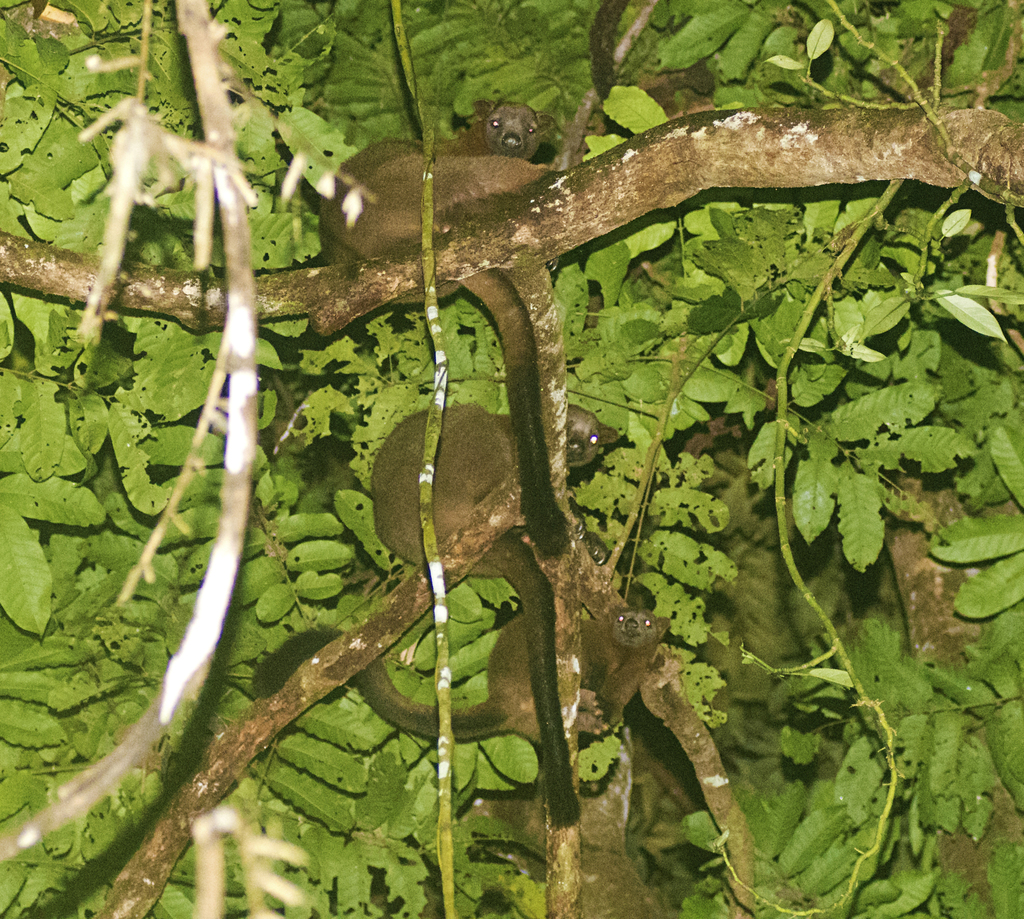
Bennett’s Tree Kangaroo
Photo © Tony Eales
Photo © Tony Eales — CC BY-SA 4.0 — Source: iNaturalist #71358991Identification
Bennett's tree-kangaroo is a large, distinctively adapted arboreal marsupial with a build quite different from its terrestrial cousins. Males are considerably larger, weighing 11.5 to almost 14 kg, while females are smaller at 8 to 10.6 kg. The most obvious adaptation to tree life is their limb structure: the forelimbs are notably longer and the hindlimbs shorter than in ground-dwelling kangaroos, paired with a long, bushy tail that aids balance in the canopy.
Coloration is subdued and cryptic. The upper body is mostly dark brown, contrasting with lighter fawn tones on the chin, throat, and lower abdomen. The forehead and muzzle are greyish, while the feet and hands are black. The tail is distinctive, marked with a black patch at the base and a light patch on the upper portion. The ears are short and rounded, quite unlike the large ears of ground kangaroos.
Range & Habitat
This elusive species occurs in a highly restricted range in far northeastern Queensland, Australia. It is found in both mountain and lowland tropical rainforest from south of Cooktown to just north of the Daintree River—an area covering only approximately 70 by 50 kilometres. Occasionally, individuals are also sighted in sclerophyll woodlands, though rainforest is their primary home.
Bennett's tree-kangaroos are almost entirely arboreal, living among the foliage and feeding almost completely on leaves from a wide range of rainforest trees. Key food plants include the umbrella tree (Heptapleurum actinophyllum), alongside vines, ferns, and various wild fruits from at least 33 different plant species.
Behaviour & Diet
As a strict herbivore, Bennett's tree-kangaroo subsists on the leaves of its rainforest home, browsing from the canopy with remarkable agility. These animals are extraordinarily adept climbers and leapers, capable of launching themselves 9 metres between branches and famously able to drop as far as 18 metres to the ground without injury—a testament to their specialised anatomy and reflexes.
The species is considered cryptic, meaning it is inherently difficult to locate in the wild. Once hunted by Aboriginal Australians, its main predators today are Australian scrub pythons and dingoes. Interestingly, Bennett's tree-kangaroo is thought to be the closest living relative to the ancestral form of all tree-kangaroos, making it particularly significant scientifically.
Best Time & Places to See It
Although Bennett's tree-kangaroo remains elusive by nature, sightings have become far more common in recent years. This encouraging trend reflects both population recovery and range expansion, likely driven by habitat protection under World Heritage legislation and the cessation of traditional hunting. The species' restricted range near Cooktown and the Daintree River in northeastern Queensland is your best bet for encounters, particularly within protected rainforest areas.
Photography Tips
The cryptic nature and arboreal habits of Bennett's tree-kangaroo present challenges for photographers. Early morning or late afternoon visits to rainforest areas may improve your chances, as the animal is most active during these periods. Look upward into the canopy and mid-storey foliage, scanning for the distinctive dark brown upper body and bushy tail. A telephoto lens is essential, as these animals favour the higher branches and rarely approach ground level. Patience and quiet movement through the forest are vital—sudden movements will send these agile creatures bounding away into the depths of the rainforest.
No community photos yet. Log in to add the first one.
No community observations of this species yet.