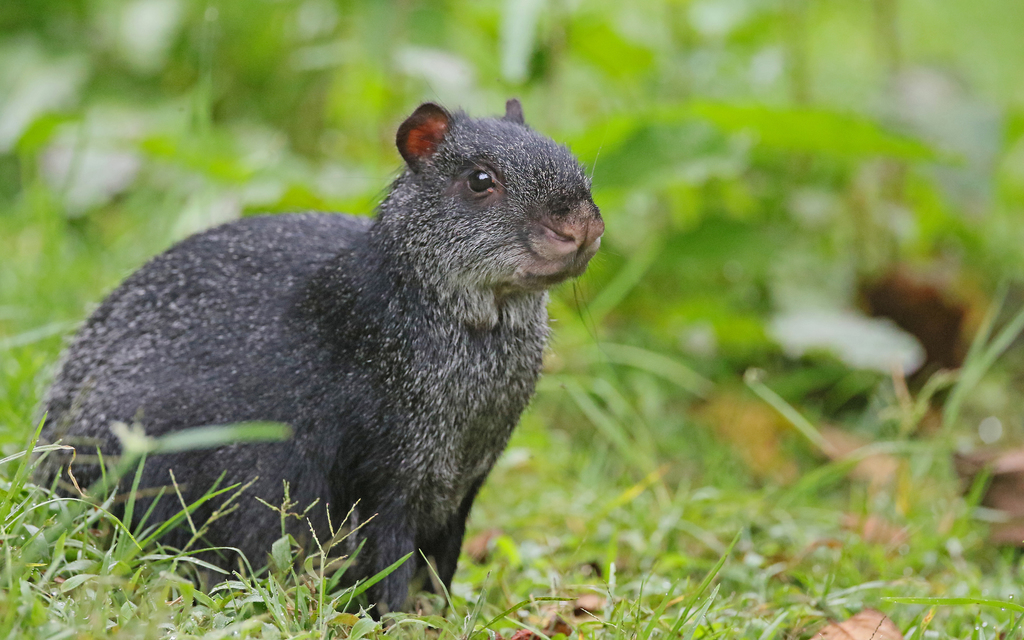
Black Agouti
Photo © Christoph Moning
Photo © Christoph Moning — CC BY 4.0 — Source: iNaturalist photo #162623406Identification
The black agouti is a stocky, rabbit-sized rodent with distinctive dark coloration. Its overall plumage is black grizzled with white, creating a salt-and-pepper appearance, while the throat remains pure white. Adults weigh between 3.5 and 6 kg (7.7–13.2 lb), making them robust members of the agouti family Dasyproctidae.
Range & Habitat
This species is found across the northwestern Amazon basin, with populations in southern Venezuela, eastern Colombia, eastern Ecuador, western Brazil, and northeastern Peru. A separate population exists in the Magdalena River Valley of northern Colombia. Black agoutis inhabit forests, dense brush, savannas, and cultivated areas, typically at altitudes of 2,000 metres (6,600 ft) and above. In Peru, they occupy both the low and high selva zones of the Amazon region. These animals are strongly associated with aquatic environments, living in close proximity to water and inhabiting the banks of streams and rivers of all types.
Behaviour & Diet
Black agoutis are diurnal animals, active during daylight hours. They are solitary or live in pairs, avoiding larger group formations. Like other members of their family, they are specialist frugivores and granivores, feeding primarily on fruits and nuts found on the forest floor. In some regions, they construct burrows for shelter, typically positioning them among limestone boulders, along riverbanks, or beneath the root systems of large trees.
Best Time & Places to See It
Black agoutis can be encountered year-round in suitable habitat, as they breed continuously throughout the year. Your best opportunities come in primary and secondary forests near water sources—particularly along streams and river margins in the Amazon lowlands and foothills. Early morning hours are ideal for observation, when these diurnal animals are most active foraging on the forest floor. Look for them in areas with dense fruiting trees and soft substrate where burrows are more likely to occur.
Photography Tips
Patience and a low, stable position will serve you best when photographing black agoutis. Their small size and alert nature demand a fast shutter speed and quick autofocus. Since they forage on the ground, position yourself low to capture natural behaviour. Early morning light along riverbanks creates excellent photographic conditions. The contrast between their black grizzled coat and white throat provides good compositional elements. Move slowly and deliberately to avoid startling these shy, solitary animals, and be prepared for quick disappearances into dense vegetation or burrows.
Yasuní National Park
Aguarico, Ecuador
+601 birds+43 mammals
Where the western Amazon basin converges with Ecuador's Orellana Province, lowland rainforest reaches toward the horizon in an unbroken canopy of staggering botanical density. Yasuní National…
VIEW NATIONAL PARKSangay National Park
Cebadas, Ecuador
+320 birds+10 mammals
High in Ecuador's Andean spine, where the Western Cordillera rises to touch perpetual snow, a landscape of volcanic drama and ecological intensity unfolds across Sangay National…
VIEW NATIONAL PARKAntisana National Park
Quijos, Ecuador
+432 birds+21 mammals
Where the eastern Andean slopes descend into the Amazon basin, Antisana National Park sprawls across roughly 2,500 square kilometers of some of South America's most dramatic…
VIEW NATIONAL PARKYanachaga–chemillén National Park
Palcazu, Peru
+639 birds+6 mammals
Where the eastern slopes of Peru's central cordillera plunge into cloud forest, Yanachaga–Chemillén National Park protects nearly three thousand square kilometres of montane wilderness that few…
VIEW NATIONAL PARKCordillera Azul National Park
Pampa Hermosa, Peru
+322 birds+1 mammals
Where the eastern Andes descend into the western Amazon basin, Cordillera Azul National Park sprawls across nearly 38,000 square kilometres of some of Peru's most pristine…
VIEW NATIONAL PARKNo community photos yet. Log in to add the first one.
No community observations of this species yet.