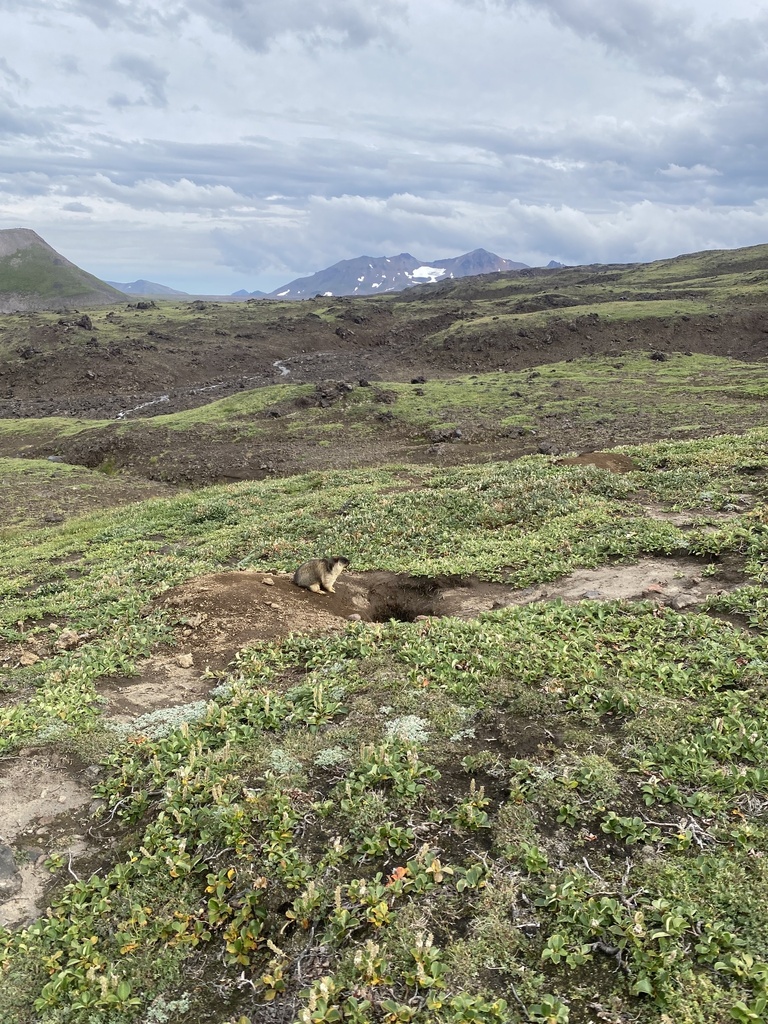
Black-capped Marmot
Photo © Илья Руденко
Photo © Илья Руденко — CC BY 4.0 — Source: iNaturalist #326371380Identification
The black-capped marmot is a relatively small marmot species, with a head-and-body length of approximately 39.5–61.5 cm (15.6–24.2 in) and weight ranging from 1.65–5.4 kg (3.6–11.9 lb). It is distinguished by its striking markings: the upper part of the head is brownish-black, with this dark colouration extending down the mid-back as a prominent dorsal stripe. The dorsal pelage is grizzled yellowish-grey, while the underparts are cinnamon or rusty brown. The limbs are noticeably paler than the body, and the relatively short tail is brownish-black.
Range & Habitat
The black-capped marmot is endemic to the Russian Far East, though its range is discontinuous and divided into three main separate populations, each with its own subspecies. The species inhabits arctic tundra and alpine environments, occurring from near sea-level to altitudes of up to 2,000 m (6,600 ft). These harsh, high-latitude and high-altitude habitats expose the marmots to extreme conditions throughout the year.
Behaviour & Diet
Black-capped marmots are diurnal and sedentary herbivores, feeding primarily on grasses, herbs and mosses. They are highly social animals, living in colonies comprising many separate burrows, each typically occupied by an adult pair and their offspring. Litters consist of five or six young, which remain in the family group for at least three years. When preparing for hibernation, the marmots congregate in larger groups and construct sleeping chambers lined with abundant bedding material, with entrances carefully plugged. The species hibernates for 6–8 months annually—from September to mid-May—which is notably long for a marmot. Daily activity patterns are significantly influenced by solar altitude and daylight duration, making the marmots dependent on sufficient light to be active above ground. To regulate body temperature, they either lie on rocks to absorb heat or retreat into burrows to cool down.
Best Time & Places to See It
The black-capped marmot is active from mid-May through August, making these months the only viable window for observation. Given the species' preference for diurnal activity in response to daylight, late spring through summer is essential for viewing. Since the population is restricted to the Russian Far East with three discontinuous ranges, travellers should seek local expertise to identify the most accessible locations within these remote regions.
Photography Tips
Photograph black-capped marmots during the brightest daylight hours when they are most active above ground and when their distinctive dark head markings and grizzled pelage are most visible. The species' sedentary behaviour and colonial living arrangement allow for patient positioning and composition. Rock outcrops and tundra vegetation provide natural frame elements. Capture images of their characteristic posture while basking on rocks or emerging from burrows, and include the striking contrast between their dark dorsal stripe and paler limbs when possible.
No community photos yet. Log in to add the first one.
No community observations of this species yet.