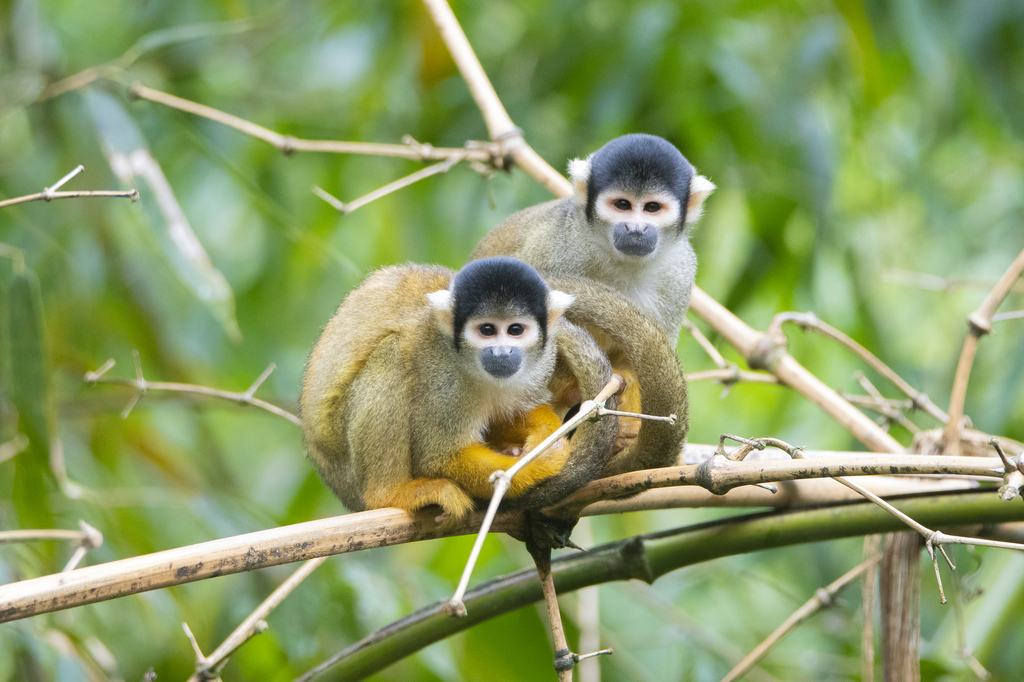
Black-capped Squirrel Monkey
Photo © David F. Belmonte
Photo © David F. Belmonte — CC BY 4.0 — Source: iNaturalist photo #242578590Identification
The black-capped squirrel monkey is a small primate displaying distinctive facial markings that make it readily identifiable in the field. Adults weigh between 365 and 1,135 grams, with males notably larger than females, and measure 225 to 370 millimetres from head to tail base. The species gets its name from the characteristic black cap on the head, accompanied by white arches over the eyes in a distinctive 'Roman' pattern—narrow and rounded—which sets it apart from related squirrel monkey species that display a 'Gothic' arch pattern instead.
The coat is short, soft and dense, with grey to olive-brown fur on the back contrasting with white, yellow or ochre undersides. The non-prehensile tail, which measures around 350 to 425 millimetres, matches the body colouration but features a distinctive black tufted tip. This tail is notably narrower than that of other squirrel monkey species, adding to the species' unique silhouette.
Range & Habitat
The black-capped squirrel monkey is native to the upper Amazon basin, with populations documented throughout most of Bolivia, northern Peru, and in Brazil between the Jurua and Purus Rivers. The species is predominantly arboreal and inhabits lowland tropical rainforests in densely forested and swampy regions, showing a strong preference for areas near running water. While these monkeys utilise all forest levels, they spend most of their time in the lower canopies, which they use for both travel and foraging.
Beyond pristine rainforest, black-capped squirrel monkeys have adapted to both native and plantation forests as well as some farmed areas, demonstrating a degree of flexibility in their habitat use. Their presence in these varied habitats is thought to reflect an abundance of fruit and insects available in their range.
Behaviour & Diet
Black-capped squirrel monkeys are highly social animals, living in female-dominated troops typically comprising 40 to 75 individuals. A notable aspect of their social structure is that males disperse to form all-male troops after reaching sexual maturity. The species is diurnal, meaning it is active during daylight hours when it forages and socialises within its troop.
The diet is omnivorous and opportunistic, consisting of flowers, fruit, leaves, nuts, seeds, insects, arachnids, eggs and small vertebrates. This varied diet reflects their ability to exploit multiple food sources throughout their forest habitat, contributing to their ecological flexibility and stable conservation status.
Best Time & Places to See It
The black-capped squirrel monkey is currently classified as 'Least Concern' by the International Union for Conservation of Nature, indicating healthy populations across its range. The species is most active during the early to mid-morning hours, making this the optimal time for wildlife viewing and photography. Travellers visiting the upper Amazon basin in Bolivia, Peru or western Brazil, particularly in lowland rainforest regions near water bodies, stand the best chance of encountering these social primates in their natural habitat.
Photography Tips
The small size and arboreal habits of black-capped squirrel monkeys present both challenges and opportunities for wildlife photographers. Their preference for the lower canopy levels makes them more accessible than many rainforest species, though patience and careful positioning are essential. Early morning activity means photographers should be in position and ready at first light to capture these monkeys during their most active foraging periods.
The distinctive facial markings—the black cap and white Roman arches—are key features to capture and will help document the species accurately. Group compositions can be particularly rewarding given their social nature and tendency to move in troops. A telephoto lens will be valuable for maintaining a respectful distance while still capturing fine detail of the facial patterns that make this species so recognisable.
No community photos yet. Log in to add the first one.
No community observations of this species yet.