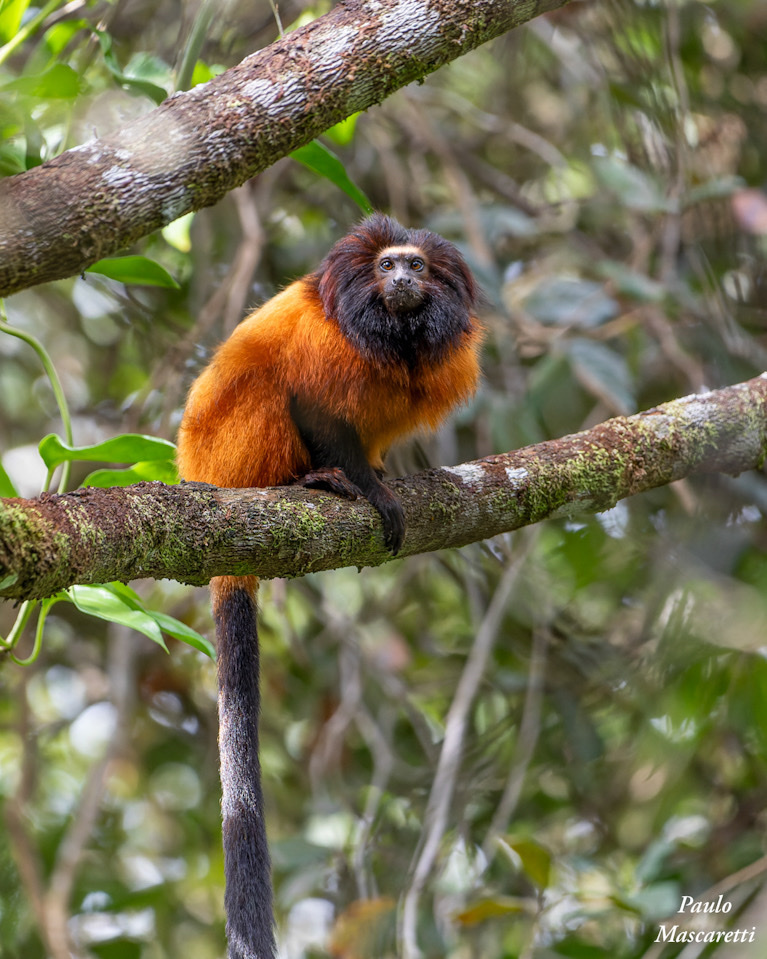
Black-faced Lion Tamarin
Photo © Paulo Mascaretti
Photo © Paulo Mascaretti — CC0 1.0 — Source: iNaturalist photo #319338667Identification
The black-faced lion tamarin is a striking small primate instantly recognizable by its distinctive colouration: a vibrant golden-orange body contrasts sharply with a jet-black face, legs, and tail. This colour pattern makes it one of the most visually arresting of all tamarin species. As a member of the Callitrichidae family, it is a diminutive New World monkey, typical of the small-bodied primates found across Central and South America.
Range & Habitat
This species is endemic to southeastern Brazil, found nowhere else in the world. Its range is restricted to coastal forests in the states of Paraná and São Paulo, with the most significant population occurring on Superagui Island and adjacent mainland areas of Paraná. A separate population inhabits the Jacupiranga region of far southern São Paulo. All populations remain strictly at altitudes below 40 metres.
The black-faced lion tamarin exhibits specific habitat preferences that vary between island and mainland locations. Island populations favour tall lowland forest and arboreal restinga—coastal forest growing on sandy soils—while mainland groups prefer swampy and inundated secondary forest. This particular habitat specialization makes the species especially vulnerable to environmental change.
Behaviour & Diet
The black-faced lion tamarin is a highly arboreal species, spending most of its time in the canopy. It lives in extended family groups comprising between 2 and 8 individuals, with typically only one breeding female per season. Females usually give birth to twins between September and March. Social cohesion within these family units is maintained through grooming, which is particularly frequent between breeding pairs and represents the most common affiliative behaviour observed in the species.
Their diet is varied and opportunistic. They primarily consume small fruits and invertebrates including insects, spiders, and snails. The species also drinks nectar, eats the young leaves of bromeliads, and supplements its diet with mushrooms—particularly during the dry season when other food sources may be scarce.
Best Time & Places to See It
The best opportunities to observe black-faced lion tamarins are within protected areas. Superagui National Park, encompassing 33,988 hectares across Superagui Island and adjacent mainland Paraná, protects most of the species' range and is designated as a conservation unit specifically for this endemic primate. The São Paulo population can be found in Jacupiranga State Park. The breeding season from September to March may offer increased sightings as family groups are more active during this period.
Photography Tips
The species' striking black-and-gold colouration provides excellent photographic contrast, but patience is essential—these are small, arboreal primates that move quickly through forest canopy. Early morning is typically the best time for activity. Use a telephoto lens to maintain distance without disturbing family groups, and be prepared for dappled canopy light by adjusting exposure settings accordingly. Visiting during the breeding season (September to March) increases your chances of encountering larger, more active family groups.
No community photos yet. Log in to add the first one.
No community observations of this species yet.