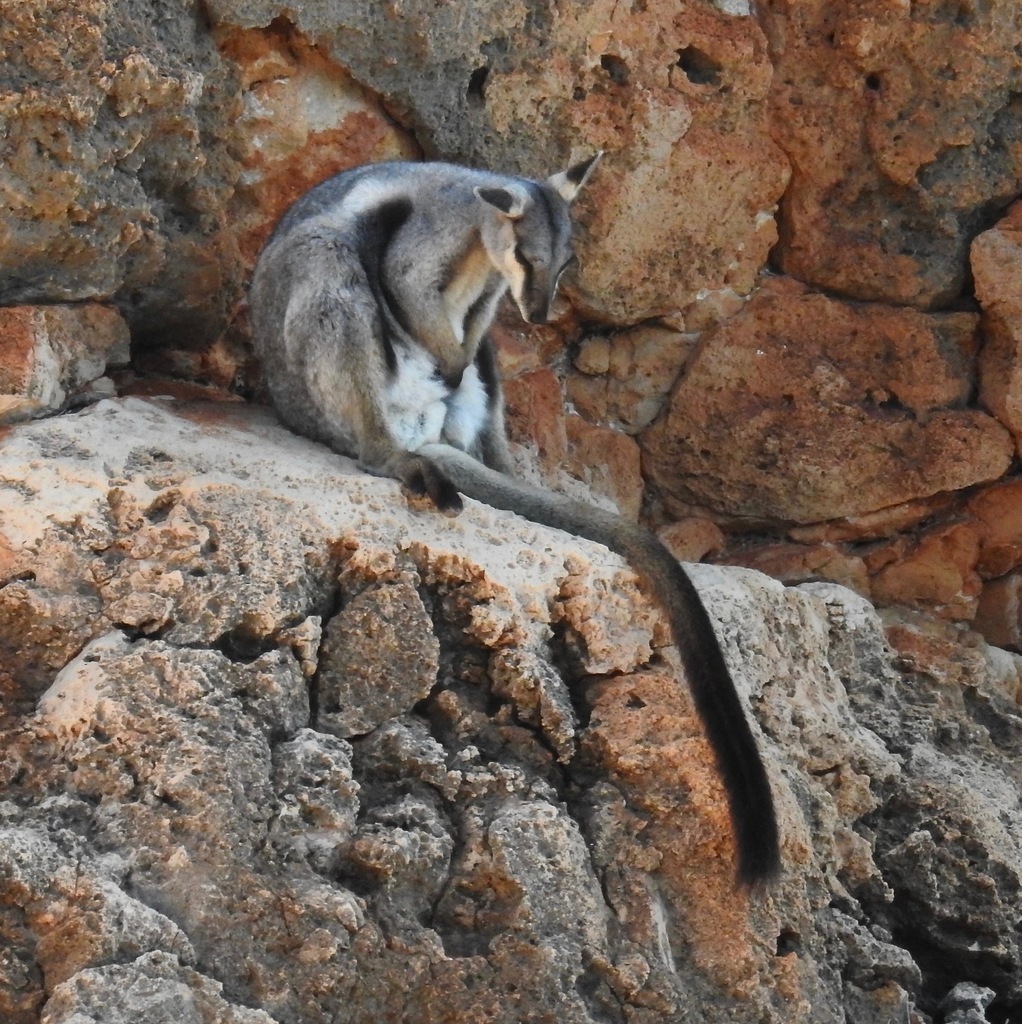
Black-footed Rock Wallaby
Photo © desertnaturalist
Photo © desertnaturalist — CC BY 4.0 — Source: iNaturalist #26960876Identification
The black-footed rock-wallaby is a small marsupial with distinctive colouration that aids identification in the field. Its fur is generally greyish-brown with a paler belly and chest, complemented by a dark stripe running from its head down its spine. The species' most characteristic features are its dark tail and dark feet—hence the common name. The tail is long and brush-tipped, an adaptation for balancing in rocky terrain. Its fur is notably short, thick, and woolly, particularly dense around the base of the tail, rump, and flanks. Colours may vary slightly among the five recognised subspecies, each with distinct chromosomal and morphological characteristics.
Range & Habitat
The black-footed rock-wallaby is endemic to Australia, with populations scattered across western and southern Western Australia, the Northern Territory, and parts of South Australia. The species inhabits rocky, mountainous terrain characterised by granite outcrops, sandstone cliffs, scree slopes, and hummock grasses interspersed with sparse trees and shrubs. Coastal limestone cliffs also provide suitable habitat. Different subspecies occupy distinct ranges: the nominate form ranges across southern and western WA; the Recherche rock-wallaby inhabits three islands in the Recherche Archipelago; the western Kimberley race is restricted to the Edgar Range and Erskine Range; and the MacDonnell Ranges race formerly ranged widely across central desert regions but has experienced significant population decline.
Behaviour & Diet
This is a shy, nocturnal herbivore that feeds on grasslands adjacent to rocky shelter areas during the night hours. The black-footed rock-wallaby lives in social groups of 10–100 individuals and forms lifelong pair bonds, though females will mate with multiple males. Sexual maturity is reached at one to two years old, with breeding cycles influenced by seasonal rainfall. The species exhibits embryonic diapause, whereby embryo development pauses until environmental conditions are favourable. After a gestation period of approximately 30 days, young develop in the mother's pouch before emerging. Unlike other kangaroos and wallabies, mothers uniquely leave their young in sheltered locations while they forage. The species is highly water-efficient, obtaining most moisture from its diet and rarely drinking, allowing it to shelter from heat in rocky caves.
Best Time & Places to See It
Observing black-footed rock-wallabies requires patience and planning, as they are nocturnal and shy. Target rocky outcrops, granite formations, and cliffsides in their known ranges across western and central Australia during twilight hours or at night with appropriate lighting. Protected populations in Western Australia offer the most reliable viewing opportunities. South Australia's APY Lands support a recovering population following successful breeding programmes, including the fenced Pintji area and recent wild releases, though access may be restricted. The species' preference for rocky terrain near grasslands means scanning suitable habitat edges during dawn and dusk provides the best chance of encounters.
Photography Tips
Photographing black-footed rock-wallabies demands preparation for nocturnal and shy subjects in challenging rocky terrain. Use high-ISO settings and sensitive equipment to capture images during low-light periods. The species' dark coloration and cryptic nature mean careful exposure metering is essential to avoid underexposed images. Approach slowly and quietly, utilising rocky outcrops for cover. The wallaby's distinctive dark feet and tail stripe make excellent focal points for identification shots. Their habitat—rocky cliffs and granite outcrops—provides dramatic landscape context. Wide-angle shots capturing the animal in its rocky terrain environment will convey the specialized habitat requirements of this endangered species effectively.
Kalbarri National Park
Australia
+157 birds+6 mammals
Where ochre cliffs and weathered gorges slice through Western Australia's semi-arid interior, Kalbarri National Park reveals a landscape shaped by millions of years of erosion and…
VIEW NATIONAL PARKCape Range National Park
Australia
+159 birds+15 mammals
Where arid limestone ridges plunge toward turquoise waters, Cape Range National Park frames one of Australia's most dramatic desert-ocean interfaces. The park's spine—a stark, weathered range…
VIEW NATIONAL PARKNo community photos yet. Log in to add the first one.
No community observations of this species yet.