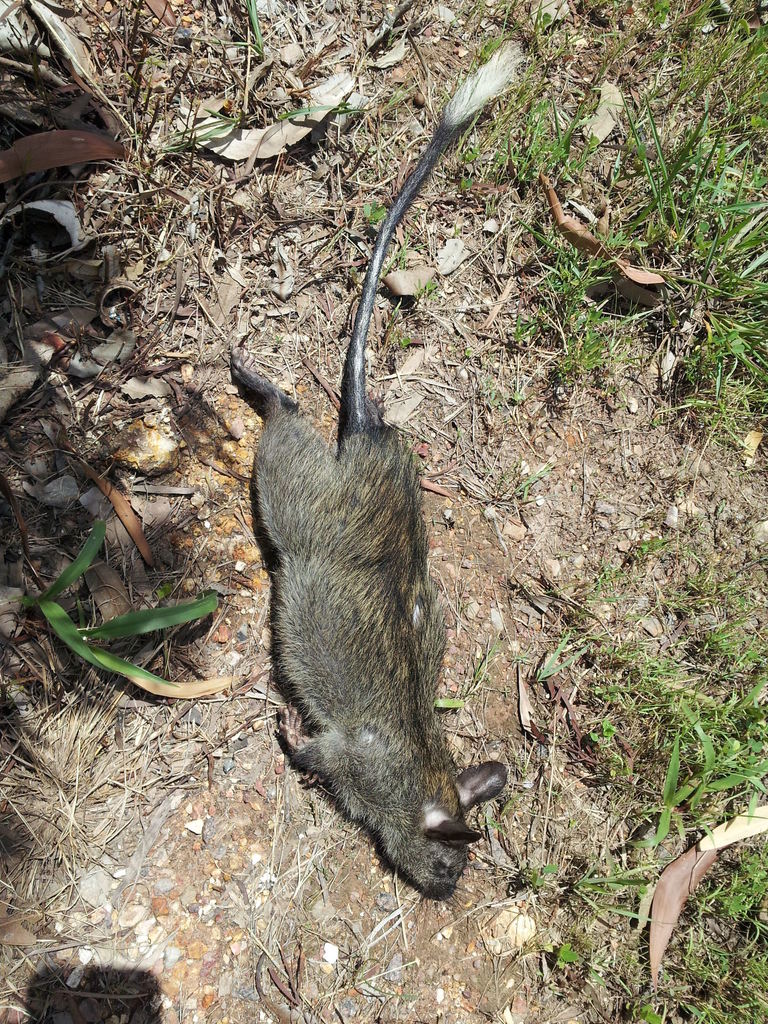
Black-footed Tree Rat
Photo © Owen Gale
Photo © Owen Gale — CC BY-SA 4.0 — Source: iNaturalist #26801945Identification
The black-footed tree-rat, also known as Djintamoonga, is one of Australia's largest rodent species. It has a distinctive appearance with a shaggy, coarse greyish-brown coat contrasting sharply with a creamy white underbelly. The most striking feature is its black hind feet, which are equipped with well-developed pads and strong, sharp claws—adaptations that reflect its semi-arboreal lifestyle. The animal also displays large ears and a notably long tail tipped with a brush of white hair. Adults typically weigh around 830 grams, with a head and body length of 250 to 308 millimetres and a tail measuring 100 to 130 millimetres.
Three subspecies are recognized, distributed across different regions of northern Australia. The Gulf of Carpentaria separates the Queensland subspecies from mainland populations in the Northern Territory and Western Australia, while a third subspecies inhabits Melville Island. These subspecies show minor morphological differences in skull and foot shape, as well as variation in colouration.
Range & Habitat
The black-footed tree-rat is endemic to northern Australia, with its range extending from the savannahs of Cape York Peninsula in Queensland westward to the Kimberley region of Western Australia. The species favours tropical woodlands, open forests, and complex coastal vine thickets, though it also persists in closed forests. However, the species is not common throughout much of its range, and many regions show substantial population declines. Research from the Northern Territory indicates that the extent of occurrence has declined by over 30% compared to pre-European distribution, with the species increasingly contracting to areas of higher rainfall, milder temperatures, and greater vegetation complexity. The global population is estimated at around 30,000 individuals, though distribution and density remain poorly understood in Western Australia and Queensland.
Behaviour & Diet
The black-footed tree-rat is primarily solitary and strictly nocturnal, though multiple individuals occasionally share den sites in tree hollows or fallen logs. The species is semi-arboreal, spending considerable time foraging on the ground and moving between trees, but typically shelters during the day in tree hollows—particularly in Eucalyptus miniata or E. tetrodonta—and pandanus stands. Individuals maintain a mean home range of approximately 40 hectares, though this varies considerably between populations.
As a folivore and frugivore, the black-footed tree-rat feeds primarily on leaves and fruits. Its diet is supplemented by invertebrates such as termites and molluscs, providing additional nutrients throughout the year.
Best Time & Places to See It
Observing black-footed tree-rats requires patience and nocturnal fieldwork, as they are strictly night-active. The species is distributed across tropical northern Australia from Cape York to the Kimberley, with populations around Darwin in the Northern Territory showing greater stability than many other regions. Areas with intact tropical woodlands and complex vegetation are most likely to support populations, though sightings remain challenging due to the species' solitary, cryptic nature and declining presence across much of its historical range.
Photography Tips
Photographing this elusive species demands specialized nocturnal techniques. Red-light headlamps or filtered flashlights will minimize disturbance while allowing you to locate and observe the animals. Focus on areas around suitable shelter sites—tree hollows in eucalypts and pandanus stands—during night surveys. A telephoto lens is advisable to maintain distance and reduce the risk of disturbing these solitary, mobile animals as they forage on the ground or move through the canopy.
Kakadu National Park
Kakadu, Australia
+273 birds+46 mammals
Kakadu National Park is Australia’s largest national park and one of the world’s most remarkable protected areas, covering nearly 20,000 square kilometres in the tropical north…
VIEW NATIONAL PARKNitmiluk National Park
Australia
+186 birds+27 mammals
Dramatic sandstone gorges carved by the Katherine River slice through the tropical savanna of Australia's Top End, creating a landscape where escarpments tower above crystalline pools…
VIEW NATIONAL PARKNo community photos yet. Log in to add the first one.
No community observations of this species yet.